3/19/15

Twins Spring Training Report from Fort Myers: 3/19/15 Perk and the Prospects

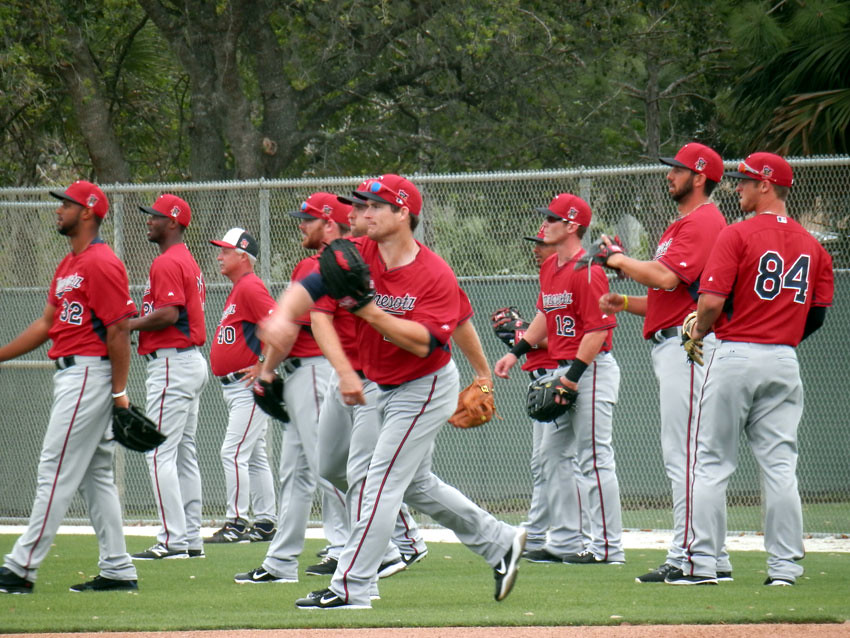
Today the Minnesota Twins played against the Rays at Fort Charlotte, which meant minor league side by side double-header action of Rochester and Chattanooga against the Red Sox' AAA and AA squads at fields 4 and 5 of the Complex.  

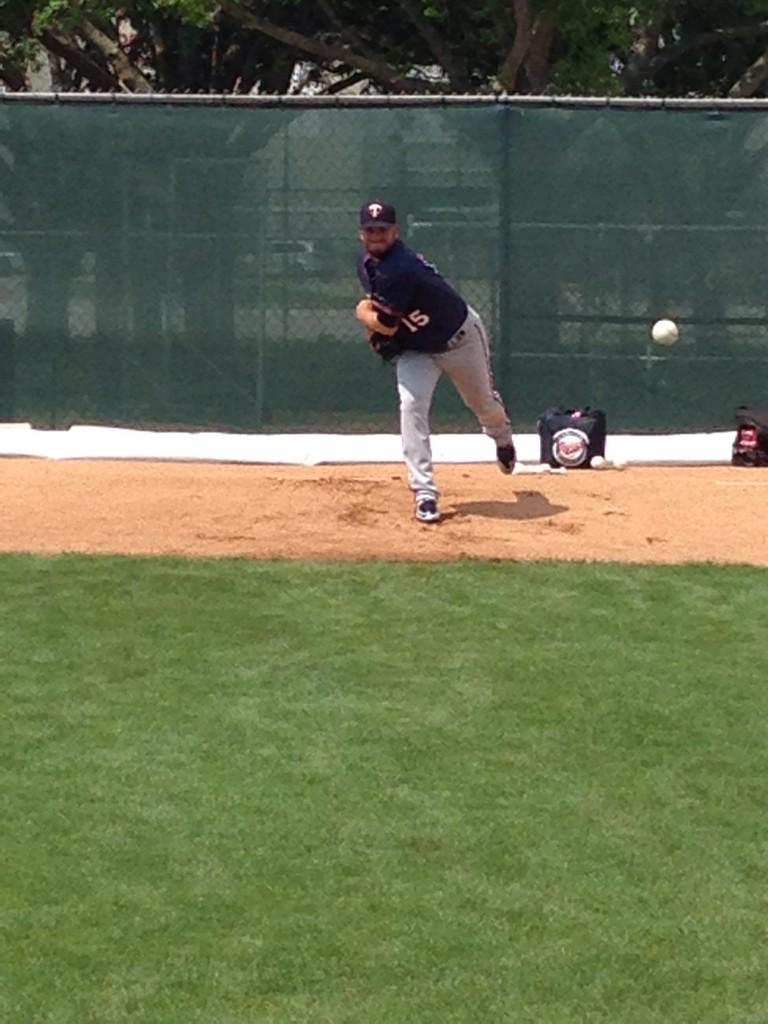
The much anticipated moment today was the return of Glen Perkins who got the first inning with the AAA club against the PawSox.   Based on reports from people who were at Fort Charlotte, he did not feel any pain.   He was carted to and fro field number 4, which is the furthest away from Hammond Stadium and he threw warmup tosses to Kyle Knudson, who was also the starting Catcher for the Red Wings.   During the game, he threw 14 pitches, most strikes.  His fastball was sitting at 90-91, hitting 92 and 93 once each.  His slider was at 81-82, all figures that are a good 4-5 mph below his season form, but it is still the second (he pitched against the Gophers) game for him.  During his warm ups he did seem to throw a couple of changeups, but could had just been slow fastballs.  All in all a good appearance, but he has to ramp up pretty quickly.


The second biggest name, as far as players are concerned, was Miguel Sano who played at Field number 5 with the Chatanooga squad.  His agent, Rob Plummer, was on site and had a change to have a very enlightening (but off the record) conversation with him.  Interesting guy and he seems really proud of the fact that he signed Sano when he was 14.  Miguel answered with a three-run monster home run that likely broke a window or two at the subdivision past the fence, with this swing, off William Cuevas :
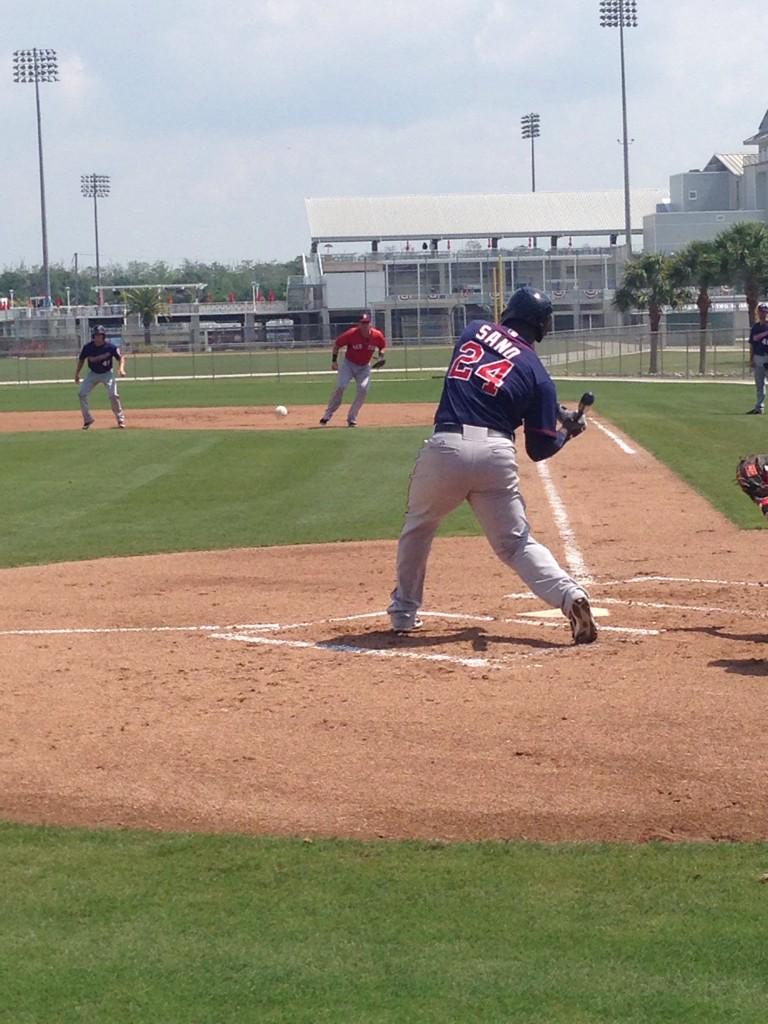


As a side note, Sano appears fitter than last season.

Speaking of celebrities, Tom Kelly was at hand and had a chance to meet with one of his former pitchers, Paul Abbott, who pitched for Kelly's Twins from 1990-1992:
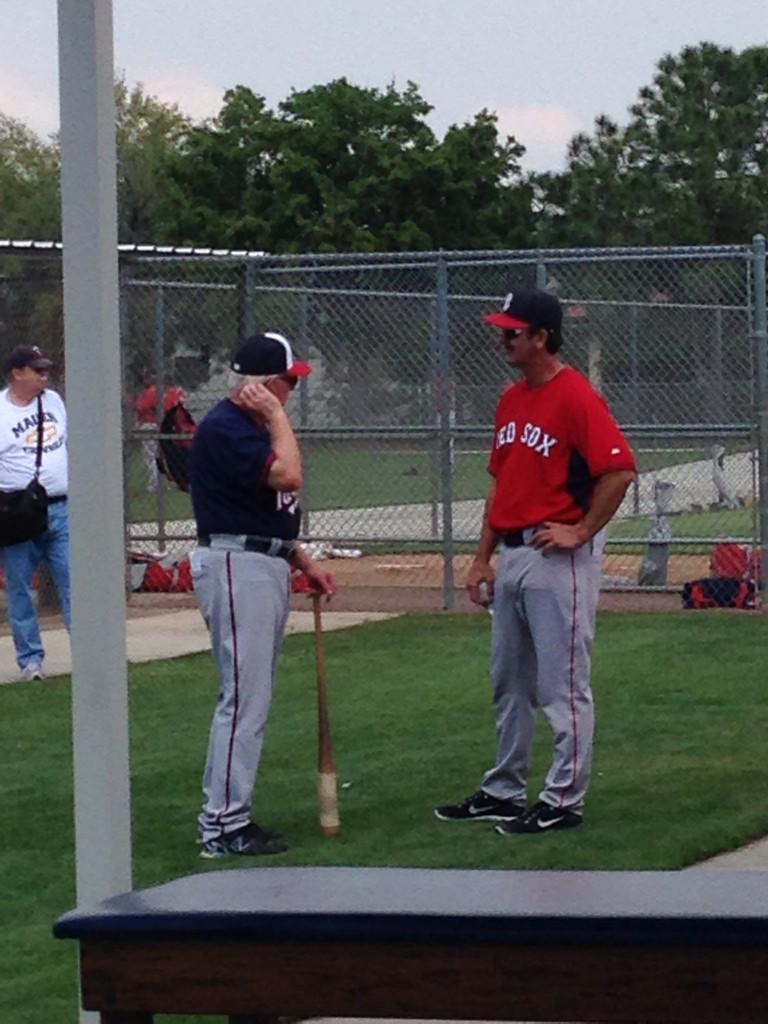


I had a chance to see several other prospects and here are quick notes:

Greg Peavey was selected by the Twins from the Mets in the AAA portion of the Rule 5 draft last winter.  He came in to pitch after Glen Perkins in the AAA side and was pretty impressive.  He has three pitches:  A 90-91 mph Fastball, a low 70s slow curve and a low 80s change.  Pitching mostly with the first 2, but his change did produce strikeouts.  Good control and command of all his pitches, very fluid motion; he is definitely a dark horse.  A mature pitcher.  Also in the AAA side of things, Cole Johnson made a good appearance.  He is a fastball slider pitcher with his FB hitting 94 but his slider location was inconsistent.  Pretty early in Spring training for that.

On the AA side of things, both Nico Goodrum and Michael Gonzalez appear different.  Gonzalez appears much fitter and for the 27 year old, this might be his last chance in a Twins' uniform. Goodrum has been working with a personal trainer this off-season and he got some muscle.  He is also taking much more robust at bats, than last Spring Training.  If you squint really hard, you might confuse him with Byron Buxton, as far as physique goes:


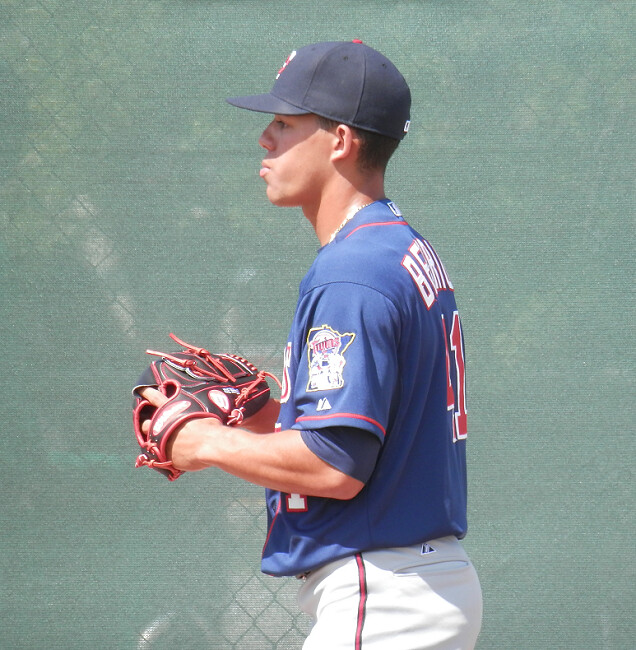
As far as the pitchers at the AA side went, Tyler Duffey started, but I chose to look at Glen Perkins and Greg  Peavey next door.  I did have a good look at Jeff Reed, who was unhittable at the Arizona Fall League and was really impressed.  His fastball was at 95-96 this early and his slider at high 80s.  I will not be surprised is he and Nick Burdi are with the big club come August or so.  Interesting 3/4 delivery with a fairly aggressive motion.  Tim Shibuya pitched a couple good innings.  He is really deceptive and one of those "rubber arm" guys.  Good repeatable mechanics, good control and command, I really see him as the long man in a major league bullpen some day. 

It was a treat seeing Jorge Fernandez, my 19th Twins' prospect, to catch today.  Really good hands , excellent feet (he got a guy out on a difficult high bounce off the home plate) and very good receiving ability.  I never had any doubts about his bat, but really liked what I saw with the glove today.   He is a guy who is not considered a prospect, does not get many praises, but I really enjoyed watching Stephen Wickens play today.  Good fundamentals and instincts on both sides of the ball, good glove and versatility, might get the 26 year old into the big leagues some day, if he gets his contact rate and plate discipline a bit higher.

As a parting shot, here is Sam Perlozzo, the long time major league coach and manager, who started his playing career with the Twins, having an 1 on 2 base-running tutoring session with the Twins' number 2 and 3 prospects.
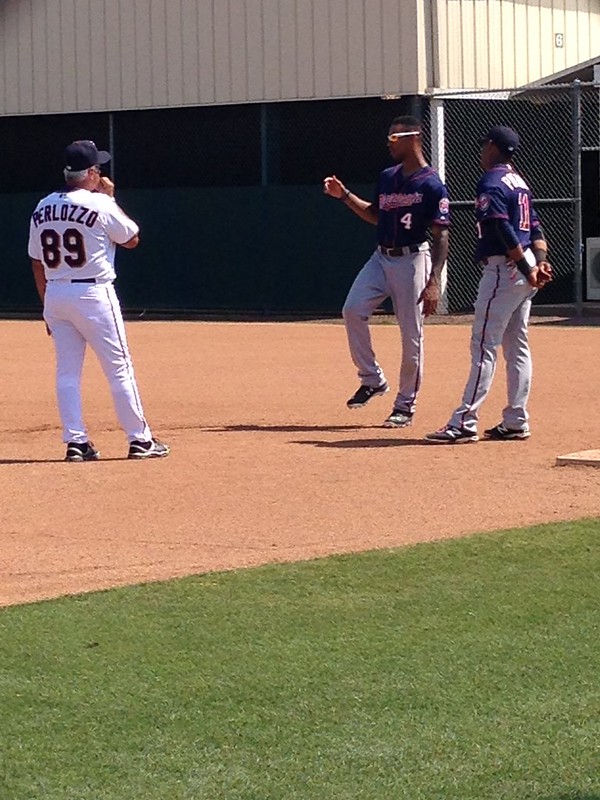

Tomorrow the Twins are hosting the Pirates at Hammond Stadium and I will be there.  You can find all my 2015 Spring Training posts here. 


3/18/15

Twins Spring Training Report from Fort Myers: 3/18/15

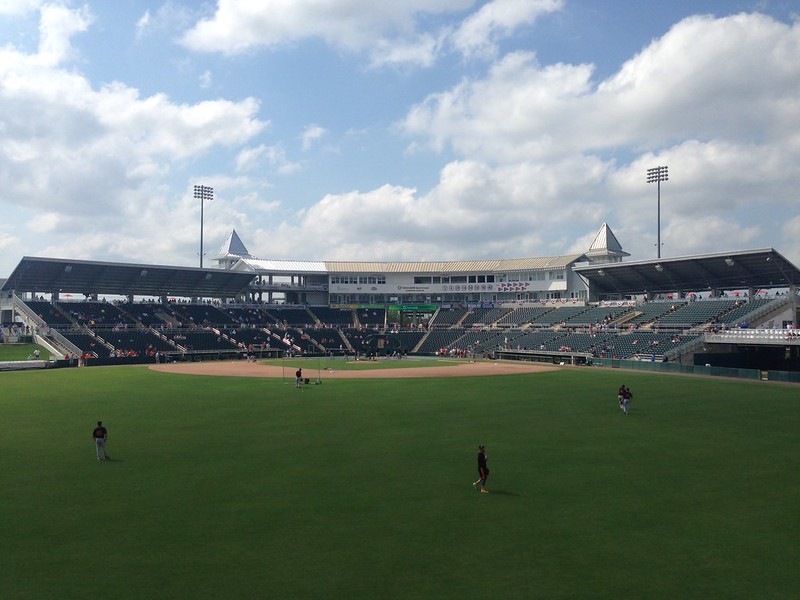
Today was my first full day at Fort Myers and the Twins had a split squad duo of games, with the half of the team hosting the Orioles at Hammond Stadium and the other half a few miles away playing the Red Sox at Jet Blue Park.  This was the second year in a row as far as renovations went for the facilities, and the Hammond Stadium looks really great.   The front facade is extended to both broaden the concession place plaza and put a roof over it and to host a couple new elevators and gift shops.  There are 4 gift shops in all now, which are much better than the single closet-size one that was there 3 years ago.  The main one, which about the size of an average AA ballpark gift shop, even had Miracle T-shirts.

For some reason there was no pregame batting practice on field number six, as it has been the norm the seasons before; I suspect that it has to do with the split-squad games today.  Joe Vavra was throwing batting practice to someone's kid in the under-stadium cages.   Not much activity in the minor league parks also;  Sporadic batting practice at the Chattanooga, including Miguel Sano and DJ Hicks hitting some good ones off Stew Cliburn, who looks scarily like Rick Anderson these days.  Jorge Polanco and AAA infielders had bunt practice at the Rochester field.  Nothing much there as far as minors go, other than Nick Burdi was surrounded by a whole slew of autograph seekers when he showed up.   No home game tomorrow, so I will be able so spend a full day with the prospects.

As far as the game today went, there were a few things of note: 

In the first inning, Joe Mauer hit a routine soft grounder to the shortstop, who had a hard time fielding it, dropped it, recovered it and threw to first to get a slow trotting Mauer out.   This was not a great thing to see from the Twins' highest paid player.  Had he run full speed, he would had been safe. I hope that these kind of plays do not happen again.   On the other hand, the subsequent inning Eduardo Nunez beat out a non-trivial cleanly fielded infield single to the shortstop; hard not to see the contradictions between someone who has a job and someone who is fighting for one.

Torii Hunter is a yeller at the outfield.  And this is a good thing.  And he does not only yell "I got it".  In  couple of situations, a fly ball to right center and a shallow fly to the right, he yelled for Schafer and Dozier respectively to go and get it.  And it worked.  That was a good thing to see.  Eddie Rosario was great with the glove at left.  He did throw out Delmon Young when he tried to stretch a single, but even more importantly (and you cannot see that on the scoreboard) he took a triple away from an Orioles hitter with a great route and a great below the knee catch.  He made it look so easy, that I bet that most of the Stadium thought that it was a routine play.  It wasn't.   Speaking of routes, I am not sure that Jordan Schaefer is the best one out there.  Had a long fly really misjudged and hit the wall, allowing eventually Torii Hunter to make the throw to the infield.  That ball was catchable.  Being a left hand throwing Centerfielder might have some disadvantages.

As far as pitching went, Stephen Pryor really surprised me.  He pitched fine, but there were earlier reports about him being healthy and being back with his mid- to high-90s velocity.  He topped at 92 in Hammond Stadium's (fast) radar today, which is not extremely thrilling, to say at least.  For comparison's shake, Ervin Santana hit 93.

Back there tomorrow morning and expect a full report on the prospects, tomorrow evening.


3/16/15

First Cut at the Twins' 25-man Opening Day Roster and Analysis of Remaining Spring Training Battles

After the 18 recent cuts the Twins made (some of them unannounced yet) yesterday, the camp roster was trimmed to 43 players.  I did provide a break down of those players by position yesterday, also mentioning whether they have options or whether they are on the 40-man roster.   Based on these numbers, I am taking a preliminary look at  the Twins' potential opening day roster, position by position:

Position players (13)

Catchers (2/3)

Suzuki, and one of Pinto/Fryer/Herrmann.  Herrmann might be added as a third catcher/Utility.  Fryer is not on the 40-man roster

Infield (6/7)

Mauer, Dozier, Santana, Escobar, Plouffe.  One or both of Vargas and Nunez.  Nunez is out of options


Outfield (4/5)


Arcia, Hunter and two or three of:  Hicks, Rosario, Robinson, Schafer. Schafer is out of options, Robinson is not on the 40-man roster.

Pitchers (12)

Starting Pitchers (5)

Hughes, Santana, Nolasco, Gibson; one of Milone, Pelfrey, May, Meyer.   All have options, but Pelfrey has to accept assignment.


Relief Pitchers (7)

Perkins, Duensing, Fien

one or two of Milone, Pelfrey, May, Meyer

two or three of Pressly, Stauffer, Thielbar, Tonkin, Achter, Graham, Thompson, Boyer, Pryor, Hamburger.  Stauffer and Graham (rule 5) have no options, Boyer and Hamburger are not on the 40 man roster.

These are the major battles right now in the Twins' camp:

The Starting Centerfielder and fourth outfielder:   Hicks/Scafer/Rosario/Robinson.  The first two have higher probability to win the CF starter.  If Scafer wins, both Hicks and Rosario will be optioned because they will need to play daily, making Robinson the fourth outfielder.  If Hicks or Rosario win the starting position, both Schafer and Robinson can make it as a fifth outfielder.  Robinson is on the 40-man roster, but might take Graham's spot if he does not stick.  Verdict:  Too early to tell, but looks like Hicks & Scafer will be the 2 who are going north

The backup Catcher: Pinto, Herrmann and Fryer are fighting for one spot.  Fryer is not on the 40-man roster, thus having a bigger mountain to climb.  Herrmann will be in the utility fight as well.  Verdict:  Too early to tell, both Herrmann and Pinto have been good with the bat this Spring, Fryer has not, but has been very good with the glove.  This might go until the last days.

The Utility Position: Nunez, the one of Schafer or Robinson who did not make the cut in the Outfield and Herrmann will be fighting for one position.   Verdict: Too close.  Scafer and Nunez are out of options, Robinson is not on the 40-man roster.

The 5th Starter and one or two bullpen positions: Milone, Pelfrey, May and Meyer are fighting for one spot. Verdict:  Milone and Pelfrey are the forerunners here, in a battle that will be bought to the end with the loser going to the pen.  I think that Meyer will likely start at Rochester; May has a chance to make the Twins' pen, thus getting 2 pen positions from this group.

The final 2-3 bullpen positions:   Pressly, Stauffer, Thielbar, Tonkin, Achter, Graham, Thompson, Boyer, Pryor, Hamburger.  The three most veteran pitchers in this group (Pressly, Stauffer and Tonkin) have been the Twins worst pitchers in Spring Training, while Hamburger, Pryor, Graham and Thompson have been shining.  Verdict: This can go both ways.  The safest would be to option May, and start with Stauffer, Thielbar and Graham.  Would it be the best?  Likely not, based on what Stauffer and Thielbar have shown.  Will be interesting to see how this will shake out as well.  This decision will also be very telling about Molitor's and Allen's philosophies.


Three things the Twins need to do to compete in 2015: Part III: Fix the attitude.

This is the third and last, but not least, segment in this series.  You can find the first segment (fixing the bullpen) and the rationale for the series here, and the second segment (fixing the outfield) here.  I think that the most important (and some times the hardest or the easiest) thing to fix for the Twins to win, is the team attitude.  

How do you measure attitude and how does attitude prevent some one to win, and what is that "attitude" thing anyway.  Isn't that thing that your parents and teachers talked about when you were growing up, or something else.  Well, as far as baseball goes, I will let former Twins' player and Texas Rangers' manager Ron Washington describe it in this 30 second video.   To borrow Washington's words from there, a winning attitude is when you "expect to win" and "do everything you need to do to win".  Arguably, the Minnesota Twins the last couple of decades has as motto (at their best,) do all you can do (aka bust your tail) and you win some, you lose some.  Those were exactly the words of a smiling Michael Cudduyer at the Twins' dugout, on September 30, 2008, after the Twins lost game 163 at the White Sox (and part of the reason was that Cuddyer did not do what he needed to do to win, colliding with and forcing the ball out of AJ Pierzynski's glove to score.)

And giving it all and being "good enough" has been the Twins' motto.  And the majority of the fans were ok with "good enough", winning the title of the weakest division in baseball about half of the time, going belly up during the post-season and when they played the AL East, in the 00s.   And if the fans are happy with "good enough", you get a brand new ballpark and brand new season ticket sales and that is more that "good enough" as far as revenue goes, when it is not broken, why even bother to think about fixing it?   That was the Twins' past decade of "Glory", in half a paragraph.  And then it went South.

What happened? Well, the Twins did not even do all they could do in the ballpark; add that to a culture of favoritism in the clubhouse, where it did not matter to whether the veterans did all they could do, but when people outside the inner circle opened their mouths were thought under the proverbial bus; add that to not expecting to win, to start with, and you got 99 + 96 + 96 + 92.  And most importantly, no excuses for even the most single-sighted fans to believe that this team can win, thus a drop in tickets, thus a drop in revenue, thus...

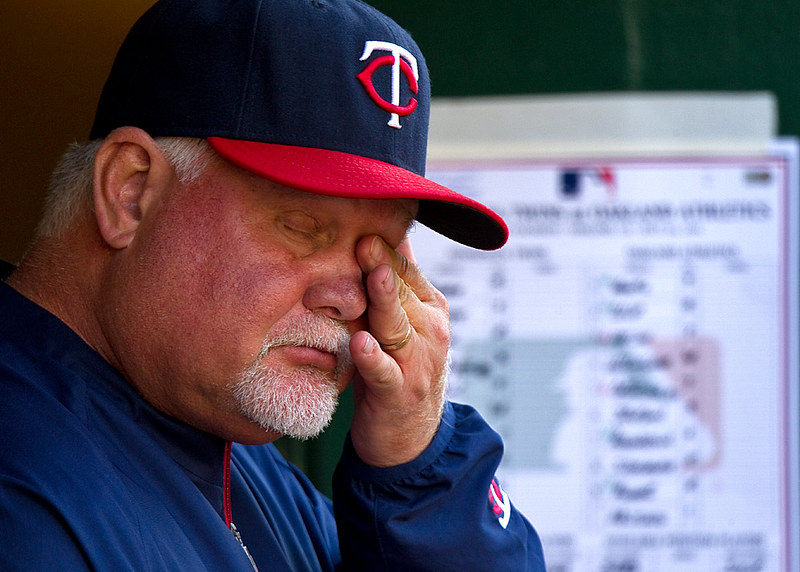
To win, a team needs a leader who expects to win and make sure that his players and coaches do everything they need to do to win.  Here was the most common expression of the previous Twins' leader during games the last several seasons (hanging on to the dugout railing optional) :


Is this the expression someone who is doing all he needed to do to win and lead by example.  Is this the expression of someone who expects his team to win?  Or is this the expression of someone who looks defeated and solemn?  Rhetorical question.

There was not a more obvious time for me to see that the Twins players not only doing what they needed to do, but not even all they could do, and was fine with the manager and the coaches, than this particular game last spring training.  Before I went down there last season, I did have hopes that with the changes they made in the rotation, plus some players improving, had a chance to break even and have an 81-81 record.  But after what I saw, I predicted that the Twins will end up the 2014 season with a 70-92 record.

That is the past, and tomorrow I am landing at Fort Myers where I will be for more than a week and be able to see how thing are, but I have a good feeling that they are heading the right way.  Other than getting rid of their manager and pitching coach, which by itself is adding 10 wins pretty much, and replacing them with good baseball people and a Hall of Famer as manager,  they brought back Torii Hunter.  It did not make much sense at the beginning, and I think that they guy is a prick, plus he left the Twins' in free agency just for money and he added insult to the injury, by singing with the biggest division rival in his second free agency, but there might be something positive:  As I indicated here, Hunter can help the young players (who were tainted by the Twins' clubhouse attitude, it is no secret) realize that they have to at least give it all and lead by example. 

I have seen signs from Molitor that he is leading his players towards doing what they need to do.  First example, was the no-cell phone policy during game days, which was awful last season.  Players need to focus in the game and not in their social media during game day.   Second, he benched Aaron Hicks during a game for losing track of outs; a gesture that has not happened during a Twins' Spring Training since 1965, when Sam Mele, the Twins' manager, took Zoilo Versalles (the eventual 1965 MVP) out of the lineup because of lack of effort.  And you know what the Twins did in 1965.  Also, after a couple of mishaps in short fly balls and lack of communication between infielders and outfielder, Molitor had extra drills of those circumstances with the whole team.  The whole team.  In previous years, veterans and the inner circle would be excluded and only few would participate in similar drills.

There are a lot of positive signs about (at least) a realization that the teams attitude needed to change to win, and actual steps taken this direction.  I will be able to know more about how things will play out in this department, in 10 days or so, after I return from Fort Myers and see the team play this Spring.  Last year I predicted that 70-92, based on what I saw, I hope that this year, it is the reverse...


3/15/15

The 43 Players left on the Twins Spring Training roster after today's 18 cuts

The Twins announced a whole bunch of cuts today, did not announce a bunch of others.  It was a good timing in that there is no MLB game tomorrow so the cut players can play with their teammates.   According to different reports the following eighteen players were cut, officially and unofficially:

Sano, Kepler, Berrios, Buxton, Duffey, Rogers, O'Rourke, Meneses, Garver, Turner, Darnell, Polanco, Salcedo, Diaz, Wheeler , Oliveros, Farris, Grimes

Who is still remaining at the Major League Camp (in no particular order, * denotes a non-roster invitee) :

22 position players (which means 9 more cuts to go and 7 non-roster invitees, which makes the position player situation much clearer than the pitcher;  Players on the 40 man roster with options are marked with #)

5 Catchers:

Suzuki, K
Herrmann, C (#)
Pinto, J (#)
Fryer, E (*)
Rohlfing, D (*)

10 Infielders:

Dozier, B
Escobar, E
Santana, D (#)
Vargas, K (#)
Mauer, J
Nunez, E
Beresford, J (*)
Bernier, D (*)
Plouffe, T
Martinez, J (*)

7 Outfielders:

Hicks, A (#)
Rosario, E (#)
Robinson, S (*)
Arcia, O (#)
Schafer, J
Hunter, T
Ortiz, D (*)

21 pitchers (which means 9 more cuts to go and only 2 non-roster invitees)

8 Starting Pitchers:

Hughes, P
May, T  (#)
Nolasco, R
Meyer, A (#)
Santana, E
Pelfrey, M (# - but has to give consent)
Gibson, K (#)
Milone, T (#)

13 Relief Pitchers:

Duensing, B
Perkins, G
Pressly, R (#)
Stauffer, T
Thielbar, C (#)
Tonkin, M (#)
Achter, A (#)
Graham, J
Thompson, A (#)
Boyer, B (*)
Pryor, S (#)
Fien, C
Hamburger, M (*)

3/12/15

Looks like the Twins had only one awful pitcher and 13 at average or above in 2014, according to this new data.

A great article was written today by  Jonathan Judge and published at The Hardball Times, called FIP in Context, introducing an new metric, called cFIP, or contest-adjusted FIP that attempts to "estimate the pitcher’s true pitching talent during a particular season".  Always interested in new pitching metrics development, and not only because I have partaken myself in the endeavor. this is an interesting one, albeit much more complex than PE and xPE.  It also correlates well with SIERA, which along with xPE (because it is easy to calculate) are my 2 favorite predictive metrics regarding pitching performance.

I will not steal Jonathan's thunder, please read that excellent article, but I will present his framework and then present his work regarding the Twins' pitchers (he calculated cFIPs for every pitcher in the league the past 4 years, including Jamie Carroll.)  The cFIP scale is normalized to 100 for average, just like OPS+ and ERA+, but it is a minus scale, meaning that less is better, like ERA and FIP and SIERA and all similar metrics.   Should have been called cFIP-, but that is a different story.  So 100 is average and less is better.  Jonathan Judge has the following buckets of pitchers, according their cFIP:


<70 nbsp="" p="" superb="">70–85    Great   
85–95    Above Avg.   
95–105    Average   
105–115    Below Avg.
115–130    Bad   
130+    Awful

Let's put the 2014 Minnesota Twins' pitching staff in those buckets.  For reference, players that are not still with the team are in (parenthesis).  I am also including the 2015 cFIP numbers of the newcomers this off-season.  They have an asterisk behind their names, that would have made Barry Bonds jealous:

Superb:
Phil Hughes    70

Great:
Glen Perkins    74

Above Avg.:
Casey Fien    89
Tim Stauffer    91*
(Yohan Pino    94)

Average:
Aaron Thompson    98
Logan Darnell    99
Ricky Nolasco    100
Trevor May    101
Ervin Santana    101*
Michael Tonkin 102
Caleb Thielbar    103
Blaine Boyer    103*
Lester Oliveros    105

Below Avg.:
(Jared Burton    106)
(Kris Johnson    106)
(Sam Deduno    107)
Stephen Pryor    108
Kyle Gibson    109
(Anthony Swarzak 111)
A. J. Achter    112
Ryan Pressly    112
Brian Duensing    114
Tommy Milone    114

Bad: 
(Matt Guerrier    116)
(Kevin Correia 119)

Awful:
Mike Pelfrey    132

 A few obsevations:

  • According to this, the Twins had a superb pitcher, Phil Hughes, a great pitcher, Glen Perkins, and 13 total (I am not counting the newcomers) pitchers (that is a full MLB staff, ladies and gentlemen) who were average, above average, great or superb.  Mike Pelfrey (who tied for worst in the majors in this metric) was the only awful pitcher in the Twins' staff
  • But, The Twins had the second worst bullpen in the majors according to xFIP and SIERA and the third worst rotation in the majors, according to SIERA (fourth according to xFIP)
  • Other than Yohan Pino, who was an unfortunate loss, The Twins' front office seems to behave pretty well according to this metric: The pitchers they let go, are all bellow average or beyond.  They did keep a few below average pitchers, and they did keep Mike Pelfrey, who is better suited for the pen and was injured.  Other than Duensing who had a down season, the below average pitchers are all young. 

Big issue in the big picture here:   The Twins had a whole staff worth (13) pitchers who were average and above, yet they managed to be almost at the bottom of the league in pitching.  Those things seem pretty conflicting.

Let's dig deeper and check out the 2013 Twins' cFIP buckets that Jonathan Judge calculated.  For reference purposes, players who left after 2013 are in parenthesis and I added Ricky Nolasco (with an asterisk) as well


Superb:
Glen Perkins    63
Casey Fien    67

Great:
Nobody

Above Avg.:
Jared Burton    91
Caleb Thielbar    91
Ricky Nolasco    93*
Michael Tonkin    94

Average:
Anthony Swarzak    97
Brian Duensing    97
(Shairon Martis    105)

Below Avg.:
Mike Pelfrey    109
(Liam Hendriks    110)
Ryan Pressly    111
(Cole DeVries    114)
(Andrew Albers    115)

Bad: 
Kevin Correia    116
Samuel Deduno    116
(Josh Roenicke    118)
(P.J. Walters    122)
(Vance Worley 124)
Kyle Gibson    125
(Scott Diamond 129)

Awful:
Nobody

This is some really interesting data.  Here is what I see:

  • I think that I either underestimated the Twins' Front Office use of metrics in personnel decisions building the team or Jack Goin should buy me a beer next week at Hammond Stadium, because this tool really describes what the Twins are doing regarding personnel decisions:  The tend to get rid of below average and below pitchers and add average and above pitchers.  Hughes was around 100, but I did not add him here.  This is a stop the presses type of statement, me coming close to shake my head in approval of what the front office is doing... 
  • This tells a tale of 2 cities:  All the Average and above pitchers were relievers.  All starters were bellow average or worse but not awful.  And Pelfrey was the best.  
  • Enough with 2013.  What happened in 2014, comparatively to 2013?  Every single reliever from Perkins down regressed, while the starters (save hurt Pelfrey and replacement level Correia) improved. This is fundamentally interesting, because it kinds of breaks some old school axioms.  And the one excuse for the decline of the Twins' pen in 2014 was that, they were worse because they were too tired because the rotation was so bad.  This data, turns this upside down:  The Twins 2013 rotation was worse than the Twins 2014 rotation, and the 2014 Twins' pen made the 2014 Twins rotation worse.  So a bad pen can make a rotation worse.  Like a reliever coming in with 2 outs and the bases loaded to give a grand slam and 4 runs to the starter. What a concept...
I am starting to really like this metric...  So (and this is really hard for me to say) the Front Office did some improvements for 2014, that actually seem to be supported by real data, but the pitching tanked compared to 2013.  Why?

I'd love to hear your theories after this, and this is what I am thinking:

  • Look at that 2014 list up there.  In your mind, normalize it for playing time.  That would shift the buckets heavier to the below average.  How many games did Pino or May start compared to Pelfrey, Correia, Deduno?  Why was Burton used in high leverage situations over better relievers?  Yes.  Do the same normalization for playing time for the 2013 data.  And you are looking at evidence of what has been written here loudly and clear about mismanagement of the Twins' pitching staff by Gardy and Andy for ages.
  • This has to be part of the reason cause for the pen decline in 2014, and the root causes are described within there.   And they have to be fixed.  And, yes, metrics can be devised to normalize and approximate defense independent pitching, but I have not yet seen one that could estimate the madness of the Twins' 2014 OF (what is the range factor :) of a bucket?)


This actually makes me more hopeful, because it seems like the Twins are doing an effort to address some things.  So, what do you say?


3/5/15

Random Twins Thursday Tidbit: Who the hey is Jon Schaeffer?

It's been bugging be for a while, but for some reason, Jordan Schafer a. sounded familiar when the Twins acquired him last season and b. spelling his last name has been giving me hell.  Now I know the reason.  I have been confusing him (subconsciously apparently) with the Twins' 1987 9th round pick from Stanford, catcher, Jon Schaeffer. Jon Schaeffer had a pretty good career in the Twins system, making it to AA and had a career .282/.404/.458 minor league line, which for a catcher is pretty darn phenomenal.  Schaeffer followed the Chris Herrmann (who was drafted as an OF) and Dan Rohlfing models, rotating between, Catching, playing First Base and the Outfield.  This was pretty much the norm for all catchers under the watchful eye of Twins' minor league director Jim Rantz.   For some weird reason, Schaeffer was traded to the Athletics in June of 2000 for T.R. Marcinczyk, a power-hitting first baseman who was slashing .325/.386/.525 in the California league and had topped 23 HRs the previous 3 seasons.  Marcinczyk (who would had been a great complement to Mientkiewicz and Pierzynski) spend another year in the minors and then quit baseball with a career .262/.345/.473 line and 105 HRs in 6 seasons.  Schaeffer quit baseball that year.  I guess a degree from Stanford (even in Sociology) gives better opportunities than being a catcher with a .862 career OPS in the minors might give.   By the way, Jon Schaeffer is six months younger than the oldest position player in the majors, Twins' RF Torii Hunter (Born on January 20, 1976; Hunter was born on July 18, 1975).  In a where they are now, Jon Schaeffer, going by Jonathan, lives in LA with his family and has had a successful career in the financial services and insurance arenas.

Three things the Twins need to do to compete in 2015: Part II: Fix the outfield

In the first part of this series, I discussed why the Twins should focus only on improving 3 things, and if they do so, they will be competitive.  I also spoke in length about the first of those things, fixing the bullpen.  Today, in the second part, I will be discussing the outfield.

The outfield situation was, using one word, horrid in 2014.  And this is nothing new.  I looked at the outfield defense performance at length, while the ashes of the Twins' season were still hot.  You can find that analysis here. This statement from that writeup summarizes the Twins' outfield defensive performance in 2014:

[The 2014 Twins outfield sum of] plus/minuses is 57.  Which means that the Twins' outfield gave up 57 more runs than an average outfield.  In 2014 the Twins scored 715 runs and gave up 777 for a 62 run differential.  If they had an average outfield, that differential projects at -5, which projects to an 80-82 record, which, albeit not competitive, is respectable.

In the bullpen segment I indicated that the Twins' bullpen was 27th in the majors in ground ball percentage.  The overall pitching (including the rotation) was also 27th in the majors in this metric.  This had a compound effect:  The pitching resulted in a lot of balls on the air, and the defenders who were supposed to catch those balls could not.  And this is an issue; how large of an issue?  According to the above calculations, it was a 10 win issue.   That plus/minus was by far the worst in the majors outfield defense.  The second worst outfield, according to that metric, was the Indians' with -43.  It is pretty interesting that other than the Royals who led the majors in plus/minus with +37, the rest of AL Central (Tigers at -22 and White Sox at -21) was also at the wrong side of zero.

This was a very obvious problem and needed addressing this off-season.  What did the Twins' do in the off-season to address this? 

a. They replaced traded and subsequent retired Josh Willingham (-8 UZR/150; need to use normalized rate metrics for comparison here because of the discrepancies in the number of chances, thus the UZR/150) with Torii Hunter (-20.1 UZR/150 in 2014; but -5.1 UZR/150 in 2013 and +14.0 UZR/150 in 2012; don't go home yet, I have a theory about this.)

b. They have Oswaldo Arcia switch from Right to Left

c. They have Jordan Schafer (1.2 UZR/150 OF,) from the begining of the season.

d. They brought in 30 year old Shane Robinson (10.6 UZR/150 OF) who is a defensive wizard and can play all 3 positions 

e. they hope that Aaron Hicks (-8.2 UZR/150; yes UZR does not like Hicks) will win the centerfield job;

and last but not least

f. they pinky swore that they will not play catchers, DHs and shortstops at the outfield (maybe they should play Nunez on occasion, he is a pretty good left fielder.)  Presumably the aforementioned 5 outfielders will take those innings.

How will that work?  On paper, this is pretty much the same outfield that was the most awful outfield in the majors.   In reality, the last point (f, i.e no Kubel, Bartlett, Colabello, Parmelee et al), has the potential to make this outfield about 29 runs better than it was in plus/minus (that's approaching Tigers & White Sox territory.) And it could potentially be better.   The starting Twins' OF looks like Arcia at Left, Hicks and/or Schafer at Center and Hunter at Right.  For this, let's assume that Hicks will win the CF position and Schafer will play in all 3 spots.

Allegedly, according to the Twins General Manager Terry Ryan, Arcia had problems with the RF overhang at Target Field that caused his fielding problems.   Terry Ryan suggests that Arcia "was a pretty good minor league outfielder".   From what I have seen, Arcia has been an average corner outfielder (Ryan's suggestion, btw, in that linked piece that Arcia was "a pretty good center fielder" is pretty inaccurate, esp. as far as range is concerned.)  Most fielding measures, have Arcia being a better Left Fielder than Right Fielder (and some of them, like Total Zone Fielding Runs Saved Above Average (Rtot), have him as a slightly above average Left Fielder.  Plus, he is young and has the potential to improve.  In 2014 the Twins as a team used eleven different Left Fielders (none of them Named Oswaldo or Arcia) who accounted to -4 Rtot for the season.  Arcia's Left Field performance in 2013 projects to +5 Rtot/year; so this is a 9 run differential.  If Hicks (51 Rtot/yr at LF; small sample size 22 Innings) or Schafer (career 13 Rtot/yr, 2014 21 Rtot/yr at LF) or Shane Robinson (career 5 Rtot/yr at LF) play 25% of the games there and Arcia 75%, we are looking more at a 12 run differential in the position from 2014.

In 2014 the Twins used seven different Center fielders who accounted for -9 Rtot for the season.  Hick's performance on CF in 2013 was 3 Rtot/yr, then went downhill in 2014 for a career of +1 Rtot/yr.   In 2014 Schafer had a +1 Rtot/yr as a Center Fielder in a smaller sample size between Atlanta and Minnesota.  Assuming that Hicks will start and Schafer will be the back up, I think that it is safe to say that we are looking at a baseline of around 1 or a 10 run differential at Center Field, which is just a baseline, because with Hicks getting consistent play and back to 2013 levels, it could be close to 13-15 runs. 

The Twins used ten different Right Fielders in 2014 who accounted for a whopping -17 Rtot for the season, which was in par with Torii Hunter's -18 Rtot/yr for 2014.  Do you remember that point in the listing above under a., regarding Torii Hunter's exponential UZR/150 drop the past 3 seasons?  It is the same for his Rtot/yr:  It dropped for +4 in 2012 to -5 in 2013 to -18 in 2014.   And by looking at film of Torii's outfield adventures with Detroit, I think that it is potentially fixable.  Most of his issues were from taking bad routes to balls, misjudging balls, missing balls and the like, indicating that he had a hard time getting a good look and a good jump and positioning.  Torii Hunter is the oldest fielder in the majors.  I am pretty sure that I saw Torii Hunter wearing eyeglasses in an interview with MLB Network when with the Angels regarding the Pujols' signing.  So, one plus one means that he needs to see an ophthalmologist, which might had happened during the off-season.   I also hope that he will take a lot of fly balls out there, as well.  If Hunter's fielding returns to his (below average) 2013 levels of -5 Rtot/yr, we are looking at a 12 run differential at Right Field.   Right Field is Jordan Schafer's best position with 22 Rtot/yr.  So assuming Schafer as a late inning replacement or starting 20%  of the games there, a 14 run differential at Right Field is realistic.  

So, the total differential is about 36 runs, or 6 wins better than 2014, using this calculation.  This still projects a below average outfield (basically because of Hunter at RF,) just not an outfield as horrible as 2014.  Thus the 36 run differential vs the 57 for an average with that calculation.  Can the outfield get even closer to average?

 Another note about 2014:  I believe that part of the bad performance at the outfield was the on the manager.  11 LFs + 7 CFs + 10 RFs (14 different individual players in total) adds to exponential combinations and an outfield needs to play together to gel.  The most games a player started in any OF position was Arcia at RF with 97 at Center Field Santana (62) and at Left Field Willingham (52) led in starts.   You cannot build consistency this way.  This matter cannot be calculated, but will definitely add to the sum total of the fielding performance of the 2015 outfield.  The musical chairs need to stop and have four to five rear ends landing on them and not fourteen.  That was begging for trouble and trouble was what the Twins' got with their OF defense in 2014.  A consistent outfield will improve the individual performances and will be the only way that the Twins' OF defense will get close to league average...


3/2/15

Three things the Twins need to do to compete in 2015: Part I: Fix the pen.

At first read, the title of this series sounds very much like A Midsummer Night's Dream: Do I dare suggest that the team that went from 99 to 96 to 96 to 92 losses the past five seasons needs to do only three things to compete?   The next number to that Arithmetic Progression up there is between 88 and 92 and that is not competing by any means.   Let me explain my train of thought here before the nice kind people in white come and get me to warmer climates:  First: In order to make significant, measurable and effective change, you cannot focus on changing 20 things.  Too many balls in the air, some will drop.  Focusing of few things that you can change and make an effort to do so, is much more effective.  Second: I do believe that with the changes this off-season, the Twins removed a huge barrier to their success: Breaking ties with Gardernhire, Anderson, Ulger and Steinbach (even though they did not go far enough in my opinion, but this is all another matter,) is the equivalent of starting the seasons with (at least) plus five wins. 

So that next number in that loss progression looks more between 83 and 87.   So those three things that need to be done, if done correctly and effectively, will be enough to give the Twins an extra 5-7 wins, putting that total loss range to 76-82 and that is not a losing record.  The top number of that range (86-76) is close to a wild-card number and likely, if the Twins get there, they will compete for the title in a weakened and more balanced Division.

The first thing they need to do to get there is to fix their bullpen.  And I hope that they know that this was a huge problem in 2014; as a matter of fact a bigger problem than the rotation.  I touched it a bit here, suggesting that they spend some more money and get another late inning reliever, even though this bird has flown already, there are similar possibilities, especially in a trade, outside the organization.  But there are potentially intriguing possibilities inside the organization.   Let's frame the problem first, and then let's look at what they have at hand, and explore potential solutions:

The Problem:

In 2014, the Twins' bullpen was bad; how bad?  It ranked 29th in the majors in both xFIP (4.18) and SIERA (3.84).  And those are numbers that are a. fielding independent so Gardy's Catchers at the Outfield are not factoring in, and b. reflect the actual talent of pitchers and not external parameters, thus really measuring how good the staff is in a vaccum (as much as one can have.)   So why the Twins' pen was one better than the worst in the majors?  Let's do some root cause analysis:  Here are some other numbers for the pen, and their rank in the majors: K/9: 6.66 (30th), K% 17.3 (30th), SwStr% 9.2% (30th), GB%: 40.1 (27th), FBv: 91.5 (27th), Contact% 80.9 (1st).   So, in other words, the Twins pen:  Had the worst strikeout rate in the majors, the worst swing strike percentage in the majors, the third from the bottom ground ball rate in the majors, the third from the bottom fastball velocity in the majors and the most contact rate in the majors.  However, it could had been worse:  The Twins' pen ranked 15th in BABIP (so they were not particularly unlucky) and 23rd in HR/FB.  So in simple terms, the 2014 Twins' pen:

  • Could not induce swings and misses or strikeouts
  • Put the ball in play more than any other pen
  • And the put the ball in play with the third worst velocity in the majors
  • When the ball was in play was the least on the ground than all but 3 other teams 
  • Thankfully, they were lucky enough that their fly balls translated to home runs in a rate less than league average and batted balls (other than home runs) were hits at a league average rate.

What they have at hand:

To see what they have at hand, let's create an imaginary construct called the league average reliever.  So here are the numbers (and I am focusing on the Twins' weaknesses here) of the league average reliever: xFIP: 3.67, SIERA: 3.34  (those 2 are pretty much equivalent, they correlate with 92% coefficient, so I will be focusing on SIERA only for simplicities' sake), K%: 22.2, Fastball velocity (FBv): 92.5, Swinging Strike% (SwStr%) : 10.5.

Here are how the current Twins' bullpen candidates (and "locks") performed in those categories in 2014.  If they are equal or better than the average major league pitcher, that number is in bold. For players mostly in the minors, I am including their K% in the minors (in parenthesis).  The other numbers are not available.


Pitcher SIERA K% SwStr% Fbv
LHP


Glen Perkins 2.62 25.4 11.2 93.4
Brian Duensing 4.29 14.4 8.6 91.1
Logan Darnell 3.55 19.6 (18.1) 9.9 89.8
Aaron Thompson 3.8 19.4 (22.5) 10.8 89.1
Caleb Thielbar 4.06 17 6.2 89.1
Tommy Milone 4.57 14.5 7.3 86.6
Ryan O'Rourke
NA (28.7)

RHP


Lester Oliveros 4.62 18.5 (35.4) 9.8 93.7
Ryan Pressly 4.18 11.5 (24.6) 8.3 93.3
Blaine Boyer 3.45 18.1 (23.5) 9.8 93
Michael Tonkin 3.56 18.4 (24.2) 8.4 92.8
Casey Fien 3.43 19.6 10.4 92.3
Trevor May 4.2 20.7 (23.5) 9.4 91.9 (*)
Stephen Pryor 6.94 12.5 (27.2) 5.7 91.7 (*)
Tim Stauffer 3.09 24.5 10.9 91.1
A.J. Achter 5.11 10.2 (24.6) 8.3 90.2
J.R. Graham
NA (15.7)

Mark Hamburger
NA (16)


So, in other words, the Twins now have only 2 pitchers who were above the proverbial average pitcher in 2014:  Glen Perkins and Tim Stauffer. In a seven men bullpen, this is not very encouraging.  For the time being, let's pen in Perkins and Stauffer and look for 5 more names, at least one of whom has to be a lefty.  I assume that starting pitching prospects like Alex Meyer, Taylor Rogers, Tyler Duffey & Jason Wheeler, will be in AAA if they do not make the rotation, so these 5 are out of this discussion. 

One wild-card is Mike Pelfrey.  I believe that he has the stuff to make an excellent late inning reliever, and make the jump the Glen Perkins and Joe Nathan did before.  However, Pelfrey has been a better starter than either Perkins or Nathan, so his ceiling as a late innings reliever is higher than both.  Pelfrey has pitched on 2 games in relief (for the Mets in 2007) thus if that transition happens, it should happen as soon as possible, to be able to pitch in consecutive days when the season starts.  Why do I think he can be a good late innings reliever?  His fastball is explosive when healthy and is his primary weapon.  As a starter, he has to mix his pitches.  As a reliever, his 92.5 mph fastball, can easily gain 3-4 more miles an hour.  His curve ball is a good complimentary offering and he would have the luxury to drop his non-successful slider and cutter and just occasionally mix his less than stellar split finger change.  This makes 3.

As far as righties go, the Twins will likely take Casey Fien up north (and hopefully not use him in high leverage situations, because he is below average in all of the above categories, and he is one of the major drivers of the low GB%, since his is only 32.1.)  Fien would not be my choice.  I would rather see what Trevor May can do as a reliever.  Similar discussion with Pelfrey, his 91.9 mph FB average will get to the mid 90s as a reliever, plus he had the second best K% of the group in the majors and a respectable SwStr% (mostly as a starter, and will get better as a reliever.)  And the cherry on top is that we led the 2014 Twins' pen with 2 Ground Balls per Fly Ball and a 57.1% GB%. May projects as an above average reliever.  This makes 4.

Need a lefty, and from that group, I'd go with Brian Duensing, and not because he is the most veteran.  Brian Duensing (like Glen Perkins) regressed a bit in 2014, mainly losing about 1 mph velocity in his fastball and losing effectiveness in his slider.   That translated to a K% drop from 20.9% to 14.4% and a SwStr% drop from 10.5% to 8.6%.   That said, he had the highest GB% from all lefties in the Twins' pen (45.7%) and has by far the highest velocity from the lefties left in the list.  As far as offerings go, I think that Duensing has too many pitches.  Losing either the slider or the curve (both have been inconsistent) and focusing on one, plus regaining his 2013 form (which was at or above the average pitcher's) will do wonders for the Twins.  I hope that the new pitching coach will help in these regards.

This makes 5 which leaves a lot of candidates for 2 spots.  I think that the Twins will need someone who can fulfill the Anthony Swarzak role, but all of the above have been starting pitchers and there is flexibility, which means that if (e.g.) Tommy Milone loses out for the fifth starter job, he does not have to be the long man in the Twins' pen.  Having a long man by committee, might actually be an interesting approach.  The most intriguing names above for me for the last 2 spots are Aaron Thomson, Stephen Pryor, J.R. Graham, Ryan Pressly and Blaine Boyer.  Pryor use to throw fastballs in the high 90s (career average 96.4) but velocity slipped due to injuries last season.  Very similar situation with the rule 5 pick, J.R. Graham and their former rule 5 pick Ryan Pressly.  Blaine Boyer is the veteran in the group, with good track record and might make the team.   As far as another lefty, Thomson is ahead of Thielbar (who in addition to be below average in every respect, has a 31.8% GB%) in my book.

Should the Twins go out and target a "known quantity" like Jonathan Papelbon (2.86 SIERA, 24.3 K%, 12.1 SwStr%, 91.2 mph, 41.9 GB%) in a trade? I think that it will definitely help, but putting Pelfrey and May in the pen might work equally well.  I think that the bones are there.  Perkins and Duensing should rebound from regressive seasons, Stauffer was a good acquisition, if you break down the numbers, and they will find 2-3 more relievers.  But they have to take the best 7 up north, which means that they might have to make tough choices regarding below average extreme fly ball pitchers like Fien and Thielbar, even though there might be the belief that they are still under scholarship.


2/18/15

Will this be the piece to complete the Twins bullpen in 2015?

With all the rotation woes in the 2014 season, the fact that the Twins' pen as a whole was worse than the rotation, comparatively (and absolutely, Twins' relievers had a worse cumulative FIP than starters) to the rest of the league, was hidden very well.   So was the fact that Glen Perkins lost 1.5 mph in his fastball and slider, gained a 1.5 ERA and half FIP point and decreased his K% by a good 7%.   So was the facts  that when Caleb Thielbar's first half .258 BABIP and Casey Fien first half .243 BABIP, landed in this stratosphere, their ERAs & WHIPs skyrocketed to 4.15 and 2.019 & 7.04 and 1.609, respectively.

Of course the usual excuses are heard about the Pen's unraveling (e.g the Twins' starters did not pitch enough into the game, like this is not really manager's choice, or that the outfield defense was horrible.)   Sadly, the Twins did not do anything to address this glaring weakness, other than letting Burton and Swarzak (who was not the worse of the bunch) go, and sign another couple of replacement wave players.

I think that Mike Pelfrey will return and be a force in the Twins' pen as the Right hand set up man, at least.  Is it time that the Twins sign this guy (for the 1 year, $10 million deal he is looking for) to bridge the time for Burdi and move Perkins to the left hand set up man?

That would be a good pen.  Just $10 million dollars; heck give him $10.5.  That would help the Twins in 2015 more than the aging outfielder with the attitude problem they signed for the same money

2/2/15

Complete List of the Twins 2015 Minor League Free Agents

Like every off-season the Twins have signed a bunch of minor league free agents.  Here is a complete list with a brief commentary for each player.  Of course there are plenty unsigned players out there and this list will likely grow.  

Blaine Boyer, RHRP, DOB: 6/11/1981 (33). 
Career MLB: 265 G, 274.3 IP, 102 BB, 191 K, 1.396 WHIP, 4.63 ERA, 3.84 FIP
Career AAA: 79 G, 147.3 IP, 78 BB, 130 K, 1.683 WHIP, 5.31 ERA

Boyer will provide depth in the Rochester pen with an outside chance to make the Twins in 2015.  Pitched 32 games for the Padres in 2014, his FB is average but 93-94 mph and his slider is a decent pitch.

Edgar Corcino, 3B/OF, DOB: 6/7/1992 (22)
Career INT: 186 G, 778 PA, 64 BB, 117 K, 19 HR, 30 2B, 19 SB, .294/.355/.452

Corcino is young and played only 7 games above A ball in the Detroit organization before playing Independent ball for 3 seasons pretty successfully.   Likely a utility position at Fort Myers.  Not a prospect

Allan de San Miguel, C, DOB: 2/1/1988 (27)
Career AAA: 26 G, 80 PA, 6 BB, 29 K, 1 HR, .083/.154/.125
Career INT: 61 G, 216 PA, 20 BB, 51 K, 5 HR, 7 2B, .203/.289/.332

de San Miguel was a former Twins' catcher who left the organization after 2011 for Baltimore and spend the last season in Independent ball.  Good glove, good game calling skills but makes Drew Butera look like Babe Ruth.  Filler in for Spring Training.  If he makes it past that, likely at the Rochester or Chattanooga bench

Argenis Diaz, SS, DOB 2/12/1987 (27)
Career MLB: 22 G, 36 PA, 3 BB, 10 K, .242/.306/.273
Career AAA: 555 G, 2090 PA, 156 BB, 384 K, 3 HR, 85 2B, 27 SB, .257/.315/.315

This is the seventh organization for the 27th year old who got a cup of coffee with the Pirates five seasons ago.   Average to below average glove, well below average stick, does not bode well, other than insurance at AAA.

Wil Ledezma, LHRP, DOB: 1/21/1981 (34)
Career MLB: 192 G, 396.3 IP, 196 BB, 283 K, 1.605 WHIP, 5.40 ERA, 4.73 FIP
Career AAA: 188 G, 310 IP, 134 BB, 338 K, 1.352 WHIP, 3.77 ERA


Ledezma is a well traveled lefty who played in 8 organizations, in Mexico and in Japan.  Detroit Rule 5 pick from Boston once upon a time, when he was 22.  Did ok in Mexico in 2014 and in Japan in 2013.   Might make the Rochester pen, might not make it out of Spring Training


Heiker Meneses, IF, 7/1/1991 (23)
Career AAA: 34 G, 125 PA, 8 BB, 22 K, 0 HR, 2 2B, 2 SB, .241/.295/.295
Career AA: 252 G, 930 PA, 56 BB, 194 K, 5 HR, 28 2B, 23 SB, .223/.285/.289


Another young guy,  Meneses who plays all infield positions other than first, has played in the Boston organization since 17 years old.  Rushed to AAA as a 21 year old, never produced above high A.  Likely on the Chattanooga bench as a utility player, maybe at Fort Myers.  Not a prospect. 

Jose Martinez, 2B, DOB: 1/24/1986 (28)
Career AAA: 226 G, 925 PA, 64 BB, 86 K, 14 HR, 40 2B, .272/.328/.376
Career AA: 308 G, 1312 PA, 73 BB, 115 K, 31 HR, 55 2B, .286/.333/.419


Jose Martinez, lately of Oakland, is in his fourth organization and put solid AA and AAA numbers.  The problem is that these numbers were in the Pacific Coast League and in the Texas League.  Deibison Romero replacement at Rochester. 

Carlos Paulino, C, DOB: 9/24/1989 (25)
Career AAA: 13 G, 44 PA, 2 BB, 10 K, 0 HR, 0 2B, 0 SB, .225/.256/.225
Career AA: 121 G, 439 PA, 31 BB, 67 K, 1 HR, 13 2B, 5 SB, .234/.294/.294

Paulino will likely provide catching depth at Spring Training and will head to Chattanooga.  Fine with the glove, unremarkable with the bat, organizational depth.


Greg Peavey, RHSP, DOB: 7/11/1988 (26)
Career AAA: 45 G, 91.1 IP, 45 BB, 65 K, 1.763 WHIP, 7.59 ERA (PCL)
Career AA: 49 G, 292 IP, 73 BB, 207 K, 1.240 WHIP, 3.98 ERA

Greg Peavey was not a MiLB Free Agent, but was drafted in the minor league portion of the Rule 5 draft from the Mets, so effectively, he is equivalent to the other guys in this list.  Pitched effectively at the Eastern League, not so at the Pacific Coast League, will likely be in the Chattanooga rotation.  Intriguing pitcher whose stocked dropped recently.


Brock Peterson, 1B, DOB: 11/20/1983 (31)
Career MLB: 23 G, 28 PA, 2 BB, 11 K, 0 HR, 0 2B, 0 SB, .077/.143/.077
Career AAA: 498 G, 1966 PA, 188 BB, 462 K, 76 HR, 99 2B, 2 SB, .281/.358/.479


The return of another prodigal son.   Replacement for Chris Colabello in Rochester.  Liked in Rochester by the fans and can hit the ball there

Shane Robinson, OF, DOB: 10/30/1984 (30)
Career MLB: 268 G, 452 PA, 44 BB, 63 K, 5 HR, 12 2B, 7 SB, .231/.303/.308
Career AAA: 282 G, 1130 PA, 89 BB, 135 K, 14 HR, 51 2B, 39 SB, .266/.331/.377

Shane Robinson is a prototypical fourth outfielder, with good glove in all outfield positions, better at corner but can play center about as good as anyone, on the Twins 40-man roster.  Weak bat; late inning replacement type.  Will battle with Schafer for that fourth outfielder spot with the loser ending up in Rochester or outside the organization.

Ross Stripling, RHSP, DOB: 11/23/1989 (25)
Career A+/AA:  27 G, 127.7 IP, 30 BB, 117 K, 1.136 WHIP, 2.82 ERA - 2013
2014 - Tommy John surgery

Stripling has the highest ceiling of anyone in this list.  Drafted by the Dodgers in the 5th round 2012, lost 2014 in with Tommy John surgery.  He last played in 2013 for Chattanooga (then a Dodgers' affiliate) and will likely return to his familiar area in 2015.  Before surgery he could hit 95-96 and has above average to plus curveball and acceptable change up.  Will see how the surgery affected him, but he is the only one in the list with potential prospect status, come mid-season.


1/10/15

A new metric for evaluating shortstop fielding

(this is an edit to clarify a few points that were confusing previously)

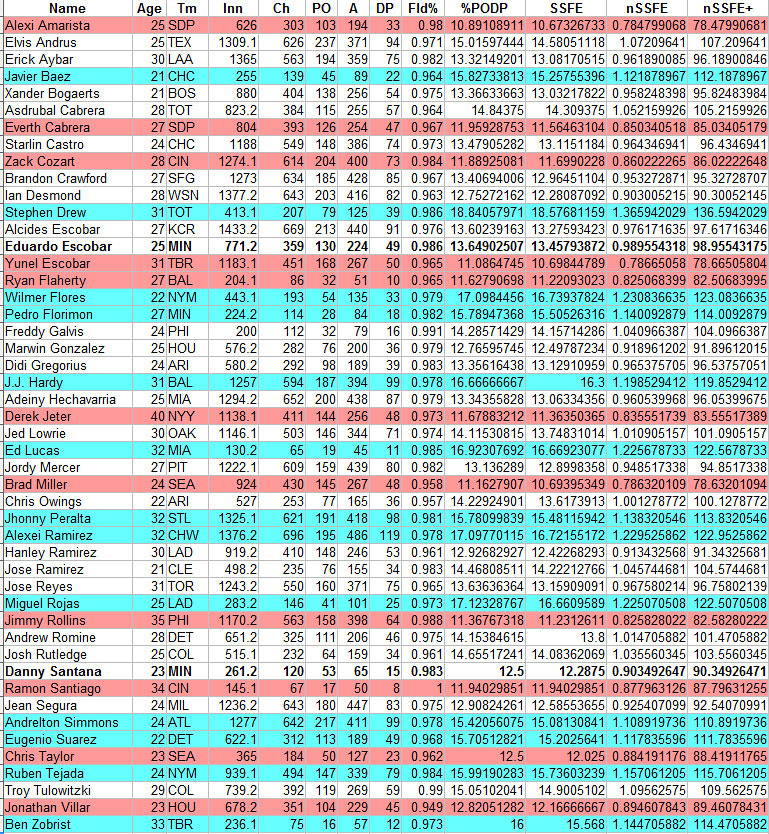
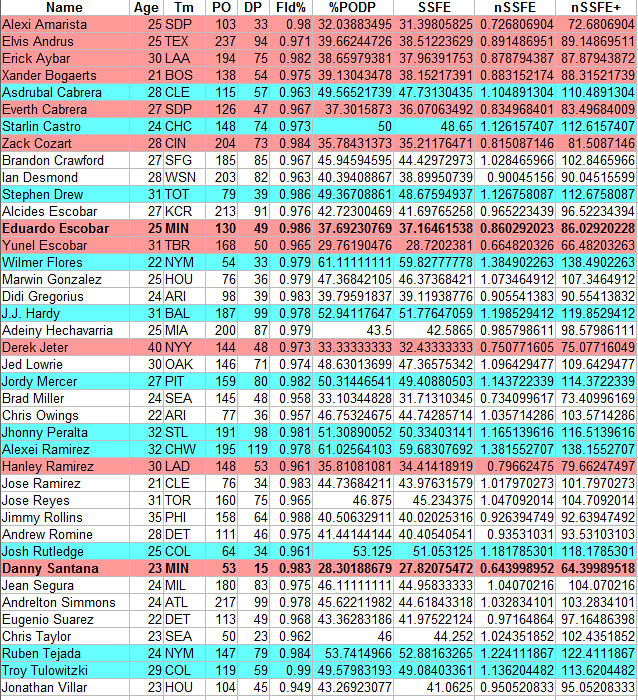
Recently when I was looking for an objective way to numerically describe how good Engelb Vielma's glove for my Minnesota Twins' top 40 prospect list, which is fairly easily understood as a concept, I came up with a simple metric:  The percentage of putouts that resulted in a double play.   I did a bit of research to see whether it will pass the stink test, and looked at  Omar Visquel's (who is indisputably a good glove shortstop and pretty recent) gold glove seasons (1994-2001).  Visquel percentage of putouts that were double plays was 40%, so I concluded that Vielma's 39.6 was indeed encouraging.    Furthermore I used this metric (as supportive to what I have seen with my eyes this season) to suggest that Jose Polanco, whose 52.3% of Put Outs were Double Plays, despite the rumors, is a very good shortstop with the glove.  This resulted in a major upset on the top 10 of my Twins' prospect list, and a hearty discussion of the metric, among other things, here.

Conceptually it is very simple metric:  An effective shortstop will turn as many outs as possible when he has a chance.  It is affected by many things like range and arm, but it is not perfect.  It misses the number of chances for double play as a normalization, and something to describe how the shortstop was with the glove when there were no putouts.   So I did three things :

a. When I first thought of  this, I thought that putouts were the way to go, because for some reason helped tell more for a shortstop than assists.  After a bit of discussion and noodling, this is not really valid.  I was wrong to use putouts for the denomination.  I think that Total Chances are a better denominator, so that is it. Instead of percent of Put Outs that were Double Plays, I am using percent of Chances that resulted in Double Plays (%CDP)

b. To add something in the measurement that describes a shortstop in a non-double play situation, I went back to an old (and tired) friend and gave it new life my marrying it with %CDP:  Good old Fielding Percentage, which by itself is inadequate to whole describe fielding, but a very simple conceptual metric: Errors over chances.  So this compound measurement is simply: The percent of Chances that resulted in Double Plays multiplied by Fielding Percentage.  Because that is a mouthful, I am calling it Shortstop Fielding Effectiveness (SSFE, and the name is similar to the other metric I device to simply evaluate pitching, the Pitching Effectiveness.)

c.  To normalize for the chances of double play (i.e. how many of total chances were with a man on base,) I normalized against the league for a full season, assuming that the chances for a double play are pretty much the same for all teams in the course of 2280 games (152 times 15) and a league normalization, would be good enough.  So I calculated the average SSFE (which was 13.5) and divided each player's with that average, resulting to a normalized value, which I call nSSFE. nSSFE of 1 is average, everything above 1 is above average and everything below 1 is below average.  To make it look numerically a bit more familiar (think ERA+ and OPS+,) I multiplied by 100 (making the average 100, like those other 2 metrics) creating what I call nSSFE+ (still a mouthful).  139 players played Shortstop in the bigs in 2014 contributing to those numbers.

Does it pass the stink test?

Here is the nSSFE+ are all MLB shortstops in 2014 with more that 200 innings at shortstop.  In blue are the above average shortstops (nSSFE+ 110 or more) and in red are the below average (nSSFE+ 90 or less.)   Since this is a Twins-focused blog, the Twins' players are in bold.


I think that it does pass the stink test if you look who is in the blue categories (JJ Hardy, S. Drew,  et al) and who is in the red (Derek Jeter, Jimmy Rollins et al.) 

Is it a perfect metric?  No; because there is no such a thing.  But I think that it is easily understood as a concept and can be valuable.   And it is better than the "eye" alone.  The two together may be awesome.   Could it be translated to other positions?   I will try to play around, but feel free to play and tell me :)   I will eventually look to see how the average moves with history, and potentially refine it, but this is the first attempt...
 

1/9/15

2015 offseason Minnesota Twins top 40 prospects: summary; all 1-40

I have been counting down the Twins top 40 prospects with descriptions and scouting reports of the players, their potential, their likely destinations for 2015, and in some cases the reasons why they were ranked where they were.   You can find all installments here in reverse chronological order.  Here are the detailed rankings: 36-40, 31-35 , 26-30 , 21-25 , 16-20 , 11-15 , 6-10 and 1-5. You can find the 2014 off-season summary list here   In these listings in parenthesis, I am including their ranking in the last prospect list, which was the 2014 mid-season list, with "--" if not ranked.  You can find that list here.

First of all the following players graduated: Graduated: Trevor May (4), Kennys Vargas (5), AJ Achter (25)

and these, ranked in the mid-season list, did not make this list: Nico Goodrum IF (22), Jose Abreu (27), Matthew Koch C (28), Zach Jones RHP (31), Sean Gilmartin LHP (32); and not only because he is not part of the organization any longer, Brian Gilbert RHP (33), Argenis Silva RHP (34), Sam Clay LHP (35), DJ Baxendale (37).

Here are my top 40 Twins' Prospects for 2015, in one single post: 

1. Miguel Sano 3B (1)
2. Jorge Polanco SS (6) 
3. Byron Buxton OF (2)
4. Alex Meyer RHP (3)
5. Jose Berrios RHP (9)

6. Amaurys Minier 1B/3B/OF (11)
7. Kohl Stewart RHP (7)
8. Eddie Rosario OF (10)
9. Lewin Diaz 1B (24)
10. Nick Burdi RHP (14)

11. Lewis Thorpe LHP (15)
12  Nick Gordon SS (8)
13. Stephen Gonsalves LHP (20)
14. Travis Harrison OF/3B (16)
15. Max Kepler OF/1B (12)

16. Jake Reed RHP (--)
17. Mitch Garver C (17)
18. Chih-Wei Hu RHP (--)
19. Jorge Fernandez C (--)
20. Engelb Vielma ss (21)

21. Adam Walker OF (13)
22. Levi Michael 2B (38)
23. Mike Cederoth RHP (18)
24. Rainis Silva C (--)
25. Alexis Tapia RHP (30)

26. Max Murphy OF (--)
27. Brandon Peterson RHP (36)
28. Stuart Turner C (--)
29. Felix Jorge RHP (23)
30. Ryan Eades RHP (19)

31. Aaron Slegers RHP (26)
32. Randy Rosario  RHP (40)
33. Zach Larson OF (29)
34. Todd Van Steensen RHP (--)
35. Mat Batts LHP (--)

36. Jermaine Palacios IF (--)
37. Fernardo Romero RHP (39)
38. Tyler Kuresa 1B (--)
39. Moises Gomez RHP (--)
40. Luis Arraez IF (--)


1/8/15

2015 Twins offseason top 40 prospects list: 1-5

Today is the eight and last installment in the top 40 Twins' Off-season prospects countdown (other than the overall summary that is coming up next).  You can find all installments here in reverse chronological order.  Previous rankings: 36-40, 31-35 , 26-30 , 21-25 , 16-20 , 11-15 and 6-10. You can find the 2014 off-season summary list here   In these listings in parenthesis, I am including their ranking in the last prospect list, which was the 2014 mid-season list, with "--" if not ranked.  You can find that list here.   Every Twins' fans should know those names, so I am really going emphasize discussion of the rankings here:


5. Jose Berrios RHP (9) RHSP, DOB: 5/27/1994, 6'1", 185 lbs

Jose Berrios was drafted by the Twins in the supplemental first round of the 2012 draft from Papa Juan (PR) High School.  Since he was drafted by the Twins, he had to face criticism about his height, which he answered by being a maniac worker, improving his arsenal every single season and knocking in the door of the majors just 3 seasons after he was drafted.   Berrios has a plus fastball that sits at 93-94 and can get up to 96-97, an above average change and a plus curve ball. He reached Rochester for one start, but likely will begin his 2015 season anchoring the Chattanooga rotation

4. Alex Meyer RHP (3) RHSP, DOB: 1/3/1990, 6'9", 220 lbs.

Meyer was drafted in the first round of the 2011 MLB draft by the Washington Nationals out of the University of Kentucky and traded to the Twins in 2012  for Denard Span.  Meyer is the best pure pitcher in the Twins' organization stuff-wise.  His repertoire includes 4 pitches: a plus plus fastball that averages 94-96 and hits 98-100, a plus to plus plus hard slider at high 80s with a sharp break a slow curve that sits in the low 70s and he learned a low 80s change up recently, which he used last season.  If you do the math, this is 30 mph differential.  He still needs to command his stuff, but think of a RH Randy Johnson, with a slow curve and a change up, as far as stuff goes.  The only things he needs to do, it to challenge batters and keep healthy.   Definite ace potential here.

3. Byron Buxton OF (2) RHB, CF, DOB: 12/18/1993, 6'2", 190 lbs

This and the next ranking will be the major controversies here.  I have been ranking Buxton second to Sano, but right now I feel that another Twins' prospect has surpassed him.   I am not counting Meyer's, Buxton's, and Sano's injuries against them in these rankings.  My question about Buxton is not whether he is injury prone (which is a fair question because his injuries, unlike the ones for Sano and Meyer that were the product of repetitive use, were on the field of play in plays like sliding head first while nursing a wrist and diving into a teammate's knee head first.)   For me the question is not whether Buxton can be the next Rickey Henderson or the next Bo Jackson.  For me the question is whether he can be the next Rickey Henderson, the next Vince Coleman or the next Otis Nixon.  And unless he dominates with the bat above the Midwest League level, which he hasn't done in at least 3 chances, he might be more like Vince Coleman than Rickey Henderson, and unless he can hit the league average above the Midwest League level, he will be more like Otis Nixon.  After last season he hit .212/.281/.404 in 57 PAs in the Arizona Fall League.  This season he hit .240/.313/.405 in 134 PAs at Fort Myers (I am discounted his single unfortunate game in New Britain) and capped it with hitting .263/.311/.298 in 61 PAs in the AFL.  Sorry, folks, this is not the best prospect for the Twins (and you can read my reasoning from last year regarding the Sano/Buxton comparison here,) which takes us to probably what most people would think of as the biggest surprise in this ranking:


2. Jorge Polanco SS (6)  SH, SS, DOB: 7/5/1993, 5'11", 165 lbs.

Polanco was added to the Twins' 40-man roster last offseason to be protected from the rule 5 draft, and had a cup of coffee (mostly warming the bench while getting 8 PA) when the Twins needed someone because of injuries this season.  Unlike the other prospects who saw MLB time, I don't consider him graduating this status, because he just was practically sitting on the bench.  So why Polanco 2 and Buxton 3, other than the fact that I might be crazy?   Simple.  They are the same age, Polanco has outhit Buxton in the higher levels and Polanco's glove is close to becoming elite.  Last thing first:  For some reason, there is a tale that Polanco's glove is not good enough to be a shortstop and he is better fit to be a second baseman, that has been propagated like the one about the guy with the bathtub and ice and kidneys.  Not sure where that came from, but let's look at one number:  Do you remember when I talked about Vielma's glove here and said the following?

How good is Vielma with the glove?  I will let the numbers speak for themselves and the number I would like to use as a criterion of a good SS is the percentage of Put Outs that were double plays.  Omar Visquel, the perennial AL gold glove winner, had a 40% of his Put Outs being double plays, in average of his gold glove years 1994-2001.  Last season for Vielma 39.6% of Put Outs were Double Plays.  In other words, four out of ten outs were in double plays.  I know that defensive metrics like RZR, RangeF, UZR etc are not believable by some people, because it involves a lot of math, but % POs that were double plays, is a very tangible concept.  For comparison's purpose, here are these numbers for the 2014 Twins with more than 50 POs: Escobar 49/130, 37.7%  and Santana 15/53, 28.3% - (Santana's MiLB career numbers are 209/622, 33.6%)

Here are Polanco's Put Outs that were Double Plays this season: 63/120 at Fort Myers (52.5%,) 18/29 (62.1%) at New Britain and 3/3 100% with the Twins.  I hope that this, along with Twins' fans witnessing his soft hands in the majors this year, seals that myth for ever.

This season Polanco hit .291/.364/.415 at Fort Myers in 432 PAs and .281/.323/.342 at New Britain in 157 PAs.  You can check what Buxton did this season in the same levels.   And I would argue that a good fielding shortstop who can hit is much more rare than a good fielding centerfielder who can hit.  Buxton does have more speed.  But he is more injury prone and he has not hit as well as Polanco at the same levels.  That seals it for me...

Polanco will likely start the season as the shortstop at Chatanooga, and will move up to the Twins at least by September.

1. Miguel Sano 3B (1) RH, 3B, DOB: 5/11/1993, 6'34", 235 lbs.

Sano should be regarded the best prospect in the game.  Period. Rationalization here and not much more needed to even discuss.  His hitting will be back, his fielding has been improving.  Likely will start as the Red Wings' third baseman, with an outside possibility of making the Twins during Spring Training. 


1/7/15

2015 Twins offseason top 40 prospects list: 6-10

Today is the seventh installment in the top 40 Twins' Off-season prospects countdown, and the descriptions of the player and rationalization of their rankings continue to a bit more detailed.  You can find all installments here in reverse chronological order.  Previous rankings: 36-40, 31-35 , 26-30 , 21-25 , 16-20 and 11-15. You can find the 2014 off-season summary list here   In these listings in parenthesis, I am including their ranking in the last prospect list, which was the 2014 mid-season list, with "--" if not ranked.  You can find that list here.   Before I start counting down the top 10, I need to mention the names of the players who dropped from the mid-season top 10 (along with their rankings in that list in parenthesis) : Nico Goodrum IF (22), Matthew Koch C (28), Zach Jones RHP (31), Sean Gilmartin LHP (32); and not only because he is not part of the organization any longer, Brian Gilbert RHP (33), Argenis Silva RHP (34), Sam Clay LHP (35), DJ Baxendale (37).  Now that we established that Nico Goodrum is not one of the top 10, here are the prospects 10 to 6, with a couple of surprises:


10. Nick Burdi RHP (14) RHRP, DOB: 1/19/1993, 6'5", 215 lbs.

Nick Burdi was the Twins' 2nd round draft pick in 2014 from Louisville.  This was what Nick Burdi did in relief in 2014:  Louisville: 37 IP, 65 K, 10 BB;  Cedar Rapids: 13 IP, 26 K, 8 BB; Fort Myers: 7.3 IP, 12 K, 2 BB.  Total: 57.3 IP, 103 K, 20 BB.  His K% was 43.6% in College, 48.2% at Cedar Rapids and 42.9% at Fort Myers.  A high 90s nasty fastball that often reaches triple digits, complemented by a low 90s even nastier slider, and there is no wonder than many, including the author of this, were wondering why Burdi did not start his pro career in the majors, since he is the best RHRP in the Twins organization at any level, since he was drafted.  But this is not the way the Twins are thinking.  The 22 year old had nothing to prove in a league whose average age was 2 years + older.  He will likely have nothing to prove in Chattanooga and be called to the majors by mid-season to serve as the Twins' set up man or even the closer.  He is not on the 40 man roster and has not been invited to the MLB Spring Training camp as of yet. 

9. Lewin Diaz 1B (24) LHB, DOB: 11/19/1996, 6'3, 180 lbs.

Lewin Diaz is an unknown name among most Twins' fans, but it will not be so for long.  He was signed as a 16 year old in 2013 from the Dominican Republic for a $1.4 million bonus.  2014 was his Pro debut in the DSL where he hit .257/.385/.451 with 5 HRs and 24:26 K:BB in 174 PA as a 17 year old.  He was about 1.5 years younger than the league average and hit well in a pitcher's league where the average slash line is .245/.339/.331.  Five HRs might not seem like much, but Diaz hit all but 2 of the DSL HRs and had the same or more HRs than 3 of the Leagues' teams.  His is stronger (and bigger) as a 17 year old than both Miguel Sano and Kennys Vargas at that age.  His glove is a work in progress at 17 and will likely end up at first base.  Will likely move to the GCL in 2015, where he will make his presence known to most of the Twins fans.  Here is a picture of Diaz from 2013 with David Ortiz, when Diaz was on the Dominican elite travel team (and Diaz was just 16 years old) to get an idea about the size of this kid:


8. Eddie Rosario OF (10) LHB, DOB: 9/28/1991, 6'0", 170 lbs.

Eddie Rosario was the Twins' 4th round pick of the 2010 MLB draft from teh Rafael Lopez Landron High School in Puerto Rico.  Rosario has been a top Twins prospect since he hit .337/.397/.670 with 21 HRs in 298 in Elizabethton as a 19 year old (1.5 years younger than League Average) in 2011.  In 2012 he hit .296/.345/.490 in Beloit where he suffered a broken jaw as result of being hit by a pitch, and in 2013 he hit .329/.377/.527 in Fort Myers and .284/.330/.412 at New Britain.  Baseball Prospectus twice named him top 100 prospect (#87 in 2012 and #60 in 2014). Last season was a trying season for Rosario.  Suspended for 50 games for street drug use, changing position from 2B to full time OF, he never found his swing.  He hit just .237/.277/.396 at New Britain and .300/.382/.300 in 8 games at Fort Myers, where he started the season. 

So why is Rosario ranked so high, if he apparently has contact problems at AA?   It is because of his past and his  potential (for pretty much the same reason that Sano and Buxton are still top prospects, even though they had worse seasons that Rosario in 2014) and because of what he did in the Arizona Fall League where he hit .330/.362/.410 with 10 SB in 105 PAs (his highest SB/PA rate ever.)  I take it as a clue that the 23 year old has put his bad couple seasons behind him and he is on his way of realizing his potential.  I'd like to see more doubles as well, but he is getting there.  He is on the Twins' 40 man roster, and unless something bad happens, he will be called for a cup of coffee in September, maybe sooner depending on his performance and the MLB team's needs.  His stock as a prospect dropped when he moved to the outfield from second base, but still Rosario would had been a top 5 prospect in most organizations out there.  Will likely start 2015 as the starting Centerfielder for the Red Wings (the assumption is that Buxton will have that position for the Lookouts,)  unless he gains a major league job out of Spring Training.

7. Kohl Stewart RHP (7)  RHSP, DOB: 10/7/1994, 6'3", 195 lbs.

Stewart was drafted by the Minnesota Twins in the 1st round (4th overall) of the 2013 from St Pius X (Houston, TX) High School.  Other than a single game started in Elizabethton (4 IP, 1 H, 1 BB, 8 K) he started his pro career in the GCL at age 18, where he pitched in 7 games (4 GS) for 20 innings, walking 3 and striking out 16.  He had a 1.69 ERA and 0.938 WHIP.  Last season was not Stewards best, when he was promoted to Cedar Rapids. There he started 19 games and looks like he was bitten by the pitch-to-contact bug of the Twins' organization.  His K% dropped from 23.2% in the GCL (which is not great for someone with his stuff to begin with) to a mere 17.2%, putting his K rate to the Blackburner.  His 2.59 ERA and 1.14 WHIP might look encouraging before someone takes a look at his 3.73 FIP and .270 BABIP.   Still Stewart was a full 3 years too young for the league at 19 and has been battling shoulder issues pretty much the whole season. 

Stewart has 4 pitches that he commands well:  A plus to plus plus mid 90s fastball that peaks at 97-98, a close to plus mid to high 80s slider, an above average high 70s to low 80s curveball and a very good mid 80s changeup.  In August his fastball was barely hitting 90, which is an indication of injury.  He is still young, he has a lot of potential as long as the shoulder is strong.  If that happens and if he can start to miss bats, he could be a top of the rotation pitcher.   Right now, he is the third best RHSP prospect in the Twins' organization.

6. Amaurys Minier 1B/3B/OF (11) SHB, DOB: 1/30/1996 6'2", 190 lbs

Amaurys Minier might be slighted by this ranking (and it is the highest I have seen him ranked in any of these lists.)  He was signed by the Twins as a 16-year amateur free agent ($1.4 million bonus) out of the Dominican Republic on July 2, 2012.  In his first pro season in 2013 at the GCL he hit .214/.252/.455 (which other than the power numbers, is pretty bad) and then, he had shoulder surgery in the off-season for batter's shoulder.  Recipe for disaster.  Everyone thought that it will be a lost season.  But what did Minier do?  He played a full season in the same GCL as an 18-year old (2 years younger than the league average) and hit a mere .292/.405/.520 with a 29:52 BB:K ratio in 205 PAs.  To put this into perspective:  Minier had shoulder surgery, is 3 months younger than Nick Gordon, who in most lists is a top Twins' prospect, and out hit him in any possible way in the same team (Gordon's numbers: .294/.333/.366, 11:45 BB:SO, 256 PA.)  If you have 2 players the same age, one coming from a surgery and outhitting the other by that much in the same team, there is no way to justify not ranking them in this order.  Or is there?
The one issue with Minier is his glove.  He was signed as a SS (a position he never played professionally and likely will never play,) played an awful third base in 2013 and a better 1B and so-so LF in 2014.  A lot of people think that Minier might have the most power in the Twins' organization (and this includes his compatriots Sano and Diaz and the MLB stars in making Vargas and Arcia; Sano's GCL slash line was .291/.338/.466, for comparison.  With these 5 players mentioned, the Twins might have locked the corner IF and OF and DH positions for a while.  But this while will not start as soon as for the others, for Minier and Diaz.  Definitely exciting to see how these young powerful guys develop for the Twins.