1/13/14

What the Twins are getting with Ricky Nolasco: A comparison with a former Twins' starter.

Last month, I examined in depth the re-signing of Mike Pelfrey to a two year contact by the Minnesota Twins, suggesting that he, indeed, can be a steal for the Twins for many reasons.   Today, I am looking at the biggest free agent spending from the Minnesota Twins ever, the signing of Ricky Nolasco to a 4 year, $49 million contact with an option of a 5th year, just before Thanksgiving.  In the near future, I will look at the signing of Phil Hughes, to complete the profiles of the 2 new, and one not so new, Twins' starting pitchers.

Rickey Nolasco by far is the most experienced pitcher in the Twins rotation and the Twins have him under contract for his age 31 through 34 seasons with the option covering his age 35 season.  How good is Ricky Nolasco?  The general sentiment, both from the main press and blogs covering the Twins has been that Nolasco is a mid-rotation type of starter, who can eat innings, and it is fairly durable (in a Carl Pavano way) but by no means he is a top of the rotation starter.

Let's dig a little deeper now that the dust has settled and the holiday period has passed.  Nolasco has been a darling in this space since about 5 years before the Twins signed him, because in his early years of pitching for the Marlins (look at this post from 11/2008, for example) he has been among elite company in pitching rankings.   His numbers have been up and down the past few seasons after the first seasons with the Marlins (which earn him 3 opening day starts for them,) thus it make sense to look a bit deeper.   And the way I will be looking is utilizing PE, xPE, FIP, xFIP and SIERA (please read this writeup for a primer about these measurements, what they do and the reasoning for their use).  I am also doing a couple more things.   I compare him to a particular Twins' pitcher, and using color coding, I am examining how both of their annual performances fit in a good rotation, using this key:


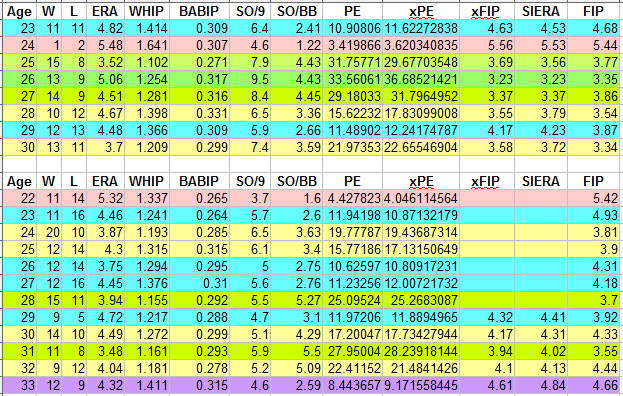
Here are the numbers:


Nolasco's are on top, and Brad Radke's are on the bottom.   Because of the inability to calculate xFIP and SIERA in the early year's of Radke's career, I have added FIP as well.  However, as I show here, xFIP (and SIERA) correlate better with xPE than FIP, so the xPE comparisons are close to xFIP and SIERA comparisons.

Based on this, Nolasco has a season (age 26) where he performed like an Ace, 2 seasons (ages 25 and 27) where he performed as a number one or two, two seasons that he performed as number two or three (age 28 and age 30), two seasons that he performed as a number three or four (age 23 and 29) and one replacement level season (age 24.)   Clearly, his performance overall has been better than Brad Radke's performance overall.

A couple more comparison charts:

Here is Nolasco's and Radke's FIP compared annually since season age 22 (just for Radke, Nolasco was not in the bigs then) :
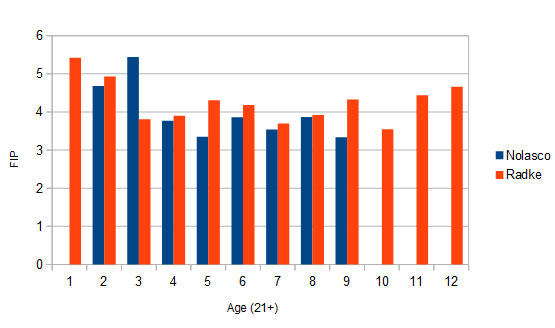


For the same age, other than age 24, Nolasco has had a very similar, but lower FIP than Radke in every season. and in the ages 26 and 30 seasons (that was 2013 for Nolasco), Nolasco's FIP was significantly lower than Radke's.

And here are their xPE comparisons (higher is better) over the same span:
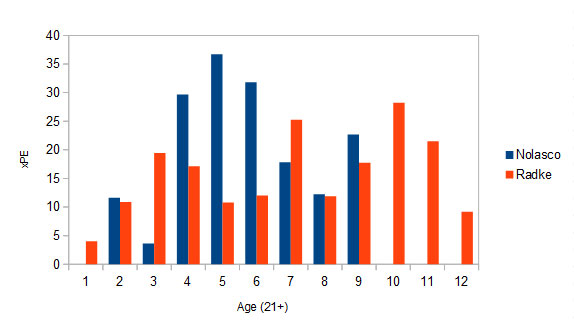


The xPE paints a bit of a more dramatic picture:  other than the ages 24 and 28 (this is a difference with FIP) season, Nolasco's pitching was much better than Radke's at the same ages.  However, there is a potential tale of caution, not obvious with the FIP chart:  Looking at both xPE and FIP, Radke's peak was his age 28-32 seasons with age 31 being his absolute best, before the shoulder issues kicked.   Nolasco's FIP is low enough in his age 30 season, but his xPE from his age 28 season one, has not quite reached his xPE peak of his career best (so far) at age 26.  The jump in his age 30 season is encouraging and hopefully indicates that the best is still to come and Nolasco is indeed still in his peak years, but the drop is something to keep in mind.

So what do the Twins have in Nolasco?   A pitcher who has pitcher close to, but better overall, than Brad Radke in a year by year comparison and who has been top of the rotation pitcher.  And based on the regard that the Twins' fanbase has for Brad Radke, an

1/10/14

Weekly summary of the Twins moves and targets: 1/10/2014

Here is the summary of the moves the Minnesota Twins did and the players they expressed interest in this week (the links will take you to reports).  As far as "targets" go, I am listing players that the Twins reportedly expressed interest in and not players who baseball writers and other thought that they would be a good fit or may fill a need.  The targets identified past weeks are still in the list unless they signed elsewhere.  Not any transactions this Holiday week, but some additional interesting targets.

As a reminder, you can see all the Twins' weekly transactions and targets in reverse chronological order here.


Moves:

Trades:

No trades last week

In:

Re-singed IF Eric Farris to a minor league contact (1/3)
Signed UT Corey Wimberly to a minor league contact with an invitation to Spring Training (1/4)

Out:


No transactions last week


The current Twins' 40-man roster is here and contains 21 pitchers and 19 position players for a total of 40 spots.


Targets:

Trade:
Free Agent:
RHP Raisel Iglesias (Cuban Defector)
SS Erisbel Arruebarruena (Cuban defector)

1/9/14

Full list of the players participating in the 2014 Twins Spring Training

Today the Twins announced the 23 non-roster players who were invited to the 2014 Spring Training.  This makes a total of 63 players attending.  This is pending any transactions in the following couple of months.

Here are all the players participating in the Twins' Spring Training by position and with the known assigned uniform numbers, with the 40 men roster players in bold:

LHPs


38 Logan Darnell 
58 Scott Diamond
52 Brian Duensing 

83 Sean Gilmartin
81 Matt Hoffman
60 Edgar Ibarra
53 Kris Johnson 
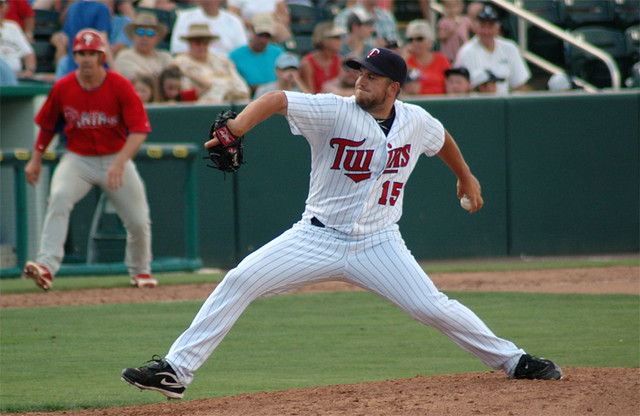
15 Glen Perkins

63 Brooks Raley  
56 Caleb Thielbar 
64 Aaron Thompson


RHPs

61 Jared Burton 
30 Kevin Correia 
21 Samuel Deduno
50 Casey Fien 
44 Kyle Gibson 

76 Deolis Guerra
45 Phil Hughes
65 Trevor May  

66 Alex Meyer
47 Ricky Nolasco  
48 Lester Oliveros
37 Mike Pelfrey 
54 Yohan Pino
57 Ryan Pressly
51 Anthony Swarzak
59 Michael Tonkin
49 Vance Worley


Catchers

26 Eric Fryer 
12 Chris Herrmann  

73 Kyle Knudson
82  Matt Koch
43 Josmil Pinto 
84 Dan Rohlfing
8 Kurt Suzuki 

85 Stuart Turner

Infielders


11 Jason Bartlett
77 James Beresford
17 Doug Bernier
55 Chris Colabello
2 Brian Dozier 
5 Eduardo Escobar 
25 Pedro Florimon
7 Joe Mauer 
24 Trevor Plouffe
78 Jorge Polanco 

79 Deibinson Romero
72 Miguel Sano
39 Danny Santana
68 Kennys Vargas 

71 Brandon Waring

Outfielders

31 Oswaldo Arcia 

70 Byron Buxton
32 Aaron Hicks 
67 Max Kepler 

13 Jason Kubel
19 Darin Mastroianni
80 Jermaine Mitchell
27 Chris Parmelee
1 Alex Presley  

62 Chris Rahl
22 Wilkin Ramirez
16 Josh Willingham

1/7/14

Clutch hitting and pitching and the 2013 Twins.

"Clutch" is a word that has been used to describe the players who go above and beyond the norm and perform highly in difficult situations in close games:  The guy who comes into the game with 2 outs and the bases loaded, down three in the bottom of the ninth and hits a grand slam off a closer who never blew a save.  The pitcher who comes in with bases loaded and no outs, up one on the bottom of the ninth and strikes out the side to save the game.   Whether or not there are players out there who are "clutch" and consistently outperform themselves in those type of situations has been a vast subject of debate.  Here is a good summary of a few historic studies and here is a list of lots of links on the subject, if you feel like reading more.

About 5 years ago, David Appelman devised a measurement called, well, "Clutch" that tries to describe clutch hitting and pitching.   Basically what it does, is it looks at the difference of someone's performance (based on Win Probability Added) in High Leverage situations only, versus his overall performance.   Players with positive Clutch outperform their overall performance in those situations and players with negative Clutch underperform.  This does not mean that a player with a higher Clutch is a "better" player than one with lower Clutch.   If someone hits .220 with the bases loaded and .200 overall, is not a better player than someone who hits .320 with the bases loaded and .340 overall, despite the Clutch numbers.

Fangraphs picked the stat now and I sorted the Twins hitters, relief pitchers and starting pitchers based on Clutch.  This is an exercise just for fun.  I don't think that it means that much (see example above), but it is interesting and it potentially be an additional tool for player evaluation, but not a stand alone tool.  Situational and High Leverage performance definitely might tell something about relievers as a group, but we are not about to jump into any conclusions here.  Just a demo :)

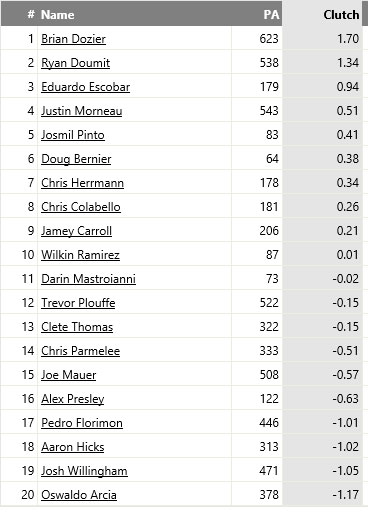
Here are the 2013 Twins' hitters ranked by Clutch (60 PA min) :


Here are the 2013 Twins' relief pitchers ranked by Clutch (10 IP min):


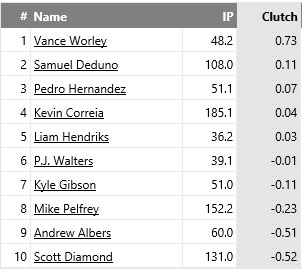
Here are the 2013 Twins' starting pitchers ranked by Clutch (35 IP min):


Pitchers in both roles are listed on both tables for that role only.  A couple of observations:

  • The Twins definitely do not use or value the metric, since about half of the players with positive Clutch numbers are gone
  • I am not surprised to see Dozier and Duensing lead the hitter and the reliever groups respectively.  It is my recollection that they really excelled in pressure situations
  • Worley leading the starter group may be a surprise, until someone considers that, in order to pitch in a high leverage situation, a starter needs to get himself into trouble to make that situation high leverage.   Thus, Clutch, is not very useful at all for starters  (other than looking at fun results like the above...)

1/6/14

Fantasy Implications from the Signings of the Top 3 Free Agent Hitters

Now that the top three free agent hitters have all been signed to long-term deals, it is time to analyse what type of impact the change in scenery will have on their fantasy baseball numbers. The three left-handed bats (Jacoby Ellsbury, Robinson Cano and Shin-Soo Choo) all want to have career years to justify their contracts, but can they meet expectations?

Ellsbury battled some injuries a season ago, but he was healthy enough to help lead the Boston Red Sox to the World Series. Fantasy baseball  owners were still able to enjoy a .298 average from him and 52 stolen bases, but his power disappeared a little bit. That should change a little now that he is playing half of his games in Yankee Stadium. Health is the biggest issue for him here, but if he can stay on the field, his fantasy baseball numbers will be near career highs.

The Yankees were able to pay Ellsbury because they didn’t spend money on second baseman Robinson Cano. After being the main cog in the lineup for New York all last season, he will be switching coasts to play for the Seattle Mariners. A lackluster lineup surrounding him (even after improvements) and a bigger stadium could hurt his power numbers a little bit. Fortunately, Cano is a good enough line drive hitter that his numbers shouldn’t dive too much.

Finally, Choo goes from one good situation to another, as he signed a deal with the Texas Rangers. He put up nice numbers in Cincinnati in 2013, sporting an on-base percentage of .423 and slugging 21 home runs. He won’t have to play centerfield in Arlington, and he gets to hit in a stacked lineup in a hitter friendly ballpark. Expect some of his best career numbers this upcoming season as long as everyone else lives up to expectations. Some should worry slightly about his age and injury history, but he is still a top flight fantasy baseball option.


The chronicle of the shoulder injuries of Twins' RHP Samuel Deduno

Last season, after his World Baseball Classic performance (which ended with a pulled groin that made him miss a chunk of Spring Training and 44 games with the Twins) and his consistent performance in June and July that had him enter August with a 7-4 record and a 3.18 ERA in 12 starts, made many people in the Twins Cities  call Samuel Deduno an"Ace".   This included several well-respected mainstream media. (For sample of relative stories, look here, here, here, here and here.) 

Not sure whether calling Deduno an "Ace" (which, of course, he never was; being the only pitcher who gives a bad team a semi-consistent change of staying close in a game, an "Ace" does not make) caused a hubris-derived curse, but he was never the same afterwards, because of an injury that caused him to have double (labrum and rotator cuff) shoulder surgery the Fall, making his trip up North breaking camp with the Twins pretty dubious. 

When (then interim) General Manager Terry Ryan, returned to that role with the Twins after the 2011 ninety nine loss season he identified several places that needed change in order for the team to improve.  In addition of the firing of Jerry White and Rick Stelmaszek, the retirement of Steve Liddle and the "no scholarships" approach about certain players like Tsuyosi Nishioka,  and the reassignment of the other remaining coaches, Ryan fired the Twins' head athletic trainer Rick McWane, establishing medical treatment of the players as one of the areas for improvement and part of the cause of the Twins demise in 2011.

How well have those changes worked in 2013?  Let's look at the chronicle of Samuel Deduno's shoulder injury, diagnosis and treatment, with stories from last August on as they happened, and let the readers reach their own conclusions:

August 7:  Deduno allows 4 runs in 5.7 innings in loss to Royals giving up 12 hits.

August 13: He allows 5 runs in 6 innings in loss to Indians; 5 hits and 3 bases on balls.

August 18: Allows 5 runs in 5 innings. Allows 8 hits.  After the game Deduno speaks to the press indicating he has shoulder problems.  He said that "It started behind the shoulder a couple weeks ago [August 7] , but I could handle that".  "Now it's in the front. I felt it a few days ago [August 13]. Today, I didn't feel good. In the bullpen and during the game, I didn't feel strong." 

[In other words, Deduno makes 3 starts with shoulder issues.  It is unclear whether he communicated those issues to the training staff]

The Twins' trainers prescribe and Deduno undergoes Electronic Stimulation Therapy (a muscle therapy).

August 19:  Consistent with the treatment prescribed, the Twins' training staff diagnose the condition as bicep tendinitis

August 21: Deduno throws bullpen and says he feels fine

August 22: Starts against Cleveland. Allows one run in 6 innings in a win at Cleveland. 3 hits, 4 bases on balls

August 29: Starts against the Royals. Allows 3 runs in 3 innings against the Royals.  Out with shoulder soreness.

[In other words, Deduno makes 2 additional starts with apparently unresolved shoulder issues] 

August 30: Deduno placed on of the 15-day DL

September 8: Deduno transferred to the 60-day DL

September 9:  The Twins' GM talks to the press about Deduno. Saying that  he might need shoulder surgery but is "not as bad as it sounds" and could rehab instead.  Terry Ryan indicates that Deduno is "battling inflammation" and says that he is "sure that it is scar-tissue related"

September 9 (later in the day): The Twins announce that Deduno has "issues in his labrum and rotator cuff" and might need "just a clean up"

September 13: The Twins indicate that Deduno has "Fraying in the shoulder" recovery timetable is set to two months, should be ready on the onset of Spring Training

September 20: Announcement that Deduno has successful arthroscopic Shoulder Surgery (by his agent) reparing "slight fraying" and "slight tear".

December 9: Twins indicate that Deduno has started to playing catch and his rehab progresses (in Fort Myers) as planned and he is still on schedule for Spring Training.

Meanwhile, Terry Ryan signs three free agent pitchers who, in addition to Correia, are all penciled in ahead of Deduno for the 2014 rotation.  Terry Ryan after the season publicly said that "Deduno has pretty much earned a spot on the 2014 rotation", but his actions show that he does not count on Deduno.   Whether he will be ready for Spring Training or not, it will be seen, since there has been pretty much silence on Deduno since September 20.

It has to be noted that Deduno has been very fragile.   Here is his injury and lost days history in his professional career:

Missed 30 days of 2013 with Right Shoulder injury
Missed part of 2013 (ST and 44 days) with Groin injury
Missed 45 days of 2012 with Right Elbow injury
Missed 18 days of 2011 with Groin injury
Missed 111 days of 2010 with Right Elbow injury (inflammation)
Missed 22 days of 2009 with Hip Flexor injury
Missed all of 2008 with Tommy John Surgery recovery
Missed 45 days of 2005 with Right Shoulder injury

The only healthy seasons in Deduno's career were 2006 and 2007.  It looks like his Right Shoulder, Groin and Hip, and Right Elbow (and unfortunately even after Tommy John Surgery) have been his problem areas.   The elbow and shoulder issues are especially worrisome...

I hope that Deduno is healthy, because he pitches in an intriguing way and could help the Twins, but if his history is any guide of the future, he is not to be counted on to have the ball every fifth day.


1/3/14

Weekly summary of the Twins moves and targets: 1/3/2014

 Happy New Year!  Here is the summary of the moves the Minnesota Twins did and the players they expressed interest in this week (the links will take you to reports).  As far as "targets" go, I am listing players that the Twins reportedly expressed interest in and not players who baseball writers and other thought that they would be a good fit or may fill a need.  The targets identified past weeks are still in the list unless they signed elsewhere.  Not any transactions this Holiday week, but some additional interesting targets.

As a reminder, you can see all the Twins' weekly transactions and targets in reverse chronological order here.


Moves:

Trades:

No trades last week

In:

No signings last week

Out:


No signings last week


The current Twins' 40-man roster is here and contains 21 pitchers and 19 position players for a total of 40 spots.


Targets:

Trade:
Free Agent:
RHP Raisel Iglesias (Cuban Defector)
SS Erisbel Arruebarruena (Cuban defector)

1/2/14

My (fictional) 2014 Hall of Fame ballot

Members of the BBWAA had until 12/31 to send in their annual HOF ballots (via fax or snail mail only.)   The results will be announced in two days, so I decided to post my fictional ballot.  A couple of notes:

  •  I explain this more in depth here, but I believe that entry to the Hall of Fame should be restricted to the very few select players.   It is ok to have displays on Jack Morris' game 7, as a great game in baseball and a great appearance, but it is not ok to induct the player, just for this.  The same with Mark McGwire and Samy Sosa and their HR title contest.  Thus, my cut offs are more stringent than others.  The Hall has 306 members, some of the players have an under .700 career OPS.  This is not right as far as I can tell.
  • I am going with performance and not proven or suspected PED use.   This witch hunt has to stop.  If someone wants a "clean Hall", Hank Aaron should be kicked out, since he publicly admitted to using "greenies" that are now banned from baseball.  If someone does not vote for modern PED suspects but wants to keep already enshrined PED users, is a hypocritical position.  So is, celebrating Tony LaRussa's induction while not voting for Mark McGwire because of steroid use.   Unless LaRussa was blind or absent, he at least knew what was going on in the Canseco/McGwire/Giambi clubhouse.

With those things in mind, my 2014 HOF ballot would have been:

Jeff Bagwell
Barry Bonds
Roger Clemens
Tom Glavine 
Glenn Maddux
Mike Mussina
Curt Schiling,

There is a reason that 10 votes is the maximum.  It is not the Hall of Very Good.

12/31/13

12/27/13

Separated at Birth: Twins RHP Alex Meyer and ?

By now you have already read the story first published at Indy Star and told by David Woods, about Twins' RHP Alex Meyer spending his off-seasons as a substitute teacher.  Here is one of the pictures of Alex Meyer sporting a dress shirt and a tie in this story:


Cannot help it, but Alex in this picture looks like someone's twin:


Weekly summary of the Twins moves and targets: 12/27/2013

Here is the summary of the moves the Minnesota Twins did and the players they expressed interest in this week (the links will take you to reports).  As far as "targets" go, I am listing players that the Twins reportedly expressed interest in and not players who baseball writers and other thought that they would be a good fit or may fill a need.  The targets identified past weeks are still in the list unless they signed elsewhere.

As a reminder, you can see all the Twins' weekly transactions and targets in reverse chronological order here.

  Moves:

Trades:

No trades last week

In:

Signed C Kurt Suzuki to an 1 year $2.75M contract plus incentives (12/20)

Out:


Outrighted OF Darin Mastroianni to AAA Rochester with an invitation to Spring Training (12/23)
Released MiLB LHP Jose Gonzalez (12/20)
Released MiLB  OF Romy Jimenez (12/20)


The current Twins' 40-man roster is here and contains 21 pitchers and 19 position players for a total of 40 spots.

Targets:

Trade:
 
Free Agent:
 
RHP Raisel Iglesias (Cuban Defector)
SS Erisbel Arruebarruena (Cuban defector)

12/25/13

Merry Christmas the Minnesota Twins' way. May all your wishes come true!

I find this video very heartwarming and appropriate for today and wanted to share.  Merry Christmas to you all and let us all not forget the less fortunate these days.

12/24/13

By the numbers: a body count of the Twins' pitching depth for 2014 and myth busting

The major priority of the Minnesota Twins' General Manager, Terry Ryan, has been to re-build a rotation that has been at the bottom of the major leagues in pretty much every statistical category in 2014.   There is a general agreement that the rotation was pretty much "a mess" in 2013 and needed fixing.  There is also the general impression that the Twins' pen was one of the strengths of the team and it is better left alone.   However, this impression is false because in 2013 the Twins' pen ranked:

17th out of 30 MLB teams as far as ERA goes
17th out of 30 MLB teams as far as FIP goes
17th out of 30 MLB teams as far as SIERA goes
8th out of 30 MLB teams as far as WHIP goes
19th out of 30 MLB teams as far as K% goes

In other words, the Twins' pen, which compared to the Twins' rotation seemed great, when compared to the rest of the major league pens is proven to be average at best. 

Busted myth number one:  The Twins' pen was not great in 2013 and, while it might have been a bright point in 2013 compared to the rest of the team, it does not cut the mustard compared to the rest of league.

There is a lot of room for improvement and I suspect that Terry Ryan will address before Spring Training, since that will go a long way for the Twins to be competitive in 2014.

After the recent additions of new and returning starting pitchers there have been arguments that the Twins have too many starting pitchers and there is a logjam or pitchers on the Twins' roster.

I  thought that it might be a good time to take a breath and look at what the Twins have on their 40-man roster as far as pitching goes, and see whether this argument is true or not.

Here is the Twins' 40 man roster (alphabetically) broken down in groups (players in bold are out of options):

Group A: Starting pitchers with no options signed to sizeable contracts the last 2 seasons.

Kevin Correia (RHSP)
Phil Hughes (RHSP)
Rick Nolasco (RHSP)
Mike Pelfrey (RHSP)


Group B: Relief pitchers with no options signed to sizeable contracts the last 2 seasons or offered arbitration.

Jared Burton (RHRP)
Brian Duensing (LHSP/RP)
Glen Perkins (LHRP)
Anthony Swarzak (RHSP/RP)


 Group C: Starting pitchers with no options with small contacts who played in the majors for more than 3 seasons.

Sam Deduno (RHSP)
Scott Diamond (LHSP)
Vance Worley (RHSP)


Group D: Starting and relief pitchers with options with small contacts who played in the majors for at least one season.

Andrew Albers (LHSP)
Casey Fien (RHRP)
Kyle Gibson (RHSP)
Kris Johnson (LHSP)
Ryan Pressly (RHRP)
Caleb Thielbar (LHRP)
Michael Tonkin (RHRP)


Group E: Starting and relief pitchers with options with small contacts who never  played in the majors.

Logan Darnell (LHSP)
Edgar Ibarra (LHRP)
Trevor May (RHSP)


Broken down this way, the perceived logjam of Twins' staring pitchers becomes pretty clear:

The Twins usually have a 12 man pitching staff.  They currently have 4 starters and 4 relievers (groups A and B) who are pretty much guaranteed a job.  This opens 4 more positions, one in the rotation and 3 in the pen.  If you assume that the Twins value all pitchers in Group C who are out of options, they have the space to find them all a major league job, as well as allow another pitcher, likely from Group D or potentially outside the organization, to gain a rotation or bullpen position.  The rest of the players will provide depth in AAA and be there in case of emergency or potentially be offered in trades to fill additional needs, like position players.

Busted myth number two:  There is no pitching logjam on the Twins' roster.

In other words, the Twins do have a lot of pitching depth in their 40-man roster, but they are not in a logjam situation where they cannot accommodate all their pitchers without options on their 25-man roster.  And this assumes that Samuel Deduno who is recuperating from double (labrum and rotation cuff) shoulder surgery is available to start the season, which is an extremely optimistic approach right now.

While it is too early to name names to complete the rotation and the pen, because changes will likely happen before spring training,  this early clearly the Twins are not in any sort of a pitching logjam and also have plenty of options.


12/22/13

Video Interview with Chris Colabello

According to recent reports the Minnesota Twins have explored selling Chris Colabello's rights to at least two Korean Baseball teams, one of which offered Colabello a contract close to $1 million dollars.   A player has the option to accept or refuse the transaction and, according to the same reports, Colabello refused.   Here is a very in-depth interview of Chris Colabello right after the WBC last March with Dani Wexelman.   This interview is close to 19 minutes long and might shed some light on Chris' decision to stay (for less and potentially much less, if he does not make the team, money) and fight for a spot on the Twins team.


12/20/13

Profile of the newest Minnesota Twin: C Kurt Suzuki

It has been reported that the Minnesota Twins have Signed 30 year old C Kurt Suzuki to an 1 year $2.75 million contract plus incentives.  Suzuki, who made $6.5 million last season, will provide catching depth, allowing the Twins to pace the use of  Josmil Pinto and Chris Herrmann at the catcher position in a way that it is most appropriate for them.   He would also act as insurance, in case one or both of the rookies need additional work at AAA.   The Twins would need to create a spot on the 40-man roster for Suzuki, which likely means that 28 year old Eric Fryer, who was slated for this role now filled by Suzuki, will be taken off the 40-man roster and designated for assignement.

The 5'11", 200 lbs, Suzuki, who is from Hawaii, was drafted by the Oakland Athletics in the 2nd round of the 2004 MLB June Amateur Draft from California State University Fullerton.   He flew threw the Athletics system at a pace of a level a year starting as a 20 year old in short season A Vancouver and ended up starting 2007 in AAA Sacramento.  Baseball America had him ranked as the 89th best prospect in Baseball before that season.   Mid-season 2007 he made his debut with the Athletics where he stayed until the 2012 trading deadline when he was traded to the Washington Nationals.  He returned to the Athletics, traded back by the Nationals this trading deadline, to support thens in their post-season run in 2013.

His career slash line is .253/.309/.375 (.685 OPS, 86 OPS+).  The right hand hitter seem to be consistently declining with the bat since his age 25, 2010 season when he hit .274/.313/.421 (.734 OPS, 93 OPS+) .   Last season between the Nationals and the Athletics he hit .232/.290/.337 (.627 OPS, 73 OPS+) in 94 games (316 PAs), which is what the Twins should probably be expecting from him (in fewer PAs) in 2014 and his $2.75 million one year contract reflects this.   He is a right hand hitter but hits both lefties and righties equally.

Suzuki does not walk a lot, but he does not strike out a lot either (about 8% BB rate and 10% K rate).  He makes contact, but does not have much power.  He is a good bunter and can move runners on; also suited for hit and run plays. Suzuki's defense behind the plate, his ability to block balls in the dirt, to make hard plays and to stall runners has been praised.   So has his clubhouse presence.  So has his game calling by managers and his pitchers.  He has been extremely healthy spending only 24 days in the 15-day DL in his career for an intercostal muscle strain in 2010.  Even if he might not be able to contribute with the bat as a starter, he would be an invaluable mentor for both Pinto and Herrmann.   All in all a great addition for the Twins.


Weekly summary of the Twins moves and targets: 12/20/2013

Here is the summary of the moves the Minnesota Twins did and the players they expressed interest in this week (the links will take you to reports).  As far as "targets" go, I am listing players that the Twins reportedly expressed interest in and not players who baseball writers and other thought that they would be a good fit or may fill a need.  The targets identified past weeks are still in the list unless they signed elsewhere.

As a reminder, you can see all the Twins' weekly transactions and targets in reverse chronological order here.

 Moves:

Trades:

Traded OF/DH Ryan Doumit to the Atlanta Braves for Minor League LHP Sean Gilmartin who was invited to Spring Training (12/18)

In:

Signed RHP Yohan Pino to a Minor League contact

Signed RHP Mike Pelfrey  to a two year, $11 million contract with additional $3.5 million in incentives (12/14)

Signed OF Jason Kubel to a split contract:  The Minor League portion would be $15,000 a month.  If he makes the MLB team he will receive a base of $2M with $150K for reaching each of 300 and 350 PAs, $200K for reaching 400 PAs, $150K each for spending 30 and 60 days and $200K for spending 90 days on the 25 man roster.  Additionally he will receive $100K each for being named the World Series or the AL MVP and $25K for making the All-Star team or winning a gold glove. (12/13)

Out:

RHP Liam Hendriks was claimed off waivers by the Chicago Cubs (12/13)

The current Twins' 40-man roster is here and contains 21 pitchers (if you include Pelfrey, which is not yet official) and 19 position players for a total of 40 spots.

Targets:


Trade:

Free Agent:
RHP Raisel Iglesias (Cuban Defector)
C John Buck 
SS Erisbel Arruebarruena (Cuban defector)

12/18/13

Scouting report of newest Twins' member LHP Sean Gilmartin

The Minnesota Twins in an effort to reduce the logjam in the DH/OF position have traded Ryan Doumit to the Atlanta Braves for 23 year old minor league LHP  prospect Sean Gilmartin.  The 6'2", 200 lbs Gilmartin was the Braves' 1st round (28th overall) pick of the 2011 draft.  Before he was drafted, he was named All American from Baseball America and before the 2012 season he was ranked as the Braves' 5th best prospect, and 4th best before the 2013 season. 

Currently, he is ranked as the Braves' 10th best prospect for 2014 by Baseball America that also ranks his change up as the best in the Braves' system and suggest that he has 4th starter upside.   This is good, otherwise Gilmartin sounds a lot like a prototypical Twins' lefty:  High 80s-Low 90s average fastball with few strikeouts (6.3 K/9 in AAA in 128.7 IP, and 6.5 K/9 in AA in 119.3 IP), who needs impecable command and control to survive.  His change up is a truly plus pitch and sits in the low 80s.  He has a low 80s above average to plus slider that he uses almost exclusively against LHBs while he prefers an also above average slow (low 70s) 12-6 curveball against RHBs.   His mechanics are good and his delivery pretty smooth.

Gilmartin needs to have exceptional command and control with his average fastball in order to keep his team in games.  However, last season in AAA Gwinnett, that was not the case (and add some lackluster defense behind him and bad luck) and it showed.  He finished the season with a 3-8 record, 5.74 ERA (4.61 FIP), 1.593 WHIP (.332 BABIP), 6.4 K/9 (15.8 K%) and 1.97 K/BB.   A lot like a current Twins' LHP, but unlike Scott Diamond, Gilmartin has 3 above average to plus supplementary pitches and a full set of options.   In addition he does not need to be on the 40 man roster, which opens a spot for Mike Pelfrey.   Some of his control issues were potentially due to minor shoulder injury issues (tendinitis), which if corrected could be a good sign for Gilmartin and the Twins going forward.

Gilmartin would have ranked some place in the 20s in my Minnesota Twins top 40 prospect list

Effect on other Twins' players? 

With the addition of Kris Johnson and Sean Gilmartin and the existence of Logan Darnell on the 40 man roster and Pat Dean on the AAA roster, Andrew Albers falls even lower in the Twins' depth chart and might be moved.  Scott Diamond is out of options and Johnson and now Gilmartin might offer a better alternative for depth in AAA, so he might moved as well.   Caleb Thielbar who has options might lose his bullpen role to the optionless Diamond and start the season in AAA. 

The recently signed Jason Kubel has one less hurdle to clear to win a spot on the major league roster and be paid (with incentives) as much as Doumit was going to make.


12/17/13

Guess who wants to be in the 2014 Twins' rotation?

With no comments:


Five reasons that the Twins re-signing of Mike Pelfrey could be a steal

Late last week it was communicated, but not officially announced that the Minnesota Twins have reached agreement with Mike Pelfrey for a 2 year contract.  The contract is for a base amount of $5.5 million per season and with the potential of additional $3.5 million in incentives through the life of the contract.  Additional details about the incentives will be announced when the signing will be official.

There has been a lot of noise in Twins' Territory about this signing, and most of it was negative.   People look at Pelfrey's 5-13 record, accompanied by a 5.19 ERA and by the long time that Pelfrey took between pitches and wonder why the Twins re-signed a guy who is perceived as no better then what they already have.

I have always been a Mike Pelfrey fan and here are the reasons why his re-signing could be a steal for the Twins.

1. The Tommy John situation and already achieved improvement

Pelfrey threw in his first real game a record 10 months after his surgery.  To put it into perspective, Fransisco Liriano had his Tommy John Surgery on November 6, 2006 and pitched his first spring training game on March of 2008.  Kyle Gibson had his on September of 2011 and pitched his first game on March of 2013.   2013 was a tale of 2 halfs for Pelfrey, even by the crude ERA measurement: His ERA by month was:  April 7.66, May 5.90, June 4.66, July 3.25, August 3.60 and September 7.45.   In other words, if he took 13 months to recover and ignore April and May, those are pretty good numbers.   His September ERA (also aided by a .431 BABIP) could have been a product of fatigue.   He finished the season with a 17.9%  K% in the second half, which is really encouraging and easily led the Twins' starting pitchers.  If one uses advanced metrics, he also led the Twins starters in FIP (3.99) and WAR (2.1); and those are full season and not second half only values


2. He actually has excellent stuff.

We all know of Pelfrey's fastball that sits at 92-93 and touches mid 90, easily the highest velocity of the Twins' 2013 rotation.  Here is something very little known:  He has a few other weapons that are rarely mentioned.   I took all 2013 starting pitchers who pitched more than 150 innings in 2013 and sorted them by Slider Velocity.  This is the resulting table:


As you can see,  Mike Pelfrey has the 7th hardest slider in the majors.  And this is big news.  Looking at the names surrounding him, I cannot see a single name that Twins' fans would not be ecstatic to have.

However, the other obvious thing from this list, is that he has not been throwing his slider enough (only 9.9% of the time) and mostly relies on his fastball (72.6%) of the time, unlike his peers in this list.   I hope that it is elbow rehabilitation related and the further that he is removed from surgery, the more he will trust his elbow with the slider, like his peers.   In addition, to the Fastball and Slider, he has a mid 80s Split Finger pitch that he throws as a change up and a slow mid-70s Curve, that last season he threw only about 10% of the time each.


3. He was hurt by the Twins' defense.

Again, I took all starters in the majors who pitched more than 150 innings and sorted them by BABIP, high to low and I also indicate WHIP. Here is the resulting table:


As you can see, Mike Pelfrey had the second worst BABIP in the majors.  Normalize his WHIP for a league average BABIP and becomes close to Justin Verlander and Edwin Jackson (normalized) levels.  

Why such a high BABIP?  If you look at balls in play, he ranks 35th lowest (of the 96 pitchers who pitched more than 150 innings in 2013) in the percentage of line drives surrendered with 20.8%, which suggests that balls were not hit that hard.   His fly ball percentage 36.0 % is the 35th highest in the same group.  When you are a fly ball pitcher and have a combination of Willingham, Parmelee, Doumit, Arcia and Colabello at two out of three outfield positions, you are about to have a high BABIP and a lot of outs will become singles and doubles.   Corner OF defense is something the Twins will have to address in 2014, in order to be successful.


4. He has a lot of intangibles on his side.

Pelfrey will not turn 30 until next month.  He is in his prime and will be during the duration of the contract.  He does not have a true change up, but has Bobby Cuellar around for 2 years and is young enough to do so, if he wants to add one to his repertoire (and it will be a good idea.)

As I indicated here, yes, he was a human rain delay, but so were his teammates and this was an aberration from previous seasons, adding a full extra 3 seconds between pitches.  I don't know whether that is related to shaking off secondary pitches and  preferring the fastball because of the elbow, as shown above, but I suspect that it will improve next season. 

For what is worth, my math predict continuous improvement for Pelfrey, and my analysis on who the Twins should target in free agency had him (and Phil Hughes) in the list of 8.

Also, he is a stellar clubhouse guy, a trait that has to be mentioned. At every stop in his career, teammates, managers and coaches have the best to say about Pelfrey.

5. The monetary risk is not very much; this is a very small contract comparatively.

The annual value of Pelfrey's contact is $5.5 million if he does not meet the incentives.   To put the Twins' risk in dollars in perspective:   $5.5 million is the exact amount the Twins paid Nick Blackburn not to pitch in 2013.   Also, if you believe in WAR-based monetary value, according to fangraphs, Mike Pelfrey's contribution to the Twins in 2013 (a down season) was worth $10.7 million dollars...  The real point here is that the Twins will assume the risk they had when they had Nick Blackburn in 2012 and 2013.


12/13/13

Weekly summary of the Twins moves and targets: 12/13/2013

Here is the summary of the moves the Minnesota Twins did and the players they expressed interest in this week (the links will take you to reports).  As far as "targets" go, I am listing players that the Twins reportedly expressed interest in and not players who baseball writers and other thought that they would be a good fit or may fill a need.  The targets identified past weeks are still in the list unless they signed elsewhere.

As a reminder, you can see all the Twins' weekly transactions and targets in reverse chronological order here.

 Moves:


In:


Signed OF/DH Jason Kubel to a minor league deal with invitation to Spring Training (12/13/13)
Selected RHP Kevin Thomas from the Cardinals in the AAA portion of the Rule 5 draft (12/12/13)
Selected LHP James Fuller from Mets' Double-A roster in Triple-A phase of Rule 5 Draft. (12/12/13)
Signed 1B CJ Ziegler to a Minor League Contract (12/11/13)


Out:


LHP Joe Velasquez was selected by the Mets in AAA portion of Rule 5 draft (12/12/13)
RHP Tim Atherton was selected by the Athletics in the AAA portion of the Rule 5 draft (12/12/13)


The current Twins' 40-man roster is here and contains 20 pitchers and 20 position players for a total of 40 spots.

Targets:
Trade:
Free Agent:
 
RHP Raisel Iglesias (Cuban Defector)
C John Buck 
SS Erisbel Arruebarruena (Cuban defector)