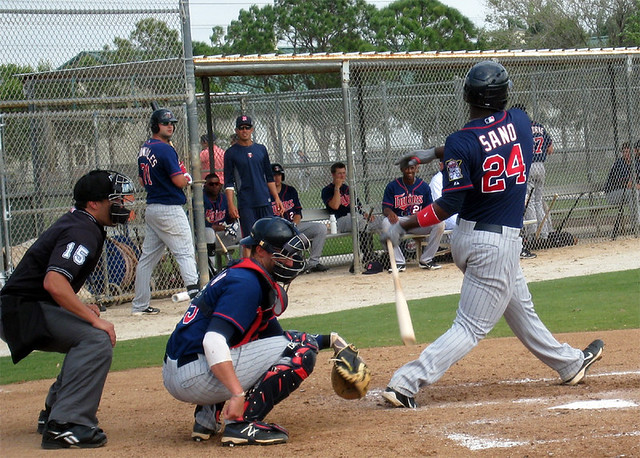
11/7/13

2013-2014 Off-season Calendar

It has been officially the Hot Stove season, or the off-season, and here is a list of important dates to keep in mind, including the annual award announcements that take place next week:

November 10
Outright waivers secured on or after September 1 expire at 5 p.m. ET

November 11
BBWAA Jackie Robinson Rookies of the Year
Last date for XX(B) players to accept qualifying offer from former club
New waiver period begins
Sporting News Executive of the Year named

November 11-13
GM and Owners Meetings, Orlando, FL.

November 12
BBWAA Managers of the Year

November 13
BBWAA Cy Young Awards

November 14
BBWAA Most Valuable Player Awards

November 18
Last date to ask outright waivers on an injured player

November 20
Last date to outright an injured player to the Minor Leagues
Reserve lists for all Major and Minor League levels filed

December 2
Tender deadline for arbitration-eligible players

December 5
Last date to request outright waivers to assign player prior to Rule 5 Draft

December 9
Last date to outright a player prior to Rule 5 Draft

December 9-12
Winter Meetings (Orlando, FL)
GIBBY (Greatness in Baseball Yearly) Awards

December 12
Rule 5 Draft

March 22-23
Opening Series in Sydney, Australia: Dodgers vs. Diamondbacks

January 14 
Salary arbitration filing.

January 17
Salary arbitration figures exchanged.

February 1-21 
Salary arbitration hearings - St. Petersburg, Florida.

February 13 
Voluntary reporting date for pitchers, catchers and injured players.

February 18 
Voluntary reporting date for other players.

February 25 
Mandatory reporting date.

March 12 
Last day to place a player on unconditional release waivers and pay thirty
days termination pay instead of forty-five days.

March 22-23 
Los Angeles Dodgers versus Arizona Diamondbacks - Sydney, Australia.

March 26 
Last day to request unconditional release waivers on a player without
having to pay the full salary for the 2014 season.

March 30
Opening Night

March 31
Opening Day


11/6/13

Naming names: The three starting pitchers the Minnesota Twins should sign in free agency

It is not a secret, that the biggest problem the Minnesota Twins had in the past few woeful season, as far as players are concerned, is the lack of a reliable rotation.   While a lot of fans are looking at 2015 or 2016 as the potential contenting point for the Twins, when Miguel Sano and Byron Buxton "come to age", the dirty secret is that there are not (other than Alex Meyer and potentially Kyle Gibson above A level) any sure bets for top of the rotation pitchers in the system, which, almost certainly would guarantee mediocrity at best for the middle of this decade.

This off-season the Twins have an opportunity to remediate this via free agency and, in addition to 2015 and beyond, be competitive in 2014.  In order to do so, the Twins would need to sign at least 3 pitchers better than Kevin Correia who can be a place holder for Alex Meyer, in his last contract year and with Kyle Gibson would be the 2 remaining parts of the Twins' rotation in 2014.   Who should those three new pitchers be?   What would it take to sign them?    Remember, we are not looking only for 2014, but we are looking beyond.  And we are looking for numbers one, two and three in the Twins' rotation, allowing Gibson to be number four and Correia number five, which would result in a competitive rotation.   Potentially one of these positions could come internally:  Alex Meyer might be one out of Spring Training;  I have not given up on Vance Worley because of an awful injury, out-of-shapeness and bad luck (BABIP) induced, age 25 season;  and nobody knows whether Samuel Deduno might take the next step.

What characteristics those free agents should have?

If you look at the measurable characteristics the top pitchers have, two jump out right away, and these 2 happen to be the exact ones the Twins' rotation has been lacking:

a. Hard throwing.   Average Fastball velocity in MLB is 92 mph, including relievers
b. Missing bats.   Average K/9 is around 7 in the majors, so we are looking for top of the rotation players with K/9 above 8.

Only 3 Minnesota Twins starting pitchers, both left-handed, since PitchF/X was introduced allowing the measurement of pitch velocities, satisfied that criteria:  Johan Santana (2004, 2005, 2006) and  Fransisco Liriano (2005, 2006, 2010).


And because of the long-term vision (we are looking for players who can get 3+1 or 4+1 contacts and would be with the team for the biggest part of the decade when Sano and Buxton come to age) the Twins need to look at pitchers who would at mostly be 31 years old in 2014, so they do not pay for a pitcher's declining seasons.   One can argue that an older pitcher can be signed in an one or two year contract as a place holder for someone like Kohl Steward, which is a valid argument, but at this point it does not guarantee competitiveness, since Kohl Steward is not a sure bet now.

Here are the 3 criteria (all measurable) the Twins should look for in a free agent:

a. Average FB velocity >= 92 mph
b. K/9 >= 8
c. Age in 2014 season =< 31

Here is a list of all 2014 free agent starting pitchers, from MLB trade rumors, alphabetically and with 2014 season ages in parenthesis:

Alfredo Aceves (31)
Bronson Arroyo (37)
Scott Baker (32)
Erik Bedard (35)
Travis Blackley (31)
A.J. Burnett (37)
Chris Capuano (35)
Chris Carpenter (39)
Bruce Chen (37)
Bartolo Colon (41)
Scott Feldman (30)
Gavin Floyd (31)
Jeff Francis (33)
Freddy Garcia (37)
Jon Garland (34)
Matt Garza (30)
Chad Gaudin (31)
Roy Halladay (37)
Jason Hammel (31)
Aaron Harang (36)
Dan Haren (33)
Roberto Hernandez (33)
Tim Hudson (38)
Phil Hughes (28)
Ubaldo Jimenez (30)
Josh Johnson (30)
Jair Jurrjens (28)
Jeff Karstens (31)
Scott Kazmir (30)
Hiroki Kuroda (39)
John Lannan (29)
Wade LeBlanc (29)
Jon Lester (30)
Colby Lewis (34)
Ted Lilly (38)
Paul Maholm (32)
Shaun Marcum (32)
Jason Marquis (35)
Daisuke Matsuzaka (33)
James McDonald (29)
Randy Messenger (32)
Ricky Nolasco (31)
Sean O'Sullivan (26)
Roy Oswalt (35)
Mike Pelfrey (30)
Greg Reynolds (28)
Clayton Richard (30)
Ervin Santana (31)
Johan Santana (34)
Joe Saunders (33)
Kevin Slowey (30)
Masahiro Tanaka (25)
Jason Vargas (31)
Ryan Vogelsong (36)

Trimming the list by age, and listing K/9 and average FB velocity for both 2012 and 2013, disqualifying pitchers who (because we are looking mostly for "sure bets".  Reclamation projects and bargains could fit for one of these positions, but are out of scope for this exercise.)  :

a. pitched less than 50 innings due to injury in 2013
b. pitched mostly in the pen in 2013
c. pitched mostly in minor or foreign leagues in 2013 

we have this list (with K/9 and FB velocity fitting the criteria indicated in green, if fit complete or in yellow if fit when rounded up to no decimals) :


The "A" list (at least two pitchers should be from this list) :

Matt Garza, RHP, 30.  Difficult to see a Garza reunion with Ron Gardenhire and Rick Anderson still on the Twins' staff.  Documented personality conflicts when with the Twins

Ubaldo Jimenez, RHP, 30. Received a qualifying offer, which means the Twins will have to surrender their second round pick to sign him.  Price will be high because of monster second half.

Josh Johnson, RHP, 30.  No qualifying offers.  Health and performance consideration (if one looks at W-L and ERA; but solid xFIP and peripherals) will drop the price

Scott Kazmir, LHP, 30.  The only lefty in the list.  No qualifying offer.  Great year suggests that recovered from injury nicely

Edinson Volquez, RHP, 30 .  No qualifying offer.  Very quietly made it to the list.  A sleeper, potentially low cost signing


The "B" list (potentially one pitcher should be from this list, but there are questions) :

Phil Hughes (28)  He is intriguing; close with the K/9.  Still in early prime.  Can be the one from this group to target

Jon Lester (30) Will likely stay with the Red Sox.  Expensive.  Lots of people think of him as an "A list" pitcher but is not.

Mike Pelfrey (30)  Interesting to see him in the list, but his K/9 is not in the ball park.  Can he get his K/9 up?  Great fit in the Twins' club house.  Should the Twins take another flier with Pelfrey another year away from TJ surgery?

 Ervin Santana (31) Expensive.  Lots of people think of him as an "A list" pitcher but is not.   Received a qualifying offer. Stay away for the money.  More expensive that all the pitchers in the A list, other than Jimenez.


The rest:

Gaudin was a reliever in 2012 when he met the criteria.  Nolasco and Vargas are thought to belong in the "A list" potentially.  They do not.

Who are the three starting pitchers the Minnesota Twins should sign in 2013, in order to be competitive in 2014 and beyond?  They are:

Josh Johnson
Scott Kazmir
Edinson Volquez

Can they sign all three?  The short answer is "yes", but I will examine the Twins' budget in another post...


9/29/13

Ron Gardenhire video countdown: 0

Ron Gardenhire's contract with the Minnesota Twins runs out, and this ends the video count down in celebration of the Manager of the Millennium's past with the Twins. He managed the Twins to consecutive 99, 96 and 96 loss seasons, and it is clear a change is needed for this team to be competitive again. To this effect:

Day 0: He Gone


Ron Gardenhire video countdown: 1

One game left until manager Ron Gardenhire's contract with the Minnesota Twins runs out, and in celebration of the Manager of the Millennium's past with the Twins, I will be counting down the days with videos from his time with the Twins.


Day 1: That's what our organization is all about & we are proud the way we do things & I don't understand a word he's saying:


9/28/13

Ron Gardenhire video countdown: 2

Two days left until manager Ron Gardenhire's contract with the Minnesota Twins runs out, and in celebration of the Manager of the Millennium's past with the Twins, I will be counting down the days with videos from his time with the Twins.

Day 2: How far is all the way?


9/27/13

Ron Gardenhire video countdown: 3


Three days left until manager Ron Gardenhire's contract with the Minnesota Twins runs out, and in celebration of the Manager of the Millenium's past with the Twins, I will be counting down the days with videos from his time with the Twins.


Day 3: That's the last time I'll let you pinch hit:


9/26/13

Ron Gardenhire video countdown: 4

Four days left until manager Ron Gardenhire's contract with the Minnesota Twins runs out, and in celebration of the Manager of the Millenium's past with the Twins, I will be counting down the days with videos from his time with the Twins.

Day 4: That's the way it's got to work, I don't care what the Yankees do:


9/25/13

Ron Gardenhire video countdown: 5

Five days left until manager Ron Gardenhire's contract with the Minnesota Twins runs out, and in celebration of the Manager of the Millenium's past with the Twins, I will be counting down the days with videos from his time with the Twins.

Day 5: Barrel of fun:


9/24/13

Ron Gardenhire video countdown: 6


Six days left until manager Ron Gardenhire's contract with the Minnesota Twins runs out, and in celebration of the Manager of the Millenium's past with the Twins, I will be counting down the days with videos from his time with the Twins.

Day 6: We signed a nice kid from Japan, Nishi, he looks like a really good one:


9/23/13

Ron Gardenhire video countdown: 7

Seven days left until manager Ron Gardenhire's contract with the Minnesota Twins runs out, and in celebration of the Manager of the Millenium's past with the Twins, I will be counting down the days with videos from his time with the Twins.

Day 7: Ciao Venezuela, we'll see you in the World Series:


9/22/13

Ron Gardenhire video countdown: 8

Eight days left until manager Ron Gardenhire's contract with the Minnesota Twins runs out, and in celebration of the Manager of the Millenium's past with the Twins, I will be counting down the days with videos from his time with the Twins.

Day 8; Out of the mouth of babies and infants:
(and I am not sure how this clip did not become viral; maybe it will now)


9/21/13

Ron Gardenhire Video Countdown: 9

Nine days left until manager Ron Gardenhire's contract with the Minnesota Twins runs out, and in celebration of the Manager of the Millenium's past with the Twins, I will be counting down the days with videos from his time with the Twins.

Day 9;  Run, don't walk:


8/27/13

I can't drive 55: The Twins' fireballers

One of the eyeballing observations of the 2012 2013 Minnesota Twins, is that, well, their pitchers do not throw that hard, compared to the other teams.  Putting this theory to test, here are the average fastball velocities of the Twins' pitchers this season (data from fangraphs):

Relievers:

Glen Perkins  94.8                   
Michael Tonkin 94.5    
Ryan Pressly  93.2
Brian Duensing  92.2
Jared Burton  92.0
Anthony Swarzak 91.9
Josh Roenicke  91.4   
Casey Fien  90.6
Caleb Thielbar 89.5

Starters:

Mike Pelfrey 92.2
Kyle Gibson 92.1       
Kevin Correia 90.4   
Samuel Deduno 90.3  
Liam Hendriks 90.0       
Vance Worley 89.5    
P.J. Walters 89.4  
Scott Diamond 88.4    
Pedro Hernandez 88.4          
Andrew Albers 85.

How do those compare with the rest of the pitchers in the majors?

Here are some rankings:

Glen Perkins: 64th
Michael Tonkin: 84th
Ryan Pressly: 166th
Brian Duensing: 256th
Mike Pelfrey: 257th
Kyle Gibson: 265th

And these are the guys above the MLB mean

So we have: 

- A "proven closer"
- A rookie reliever who has appeared in a couple of games (or three)
- Another rookie reliever who has appeared sparingly because he is a rule 5 guy, thus "not proven"
- A lefty set up guy who is so underrated and unappreciated that the Twins'  manager and pitching coached practically replace him with the softest tossing reliever in the team
- Two starters both of whom had Tommy John surgery, one of whom is a free agent and has made the fastest TJ recovery on the record, and the other one just had a cup of coffee in the major league club this season.

Any questions about why the Twins' pitching is a mess?


8/13/13

Offensive performance, wRC+ and #PowerBananas: why Miguel Sano is the best prospect in the game

The art of evaluating performance inside a baseball diamond has undoubtedly changed the last few years with the infusion of science (math & statistic notations.)   In the "good old days" if someone "hit 300", with more than 30 home runs and either more than 100 runs scored or 100 "ribies", he had a great season.  That was the measuring stick that separated great from very good.  And it still does, mainly on the mainstream press, game broadcasts and talk radio.  The expressions "he hits two seventy five" and "he cannot hit his weight" will be there as performance measures, albeit as crude as an Amish scooter is for propelling devise when compared to a Tesla .  Still, even that is light years ahead than the Fred Flintstone mobile of a hitter's performance evaluation, the "eyeballing" method, which introduces measures such as "the special sound a ball makes when leaves the bat" or "the quickness of someone's wrists" or the way "someone is flying on the bases" or something.

There has been evolution.  OPS  as a concept was introduced in 1984, and then was refined to OPS+ or adjusted OPS, that normalizes for park and league effects, plus adds an easy to compare baseline of 100 that is the league average that season, for an easy reference.   So an OPS+ higher than 100 is better than average and less than 100 worse.  Much improved from "ribies" and other cumulative stats, but still one dimensional Gremlin-like.  What OPS lacks, is that it disregards the ability of someone to sacrifice runs, steal bases, score runs, avoid hitting into double plays, and all the other goodies that are happening in real life baseball with the bat or at the bases.

A year after OPS was created, in 1985, Bill James introduced a measure for offensive performance he called Runs Created . This concept has been improved (see previous reference) constantly to account for things like stolen bases and sacrifices.  Tom Tango, eventually improved the concept or Runs Created and morphed it into weighted Runs Created or wRC.  wRC is a good way of looking at someones performance, but (like RC) it is cumulative; think Runs, HRs and RBIs.  This is fine for evaluating a season (like who had the best season in an MVP type of consideration) or whether someone's career is HOF worthy (both cummulative questions; for the record I do prefer WAR over wRC to answer those, since it includes fielding, among other reasons); however it does not answer the question of who performed the best for the time he was on the field (and maybe play him more, or call him "up", if necessary.)  

So we moved from a Gremin to a 'cuda (Yes, I like 'cudas too, especially the Hemi version, but they are not without faults)  Enter wRC+ to the equation.  wRC+ is a lot like OPS+.  It is based on wRC (runs created with the bat and on the bases, independent of league and park,) but it normalized to 100 (denoting league average, like OPS+,) and furthermore it is a rate metric (think UZR/120 vs UZR) so you can look at chunks of performance, moving plate appearance variations (sample size) aside.    A good writeup in basic terms about wRC+ is found here:   This interesting article from Denver Post (an enlightened mainstream newspaper), uses wRC+ to argue the greatness of Carlos Gonzalez.

Here is a real life field test of the effectiveness of cumulative measures like wRC (and WAR) compared to rate stats, like wRC+.  Work with me: Let's rewind to the Twins' last good season (2010) and ask the question: who was the best Twins' player on the field (for the time he played, assuming that it was significant; I like the 200 PA mark as a cut-off point) and try to find an objective quantitative measure to support your argument.  "Ribies" and ball sounds and the like are not allowed.

Here are the top 6 in wRC, a cumulative measure, with Plate Appearances (and OPS for reference) in parenthesis, in descending order.

Joe Mauer 93 (584, .871)
Delmon Young 87 (613, .826)
Michael Cuddyer 82 (675, .753)
Justin Morneau 75 (348, 1.055)
Denard Span 73 (705, .679)
Jim Thome 71 (340, 1.039)

So basically, the cummulative stat, because of the disparity of sample size favors an average player (Cuddyer) and a below average player (Span) because they had twice as many PAs as Morneau and Thome; the "longevity" effect in HOF discussions. 

Let's look at the best wRC+ with a 200 PA minimum (to filter players like Luke Hughes and Carl Pavano who make the list but had less than 10 PAs) :

Justin Morneau 184
Jim Thome 178
Joe Mauer 136
Delmon Young 120
(Danny Valencia 118)
Michael Cuddyer 104
.
.
.
(4 players)
Denard Span 88

This is what wRC+ does.  And this was the season that every single Twins' fan was saying what that season would have been, "if" Morneau did not hit his head.  I hope this little example illustrates the value of wRC+ vs things like wRC and WAR.

After the long but necessary introduction, back to the original subject, Miquel Sano.  If trying to find objective measures that evaluate performance on the field is difficult, finding objective quantitative measures that can estimate future performance, used to discuss who is the best prospect or to create prospect "lists" is borderline impossible (like trying to create a vehicle that is using air for fuel and emits water for exhaust.)  But we can dream and play.   Earlier this year, during the off-season, I looked at potential future performance of the starting pitchers in the Twins' organization using objective quantitative measures.  I will repeat the exercise this coming off-season looking at the position players and the whole slew of pitchers and not only starters.   I will be using wRC+ as the basis of that endeavor, based on the discussion above.  In addition, age and level of play will also be major factors. But for this piece here, before it turns into War and Peace, let's focus on Miguel Sano's performance this season in a quantitative way and putting it in perspective:

Miguel Sano in 243 PAs in A+ (average league age for hitters is 23) at age 20  had a 201 wRC+.  In 190 PAs in AA(average league age for hitters is 24.5) at age 20  he is having a 158 wRC+.   His AA numbers are in flex and we can discuss more after the season is over, but his A+ number are final.  To put that 201 wRC+ in perspective:

- It is the highest in the minors this season (second highest is Chris Colabello with 197 in Rochester, who is well in his prime and older than the average AAA player)
- It has been achieved by only 5 major leaguers in the past 30 years  (mininum 200 PAs): Miguel Cabrera,  Barry Bonds, Mark McGwire, Jeff Bagwell, Frank Thomas; and Cabrera's is this season, so it is not final.

For the fun of it, and the perspective of Sano's dominance, here is a list of all the MLB leaders in wRC+ (and some close to the leaders) with career highs indicated for the last 30 seasons:


2013: Miguel Cabrera, 210, in progress
2012: Mike Trout & Miguel Cabrera tied,  166
2011: Jose Bautista, 180 (career high)
2010: Josh Hamilton, 175 (career high)
2009: Albert Pujols, 180 ; Joe Mauer, 170 (career high)
2008: Albert Pujols, 184 (career high)
2007: David Ortiz & Alex Rodriguez tied, 175 (career high for both)
2006: Travis Hafner, 176 (career high)
2005: Alex Rodriguez, 174
2004: Barry Bonds, 233 (Todd Helton, 166, career high)
2003: Barry Bonds, 212 (Albert Pujols, 184)
2002: Barry Bonds, 244 (Jim Thome 189, Manny Ramirez 185); all three career high
2001: Barry Bonds, 235 (Jason Giambi 193, Sammy Sosa 186; career high for both);
2000: Manny Ramirez, 181
1999: Manny Ramirez, 172 (Mark McGwire, 168)
1998: Mark McGwire, 205 (career high)
1997: Mike Piazza, 183, career high (Frank Thomas, 179, Larry Walker 177, career high)
1996: Mark McGwire, 190 (Garry Sheffield 185, career high)
1995: Edgar Martinez, 182 (career high)
1994: Frank Thomas & Jeff Bagwell, 205 (Albert Belle 186); all three career high
1993: Barry Bonds, 193
1992: Barry Bonds, 198
1991: Frank Thomas, 179 (Chili Davis, 139)
1990: Rickey Henderson, 190 (career high)
1989: Kevin Mitchell, 184 (career high)
1988: Jose Canseco, 169 (career high)
1987: Jack Clark 176, Wade Boggs 171; both career high (Kent Hrbek, 134)
1986: Don Mattingly 160 (career high)
1985: Pedro Guerrero 181 (George Brett 168); both career high
1984: Mike Schmidt 154 (career high)
1983: Wade Boggs 155

And here are the wRC+ career highs and career averages for selected Twins' hitters

Harmon Killebrew, high: 176, 1967; career average: 142
Tony Oliva, high: 154, 1971; career average: 129
Rod Carew, high: 175, 1977; career average: 132
Kent Hrbek: high: 146, 1988 career average: 126
Kirby Puckett: high: 150, 1988 career average: 122
Dave Winfield: high: 161, 1975; career average: 128
Paul Molitor: high: 145 1991; career average: 122
Joe Mauer: high: 170, 2009; career average: 133
Justin Morneau: high: 184, 2010; career average: 118

Sano's career worst wRC+ is 146 last season in Beloit.  As you can see, his wRC+ numbers this season, in combination with his age, his level of play and the average age in that level, are totally out of the stratosphere. 

How about Byron Buxton?   Buxton is only 7 months younger than Sano, and has been playing at a full level below Sano.  So the age/level combination is very similar (but still on Sano's favor).

Here are Buxton numbers:  in 321 PAs in A (average league age for hitters is 21.5) at age 19  had a 173 wRC+.  In 174 PAs in A+ at age 19 (average league age for hitters is 23) he is having a 129 wRC+.   For comparison's sake, the Angels' Mike Trout, at the same age (19), at the same league (Midwest), at the same team (Cedar Rapids) had an identical 173 wRC+.   Objectively, Byron Buxton, looks like he is the prospect Mike Trout was and had a great season in Cedar Rapids (and this is great news for the Twins), but Sano had a monumental season in Fort Meyers.  Better than Morneau's 2010 with the Twins.  I just cannot see how objectively anyone can justify ranking Buxton higher than Sano, or not rank Sano as the number one prospect in baseball this season; unless it is the sound the ball makes when it meets his bat (or something)

Sano is poised to be a centerpiece in the majors for years to come.  Fans will enjoy seeing his #PowerBananas for a long while.  I just hope that they are all with him in a Twins' uniform...


8/8/13

Is Twins' General Manager Terry Ryan preparing the ground for a second retirement and a successor after this season?

After a third 90-plus loss season, it seems that the Minnesota Twins will need to make some changes.  Terry Ryan, the current General Manager (who had the "interim" label removed in the beginning of the season) in plenty of occasions has been on the record defending the team's manager, Ron Gardenhire, placing the blame for the incompetence on the field on himself.

But is he ready to be accountable and step down?  Who might be the successor, if so?

There are signs that this might be the case and very recently an individual in the Twins' front office has been interacting with the press, giving daily updates in a pace that he has never done before.  More and more and more (and these are just three examples from the past couple of days,) Rob Anthony, assistant general manager, whose main job has been contract negotiations, is appearing front and center giving organizational updates suited to a GM position.

Will he assume the role of the Minnesota Twins General Manager this off-season?  Very difficult to tell, but the writing on the wall is starting to appear.  It will be an interesting situation for the Minnesota Twins' fans and the press to follow this late Summer into Fall...


8/6/13

Andrew Albers pitching videos

Just a couple, about 2:30 total from last season with the New Britain Rock Cats.  Not many Twins fans have seen him pitch, so here it is:

Number one:


Number Two:


And a bonus oldie from his Kentucky days: