
In the last six months, the American nation living rooms heard of Joe the plumber and Joe six-pack, who were introduced as iconic images during the 2008 U.S. Presidential campaign, carrying the hope of victory on their shoulders for the candidates who iconized them. This season, a lot of the hopes of victory for the Twins’ nation will be carried by the backs, arms and shoulders of three Joes: Joe Mauer, Joe Nathan and the newest Joe, Joe Crede.
A potential cause for concern is the possibility that these backs and shoulders might not be ready to bear the weight of everyday play by opening day and through out the season: Joe Crede comes into the season after back to back back surgeries. Joe Mauer had kidney surgery during the off-season and his back is still sore enough not to allow him to take the field so far this spring. Joe Nathan was scratched from the U.S. World Baseball Classic team, because of discomfort in his right (throwing) shoulder (AC) joint.
Even though Joe Nathan’s injury might be the least serious of the three (there are recent reports that he threw 25 pitches Thursday with no pain), he is the oldest of the 3 and the most likely to decline. Hopefully that will not happen before he finishes his contract with the Twins.
I have discussed Joe Crede’s back situation ad noseum here. So far this spring there has not been a single report of pain or discomfort in his back either batting or playing on the field. He did make a diving play this week and Gardenhire promptly reported that he felt no pain. On the other hand, his bat (other than a double against Puerto Rico, in an exhibition game) has been fairly silent. Lets hope that this is just a timing issue and not the silence of the Lamb.
Joe Mauer’s situation has been a bit more worrisome (at least to me), mainly because the reports seem to be a bit “template-based”. He had surgery to repair a kidney constriction that he had all his life. That much we know. To do that, a surgeon goes threw ones back or abdomen, cuts through muscle and takes care of the kidney. The kidney is not an issue with Mauer’s ability to play (if corrected and healed), the muscle healing is. All it was reported was that “Mauer is looking to be 100% by opening day” and (a couple days ago) “Mauer had a small setback”. I really do not like that “setback” noun, because it is non-specific. Yes, the HIPAA (Health Insurance Portability and Accountability Act) applies to Joe Mauer as much as it to Joe Schmoe, but I am sure that fans are questioning (at least this one is) the nature of the “setback”. Was it something kidney-related (blood in the potty; sorry if this is too graphic) or was it something muscle-related? I have been trying to get information left and right these days about the nature of Mauer’s baseball-related ailment and it is just not there. Here is a simple question: How exactly is Mauer unable to play? I assume that he has problems getting to the crouch position, since that puts stress into the couple of muscles affected by the procedure (regardless whether it was through the back or abdomen) I’ve never heard a single report on (or got answers to questions about) whether he can swing a bat off a tee (edit, there was one a few hours ago, but you got to dig deep. And yes he can swing off a tee, which is extremely good news). I just wish Joe the best and I hope that he is healthy soon.
The ’87 Twins had their killer Gs (Gladden, Gaetti, Gagne.) These ’09 Twins are poised to be the killer J’s even if the Joes are not 100%. In the 40-man roster there are:
3 Jasons, Kubel, Jones and Pridie
2 José’s, Mijares and Morales, and
1 Justin (who sometimes is mistaken for a Jason,) Morneau
This makes me confident.
This post has been brought to you by the letter J and the number 90, which is how many wins I project for the Minnesota Twins for the 2009 season (more on that next week)
3/5/09


Who is Tom Stuifbergen?
Tom Stuifberger, a member of the Twins' organization, was the starter of the Dutch National Team today against the Twins. He pitched 3 innings allowing only one run to score. He surrendered two hits, was called for a balk (who brought Mike Cuddyer, the only runner who scored off Stuifberger, to 3rd base, allowing Brock Peterson to drive him home with a sacrifice fly) and walked also two. He is a 6'4` and 240 lbs 20 year old right hander and was signed by the Twins as a free agent in 2006 after his excellent performance at the inaugural WBC with the Netherlands team. Stuifbergen played for the Amsterdam Pirates in Holland before signed by the Twins. He throws a fastball in the high 80s to low 90s, a changeup and a curveball. He spent 2007 with the GCL Twins where he was used as a reliever for 7 games pitching 12.1 innings and ending up with 2.19 ERA and 0.73 WHIP for the season, holding opponents to a .140 average. He was out in 2008 after undergoing surgery to remove bone spurs from his right shoulder,. Good to see him back.
Here is a video of Tom from 2007 with the GCL Twins pitching against the GCL Orioles
Here is a video of Tom from 2007 with the GCL Twins pitching against the GCL Orioles
3/4/09
Are the Twins serious about replacing Neshek?
Then they should try to make a deal for Shunsuke Watanabe... Here is one of his performances in a Japanese All Star game. He is 32 and he will be in the WBC again. (And this is not a serious post - the guy has a 75 mph fastball; but nothing much is going on these days)
3/3/09
Does spring training record matter?
The conventional wisdom is that spring training is a time to try new players, have a look at the organizational depth and get an idea who to call up if necessary during the season, and a time for the veterans to get in top shape by opening day. A team's spring training record should not matter, right? This excellent analysis by Michael Wolverton of the Baseball Prospectus and ESPN, looked at all spring training records vis-a-vis a team's record the following season and reached the conclusion that "there's very little relationship between spring training records and regular season records, in the short term or the long term, whether you look at all teams or just the extreme ones."
That is the conventional wisdom proven. Also, the conventional wisdom is that the one single statistic measurement that has the closest correlation with wins in baseball is run differential (RS-RA). However, these Gardenhire Twins, break that conventional wisdom, as I showed here. How about that spring training record conventional wisdom and these Gardenhire Twins?
Here is the Twins spring training record the last few years and their finish in the AL division the same season:
2008: ST record: 15-15; season division rank: 2nd
2007: ST record: 14-17; season division rank: 3rd
2006: ST record: 20-12; season division rank: 1st
2005: ST record: 15-14; season division rank: 3rd
2004: ST record: 20-14; season division rank: 1st
2003: ST record: 19-13; season division rank: 1st
2002: ST record: 18-15; season division rank: 1st
So, it looks like the score is: Gardy Twins: 2, Conventional wisdom: 0
Spring training record does matter for these Minnesota Twins.
as a matter of fact, the correlation coefficient between the Twins' spring training record and their record during the season following that spring training is .849.
Here is a graph of the Twins' spring training (ST) records and regular season (RS) records, since 2002 (and the respective finish in the division during the regular season):

On a totally unrelated subject, Seth Stohs of Sethspeaks.net and the author of the Minnesota Twins Prospect Handbook -2009 (the one and only book in its category) was more than kind to invite me to participate in his weekly podcast. You can here the podcast here. It was a spare of the moment, last minute thing and I was grossly unprepared, but it was fun. I hope to do that some time again.
That is the conventional wisdom proven. Also, the conventional wisdom is that the one single statistic measurement that has the closest correlation with wins in baseball is run differential (RS-RA). However, these Gardenhire Twins, break that conventional wisdom, as I showed here. How about that spring training record conventional wisdom and these Gardenhire Twins?
Here is the Twins spring training record the last few years and their finish in the AL division the same season:
2008: ST record: 15-15; season division rank: 2nd
2007: ST record: 14-17; season division rank: 3rd
2006: ST record: 20-12; season division rank: 1st
2005: ST record: 15-14; season division rank: 3rd
2004: ST record: 20-14; season division rank: 1st
2003: ST record: 19-13; season division rank: 1st
2002: ST record: 18-15; season division rank: 1st
So, it looks like the score is: Gardy Twins: 2, Conventional wisdom: 0
Spring training record does matter for these Minnesota Twins.
as a matter of fact, the correlation coefficient between the Twins' spring training record and their record during the season following that spring training is .849.
Here is a graph of the Twins' spring training (ST) records and regular season (RS) records, since 2002 (and the respective finish in the division during the regular season):
On a totally unrelated subject, Seth Stohs of Sethspeaks.net and the author of the Minnesota Twins Prospect Handbook -2009 (the one and only book in its category) was more than kind to invite me to participate in his weekly podcast. You can here the podcast here. It was a spare of the moment, last minute thing and I was grossly unprepared, but it was fun. I hope to do that some time again.
3/1/09
Spring training week 1 summary.
The first week of spring training passed and found the Twins within 2 runs of a perfect record. I will be giving weekly recaps of the cumulative performance of players in Spring training, focusing on the roster battles.
Here is the summary of week one:
Position Players:
Outfield Starter Battle:
Young .857/.857/1.000, 1 SB (7 AB)
Gomez .222/.300/.556, 1 HR, 1 BB (9 AB)
Cuddyer .167/.167/.167 (7 AB)
Span .111/.200/.111 1 BB (9 AB)
Spot on the Bench vs Rochester Battle:
Buscher .600/.600/1.100, 1 HR (10 AB)
Hughes .333/.333/.333 (6 AB)
Machado .200/.200/.200 1 SB (5 AB)
Tolbert .167/.231/.167 1 BB (12 AB)
Macri .000/.200/.000 1 BB (4 AB)
Plouffe .000/.000/.000 (5 AB)
Battle for Rochester vs. New Britain:
Valencia .800/.800/.800 (5 AB)
Martin .600/ .667 /.889 (5 AB)
Peterson .200/.429/.800 1 HR (GS) 5 AB
Other notable starter stats:
Kubel .500/.714/1.500/.500 1 HR, 3 BB (5 AB)
Morneau .429/.500/.714/ 1 BB (7 AB)
Position Player of week 1:
Delmon Young

Honorable mention: Brian Buscher, Jason Kubel, Danny Valencia, Dustin Martin
Pitchers:
Best Starter Performance:
Slowey ERA 0.00, WHIP 0.00, 0 BB, 1 K 2 IP
Blackburn ERA 0.00, WHIP 0.00, 0 BB, 0 K, 2 IP
Perkins ERA 0.00, WHIP 1.00, 0 BB, 3 K, 5 IP
Battle for set up man:
Crain 0.00 ERA, WHIP 0.00, 0 BB, 0 K, 2 IP
Ayala 0.00 ERA, WHIP 0.50, 0 BB, 0 K, 2 IP
Breslow 4.50 ERA, WHIP 1.00, 0 BB, 2 K, 2 IP
Guerrier 4.50 ERA, WHIP 1.50, 2 BB, 0 K, 2 IP
On the bubble; battle for the last 1-2 spots:
Dickey 0.00 ERA, WHIP 1.00, 1 BB, 3 K, 2 IP
Henn 0.00 ERA, WHIP 1.50, 1 BB, 0 K, 2 IP
Mijares 0.00 ERA, WHIP 1.50, 2 BB, 3 K, 2 IP
Jones 3.00 ERA, WHIP 2.00, 2 BB, 3 K, 3 IP
Goslin 0.00 ERA, WHIP 2.50, 2 BB, 1 K, 2 IP
Humber 18.00, WHIP 2.50, 0 BB, 0 K, 2 IP
pitcher of week 1, spring training:
Kevin Slowey

honorable mention: Nick Blackburn, Jesse Crain, Glen Perkins, R.A. Dickey
Here is the summary of week one:
Position Players:
Outfield Starter Battle:
Young .857/.857/1.000, 1 SB (7 AB)
Gomez .222/.300/.556, 1 HR, 1 BB (9 AB)
Cuddyer .167/.167/.167 (7 AB)
Span .111/.200/.111 1 BB (9 AB)
Spot on the Bench vs Rochester Battle:
Buscher .600/.600/1.100, 1 HR (10 AB)
Hughes .333/.333/.333 (6 AB)
Machado .200/.200/.200 1 SB (5 AB)
Tolbert .167/.231/.167 1 BB (12 AB)
Macri .000/.200/.000 1 BB (4 AB)
Plouffe .000/.000/.000 (5 AB)
Battle for Rochester vs. New Britain:
Valencia .800/.800/.800 (5 AB)
Martin .600/ .667 /.889 (5 AB)
Peterson .200/.429/.800 1 HR (GS) 5 AB
Other notable starter stats:
Kubel .500/.714/1.500/.500 1 HR, 3 BB (5 AB)
Morneau .429/.500/.714/ 1 BB (7 AB)
Position Player of week 1:
Delmon Young
Honorable mention: Brian Buscher, Jason Kubel, Danny Valencia, Dustin Martin
Pitchers:
Best Starter Performance:
Slowey ERA 0.00, WHIP 0.00, 0 BB, 1 K 2 IP
Blackburn ERA 0.00, WHIP 0.00, 0 BB, 0 K, 2 IP
Perkins ERA 0.00, WHIP 1.00, 0 BB, 3 K, 5 IP
Battle for set up man:
Crain 0.00 ERA, WHIP 0.00, 0 BB, 0 K, 2 IP
Ayala 0.00 ERA, WHIP 0.50, 0 BB, 0 K, 2 IP
Breslow 4.50 ERA, WHIP 1.00, 0 BB, 2 K, 2 IP
Guerrier 4.50 ERA, WHIP 1.50, 2 BB, 0 K, 2 IP
On the bubble; battle for the last 1-2 spots:
Dickey 0.00 ERA, WHIP 1.00, 1 BB, 3 K, 2 IP
Henn 0.00 ERA, WHIP 1.50, 1 BB, 0 K, 2 IP
Mijares 0.00 ERA, WHIP 1.50, 2 BB, 3 K, 2 IP
Jones 3.00 ERA, WHIP 2.00, 2 BB, 3 K, 3 IP
Goslin 0.00 ERA, WHIP 2.50, 2 BB, 1 K, 2 IP
Humber 18.00, WHIP 2.50, 0 BB, 0 K, 2 IP
pitcher of week 1, spring training:
Kevin Slowey
honorable mention: Nick Blackburn, Jesse Crain, Glen Perkins, R.A. Dickey
2/28/09
Who are Sean Henn and Bobby Keppel?
Here are profiles of the Twins' minor league free agent signees who finished the game against the Yankees tonight.
Sean Henn a left handed pitcher from Fort Worth Texas who will turn 29 this April, was drafted in 26th round of the 2000 amateur draft by the Yankees. Even though he was drafted very low, he climbed in the prospect charts of the organization listed as number 6 prospect in 2002 and number 10 in 2003, by Baseball America. Sean started 8 games as a 20 year old for the Staten Island Yankees of the New York/Penn (A) league in 2001, pitching 42 innings, striking out 49 and walking 15, finishing with 3 wins and a loss and producing a 3.00 ERA and 0.98 WHIP. That was his best season as a pro. His missed all of 2002 with elbow surgery and had nagging injuries through his career. In addition, he has only 2 pitches (2-seamer fastball and Slider) and his lack over a slow pitch turned him into a reliever in 2007 and resulted to his release and signing by the Padres mid-season 2008.
His career major league pitching line is: 4 seasons, 40 games, 5 GS, 2 wins, 6 loses, 66.7 IP, 52 BB, 47 K, 7.56 ERA, 2.04 WHIP
His career minor league pitching line is: 7 seasons, 125 games, 81 GS, 23 wins, 22 loses, 1 save, 490 IP, 194 BB, 392 K, 3.67 ERA, 1.34 WHIP
I am not really sure what Henn's future in the Twins' organization is; Scouts might like his 92 mph sinker (pretty fast and very rare for a lefty) but the lack of a change up and lack of control do not project very highly for Henn. He has an outside chance to make the Rochester roster as a reliever, but unless he surprises in Spring Training, chances are that he will not be in the Twins' organization past March.

(any resemblance to Shawn from VH1's Tool Academy -pictured below- is accidental)

Bobby Keppel, who will turn 27 next June and is from St. Louis, is a different story than Henn, but had a similar career once in the pros. He was drafted in the 1st round of the 2000 draft by the New York Mets and in Mets' fashion climbed quickly in the organization, making the AAA Norfolk Tides club of the International league in 2004, as a 22 year old. Keppel was ranked by Baseball America as the Mets' number 9th prospect in 2003 and number 6 in 2004. Unlike Henn, he is not a power lefty. He is a junk ball righty who relies on his control to get batters out. He has four pitches (85-91 mph 4-seam fastball, slider, curve and change up) that he mixes and matches. His best season in the minors came as a 19 year old with the Capital City Bombers of the South Atlantic (A) League in 2001, when he started 20 games and relieved in 6, pitching for 124 innings, giving 25 walks and striking out 87, winning six games (including a complete game) and losing 7. His ERA was 3.12 and WHIP 1.15. Even though, unlike Henn, Keppel has been pretty much injury free, his career did not amount to much. After the Mets did not protect him in 2005, he signed annual contracts with the Royals, Rockies and Marlins and ended up pitching at the AAA for each or those teams, which happen to have AAA teams competing in the Pacific Coast League (Omaha, Colorado Springs and Alberqueque). His best ERA the last 2 seasons was 5.48 (in 2007 with the Sky Box) and his best WHIP was 1.57 (in 2006 with the Omaha Royals). Unlike Henn, he remained a starter. Keppel had 2 cups of coffee in the majors, in 2006 with the Royals and 2007 with the Rockies; both were forgettable.
His career major league pitching line is: 2 seasons, 45 games, 6 GS, 0 wins, 4 loses, 38.3 IP, 18 BB, 21 K, 6.10 ERA, 1.80 WHIP
His career minor league pitching line is: 7 seasons, 185 games, 159 GS, 48 wins, 50 loses, 1 save, 940.7 IP, 285 BB, 543 K, 4.65 ERA, 1.42 WHIP
What does the future hold for Keppel in the Twins' organization? I think that potentially he could have a spot in Rochester (as a long reliever, spot starter), especially if R.A. Dickey makes the Twins and Jason Jones returns to the Yankees.

Sean Henn a left handed pitcher from Fort Worth Texas who will turn 29 this April, was drafted in 26th round of the 2000 amateur draft by the Yankees. Even though he was drafted very low, he climbed in the prospect charts of the organization listed as number 6 prospect in 2002 and number 10 in 2003, by Baseball America. Sean started 8 games as a 20 year old for the Staten Island Yankees of the New York/Penn (A) league in 2001, pitching 42 innings, striking out 49 and walking 15, finishing with 3 wins and a loss and producing a 3.00 ERA and 0.98 WHIP. That was his best season as a pro. His missed all of 2002 with elbow surgery and had nagging injuries through his career. In addition, he has only 2 pitches (2-seamer fastball and Slider) and his lack over a slow pitch turned him into a reliever in 2007 and resulted to his release and signing by the Padres mid-season 2008.
His career major league pitching line is: 4 seasons, 40 games, 5 GS, 2 wins, 6 loses, 66.7 IP, 52 BB, 47 K, 7.56 ERA, 2.04 WHIP
His career minor league pitching line is: 7 seasons, 125 games, 81 GS, 23 wins, 22 loses, 1 save, 490 IP, 194 BB, 392 K, 3.67 ERA, 1.34 WHIP
I am not really sure what Henn's future in the Twins' organization is; Scouts might like his 92 mph sinker (pretty fast and very rare for a lefty) but the lack of a change up and lack of control do not project very highly for Henn. He has an outside chance to make the Rochester roster as a reliever, but unless he surprises in Spring Training, chances are that he will not be in the Twins' organization past March.
(any resemblance to Shawn from VH1's Tool Academy -pictured below- is accidental)
Bobby Keppel, who will turn 27 next June and is from St. Louis, is a different story than Henn, but had a similar career once in the pros. He was drafted in the 1st round of the 2000 draft by the New York Mets and in Mets' fashion climbed quickly in the organization, making the AAA Norfolk Tides club of the International league in 2004, as a 22 year old. Keppel was ranked by Baseball America as the Mets' number 9th prospect in 2003 and number 6 in 2004. Unlike Henn, he is not a power lefty. He is a junk ball righty who relies on his control to get batters out. He has four pitches (85-91 mph 4-seam fastball, slider, curve and change up) that he mixes and matches. His best season in the minors came as a 19 year old with the Capital City Bombers of the South Atlantic (A) League in 2001, when he started 20 games and relieved in 6, pitching for 124 innings, giving 25 walks and striking out 87, winning six games (including a complete game) and losing 7. His ERA was 3.12 and WHIP 1.15. Even though, unlike Henn, Keppel has been pretty much injury free, his career did not amount to much. After the Mets did not protect him in 2005, he signed annual contracts with the Royals, Rockies and Marlins and ended up pitching at the AAA for each or those teams, which happen to have AAA teams competing in the Pacific Coast League (Omaha, Colorado Springs and Alberqueque). His best ERA the last 2 seasons was 5.48 (in 2007 with the Sky Box) and his best WHIP was 1.57 (in 2006 with the Omaha Royals). Unlike Henn, he remained a starter. Keppel had 2 cups of coffee in the majors, in 2006 with the Royals and 2007 with the Rockies; both were forgettable.
His career major league pitching line is: 2 seasons, 45 games, 6 GS, 0 wins, 4 loses, 38.3 IP, 18 BB, 21 K, 6.10 ERA, 1.80 WHIP
His career minor league pitching line is: 7 seasons, 185 games, 159 GS, 48 wins, 50 loses, 1 save, 940.7 IP, 285 BB, 543 K, 4.65 ERA, 1.42 WHIP
What does the future hold for Keppel in the Twins' organization? I think that potentially he could have a spot in Rochester (as a long reliever, spot starter), especially if R.A. Dickey makes the Twins and Jason Jones returns to the Yankees.
2/27/09
Who is Mike Gosling?
So who was that guy who closed the third Twins' Spring Training game today against the Yankees and earned a heart-attack save, courtesy Danny Valencia?
Mike Gosling is a 28 year old leftie, from Salt Lake City, UT who was originally drafted by the Twins in the 14th round of the 1998 draft; did not sign and decided to attend Stanford University, where he got a degree in Biology (Breslow anyone?) and drafted in the second round of 2001 by the Diamondbacks. In 2002 and 2003 he was ranked by Baseball America as the second highest prospect in the Dbacks system and in 2004 as the 10th. In 2003 he was ranked as the number 59 prospect in the nation by Baseball America. In his last season in Stanford he started 14 games and relieved in 3 additional, acquiring a 7-3 record to go along with a 3.95 ERA and a 1.13 WHIP. His best professional season was his first in El Paso of the Texas League (AA), when he started 27 games pitched 166.7 innings winning 14 and losing 5, while assembling a 3.13 ERA and 1.27 WHIP. The rest of his professional career went down hill. He was rushed to AAA in 2003 (which happened to be with Tuscon in the pitcher unfriendly Pacific Coast League) and bombed. He earned a couple of cups of coffee with Arizona and was placed on waivers in 2006 because he was out of options. Picked up by the Reds, spending time between Louisville (International League) and Cincinnati the next 2 seasons did not prove career rejuvenating for him. His best season in AAA was in 2006 with Louisville where he started 13 games for 78 innings assembling a 5-3 record with a 3.00 ERA and 1.21 WHIP. This earned him a promotion to the Reds' pen where he appeared in 23 games as a LOOGY, posting a 4.91 ERA and 2.12 WHIP. Not too good. Last year he was picked up by Toronto and spent the whole season as a set up man in Syracuse (International League) finishing 26 games and earning 7 saves to go with a 3.67 ERA and an unremarkable 1.46 WHIP. Control is not his thing. He walked as many people as he struck out in parts of 4 major league seasons. He has a 86-87 mph 2-seamer, a 80 mph slider and a change.
His career major league pitching line is: 4 seasons, 43 games, 9 GS, 3 wins, 4 loses, 92 IP, 61 BB, 61 K, 4.79 ERA, 1.85 WHIP
His career minor league pitching line is: 7 seasons, 189 games, 126 GS, 46 wins, 37 loses, 7 saves, 788 IP, 299 BB, 576 K, 4.58 ERA, 1.52 WHIP
At this point, given the presence of Julianel in Rochester, I am not sure what Gosling's role could be with the Twins' organization, other than an occasional lefty in Rochester's pen, at best.
BTW, Mike Gosling has not relationship to this guy, as far as I know.
2/26/09
Twins and Money. Part 3: How do the Twins' get to $100-125 million player payroll
This is the last and the final segment in this series. In the first segment I examined whether the Twins' player payroll spending is out of line from that of the rest of the teams in the major leagues, compared to their revenue stream. The conclusion was that it was not. In the second segment, I examined whether the Twins are getting as much revenue from their market, based on their revenue and their market's personal income, introducing the term "market revenue capture" to reflect the ability of a team to extract revenue from its market, and the conclusion was that the Twins' revenue capture was below league average. In addition, looking at the revenue capture of two other division rivals (in smaller markets than the Twins), I concluded that if the Twins capture revenue at the rate of the Kansas City Royals and spend the league average on player payroll, they could afford a player payroll of $95.7 million and if the Twins capture revenue at the rate of the Cleveland Indians and spend the league average on player payroll, they could afford a player payroll of $127.3 million. Both of these scenarios would not only not cause any financial hardship to the Twins, but, it turn, it would allow them to increase their profits.
Usually companies pay management consultants a couple of cool million to have this kind of analysis, but consider this my present to Jim Pohlad for his inaugural season as the managing owner of the Twins, and I hope he puts that extra couple of million towards the payroll :)
This segment would deal with how the Twins can capture more market revenue.
As a reminder, the market revenue capture (i.e how much money goes to a major league team for every $10,000 made in its market) for an average league team is 7.80, for the Twins is 6.58, for the Royals 10.02 and for the Indians a league leading 13.30.
Here are how the Twins can pull this off (and there are well into their way, believe me):
The first 2 steps are easy:
a. Keep fielding a competitive team:
This might be a no-brainer, but here is the data (and lets look at the year 2010, which will be the year after which a lot of Twins' players are about to hit some serious paydays) :
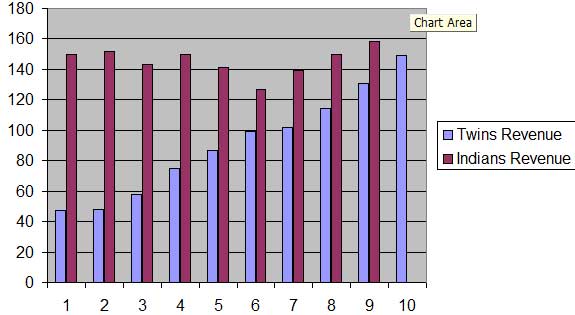
This graph compares the Twins' and Indians' (remember, they are kind of the holy grail keepers of revenue capture in the bigs) revenue in the last 10 years. Year 10 is 2008 (no data for the Indians). The numbers are from Forbes and you can find the Twins' numbers here and the Indian's here. As you can see, when the Twins became competitive, their revenue increased dramatically. A revenue that was flat in 1999 (the first year) and 2000 (year 2) increased dramatically every year, but 2005 (when the Twins were not competitive). The average increase in the years from 2003 on (I am leaving 2001 and 2002 off because the revenue jumped 20.1% and 29.3% respectively from the previous years; and this is an unsustainable pace because the Twins became from about to be contracted to division champions. I am also leaving 2005 off because they were not competitive.) was 14%. If they sustain this by being competitive and winning something, the 2009 revenue will be $161 million and the 2010 revenue will be $183.5 million. That would mean that at 2010, the Twins will jump ahead of Royals with a 10.59 revenue capture, which will allow them a $100.1 million player payroll without any hardship. It is that easy... they just have to say competitive.
b. Get the stadium going
This part is even easier than the first part, because the new stadium is well in its way. What would the revenue impact of a new stadium be? Here is a nice, technical article that looks at the impact of a new stadium in attendance and determined that in the first season, a new park could realize an attendance boost of 758,308 fans. Given that the average Twins' fan spends about $100 in the park (in the dome nevertheless), even if the number is closer to 500,000 more fans, we are looking at an additional $50 million of revenue for 2010, the first season of Target field. That would boost the above number of total potential revenue to $233.5 million, which will result to a 13.47 revenue capture (Indians territory), which would allow for a $127 million player payroll, without any hardship.
Here you have it. But this is not the whole story. There are a couple more things in play that need to be accounted for:
The economic situation. Believe it or not, this has already been accounted for. By using the 2007 data for the Twins' Market area income, to calculate revenue capture in 2009 and 2010, I assume that the Market area income will stay at 2007 levels the next 2 years (which, since income increased in 2008) is a very pessimistic scenario. But here is the biggie:
League Revenue. By ralizing more revenue and spending more in player salaries, the Twins will probably not have to pay a luxury tax, but some part of revenue sharing will decrease. How do they off-set that? Here is how (and not to underestimate the fact that the Twins will be having some money coming in from the naming rights to their stadium that hasn't been accounted here and could be worth up to $8 million a year for 25 years:
c. Expand the horizons
The Twins' need to think more than their Minnesota and Dakotas, "Twins' Territory" and try to capture more than those markets.
For starters one thing that 90% of the Twins' fans are not aware, is that the franchise is one of the original 8 1901 American league founding franchises. If the Boston Red Sox can embrace the Boston Americans' history, the Oakland Athletics, the Philadelphia Athletics' history, the Cleveland Indians the Cleveland Blues' history, the Twins should embrace the Washington Senator's history, forget about the bitter divorce of the Griffith's with the Capital City, once in a while wear throw back uniforms with W's on them and hang pictures of Walter Johnson, Goose Goslin, Sam Rice, Joe Cronin, Bucky Harris and Heinie Manush along those of Oliva, Kirby, Hrbek and Killebrew on the Target Field concourses or where their new monument park will be. Just think of the merchandise sales.
There are several states both in the upper Midwest and Northwest that are not covered by the Twins' radio and television programming, which are ripe for picking: Iowa, Nebraska, Wyoming, Montana, Utah, even parts of Wisconsin are ripe for picking. It will not take what Ted Turner did (creating a national station that televised for free all of his team's games), but the Twins can market the TV and Radio rights aggressively to stations in these markets that have no programming and whose residents would not mind listening to or watching a following a baseball team in the summer. Here is the current Twins' radio network map. Pretty limited. Also, why not target the areas of current minor league Twins' franchises?
The Twins got to build goodwill with the community. Last year the average attendance in the dome was 25000 people. That means that about 20000 tickets in every game remained unclaimed. A very simple solution will be to give away 50% of their unclaimed tickets to disadvantaged families and kids. Just give them away. Not only that would bring more people in the park to cheer the team and set the Twins as a great corporate citizen, but will bring in revenue (as in parking and concessions) to their coffers.
Their you got it. This is the plan for the Twins becoming a perennial contender with a $125+ million payroll, generating sufficient profit and paying back the community.
Eat your hearts out Yankees.
What do you think? Feel free to commend here or email me at thetenthinningstretch at gmail.com
Usually companies pay management consultants a couple of cool million to have this kind of analysis, but consider this my present to Jim Pohlad for his inaugural season as the managing owner of the Twins, and I hope he puts that extra couple of million towards the payroll :)
This segment would deal with how the Twins can capture more market revenue.
As a reminder, the market revenue capture (i.e how much money goes to a major league team for every $10,000 made in its market) for an average league team is 7.80, for the Twins is 6.58, for the Royals 10.02 and for the Indians a league leading 13.30.
Here are how the Twins can pull this off (and there are well into their way, believe me):
The first 2 steps are easy:
a. Keep fielding a competitive team:
This might be a no-brainer, but here is the data (and lets look at the year 2010, which will be the year after which a lot of Twins' players are about to hit some serious paydays) :
This graph compares the Twins' and Indians' (remember, they are kind of the holy grail keepers of revenue capture in the bigs) revenue in the last 10 years. Year 10 is 2008 (no data for the Indians). The numbers are from Forbes and you can find the Twins' numbers here and the Indian's here. As you can see, when the Twins became competitive, their revenue increased dramatically. A revenue that was flat in 1999 (the first year) and 2000 (year 2) increased dramatically every year, but 2005 (when the Twins were not competitive). The average increase in the years from 2003 on (I am leaving 2001 and 2002 off because the revenue jumped 20.1% and 29.3% respectively from the previous years; and this is an unsustainable pace because the Twins became from about to be contracted to division champions. I am also leaving 2005 off because they were not competitive.) was 14%. If they sustain this by being competitive and winning something, the 2009 revenue will be $161 million and the 2010 revenue will be $183.5 million. That would mean that at 2010, the Twins will jump ahead of Royals with a 10.59 revenue capture, which will allow them a $100.1 million player payroll without any hardship. It is that easy... they just have to say competitive.
b. Get the stadium going
This part is even easier than the first part, because the new stadium is well in its way. What would the revenue impact of a new stadium be? Here is a nice, technical article that looks at the impact of a new stadium in attendance and determined that in the first season, a new park could realize an attendance boost of 758,308 fans. Given that the average Twins' fan spends about $100 in the park (in the dome nevertheless), even if the number is closer to 500,000 more fans, we are looking at an additional $50 million of revenue for 2010, the first season of Target field. That would boost the above number of total potential revenue to $233.5 million, which will result to a 13.47 revenue capture (Indians territory), which would allow for a $127 million player payroll, without any hardship.
Here you have it. But this is not the whole story. There are a couple more things in play that need to be accounted for:
The economic situation. Believe it or not, this has already been accounted for. By using the 2007 data for the Twins' Market area income, to calculate revenue capture in 2009 and 2010, I assume that the Market area income will stay at 2007 levels the next 2 years (which, since income increased in 2008) is a very pessimistic scenario. But here is the biggie:
League Revenue. By ralizing more revenue and spending more in player salaries, the Twins will probably not have to pay a luxury tax, but some part of revenue sharing will decrease. How do they off-set that? Here is how (and not to underestimate the fact that the Twins will be having some money coming in from the naming rights to their stadium that hasn't been accounted here and could be worth up to $8 million a year for 25 years:
c. Expand the horizons
The Twins' need to think more than their Minnesota and Dakotas, "Twins' Territory" and try to capture more than those markets.
For starters one thing that 90% of the Twins' fans are not aware, is that the franchise is one of the original 8 1901 American league founding franchises. If the Boston Red Sox can embrace the Boston Americans' history, the Oakland Athletics, the Philadelphia Athletics' history, the Cleveland Indians the Cleveland Blues' history, the Twins should embrace the Washington Senator's history, forget about the bitter divorce of the Griffith's with the Capital City, once in a while wear throw back uniforms with W's on them and hang pictures of Walter Johnson, Goose Goslin, Sam Rice, Joe Cronin, Bucky Harris and Heinie Manush along those of Oliva, Kirby, Hrbek and Killebrew on the Target Field concourses or where their new monument park will be. Just think of the merchandise sales.
There are several states both in the upper Midwest and Northwest that are not covered by the Twins' radio and television programming, which are ripe for picking: Iowa, Nebraska, Wyoming, Montana, Utah, even parts of Wisconsin are ripe for picking. It will not take what Ted Turner did (creating a national station that televised for free all of his team's games), but the Twins can market the TV and Radio rights aggressively to stations in these markets that have no programming and whose residents would not mind listening to or watching a following a baseball team in the summer. Here is the current Twins' radio network map. Pretty limited. Also, why not target the areas of current minor league Twins' franchises?
The Twins got to build goodwill with the community. Last year the average attendance in the dome was 25000 people. That means that about 20000 tickets in every game remained unclaimed. A very simple solution will be to give away 50% of their unclaimed tickets to disadvantaged families and kids. Just give them away. Not only that would bring more people in the park to cheer the team and set the Twins as a great corporate citizen, but will bring in revenue (as in parking and concessions) to their coffers.
Their you got it. This is the plan for the Twins becoming a perennial contender with a $125+ million payroll, generating sufficient profit and paying back the community.
Eat your hearts out Yankees.
What do you think? Feel free to commend here or email me at thetenthinningstretch at gmail.com
2/25/09
In honor of Boof
A couple of arthroscopic labrum and rotator cuff tear repair shots
this is a partial labrum tear:

and arthroscopic repair of the labrum:

here is a torn rotator cuff:

and here a repaired rotator cuff:

That's what went on with Boof Bonser today. He is out for the season.
this is a partial labrum tear:
and arthroscopic repair of the labrum:
here is a torn rotator cuff:
and here a repaired rotator cuff:
That's what went on with Boof Bonser today. He is out for the season.
2/24/09
Twins and Money. Part 2: How high could the Twins payroll go?
Yesterday I examined the relationship of the Twins' player salary payroll to their income, and compared it with what other teams in the league are spending. The conclusion is that the Twins were slightly below league average last year (they will be about league average this year.) Also, in the process of doing this, it was shown that the Detroit Tigers and Chicago White Sox are spending an exuberant amount of their revenue towards players salary, which suggests that fire sales of sorts and periods of non-contention might be looming in the very near future of these clubs.
The Twins have a lot of good young players, several of whom are at the league minimum or close to it. In a few years the Twins might be faced with tough decisions about keeping some of these players. How far could the Twins' payroll stretch, so they will be able to pay and keep their young talent (when it makes sense). I am trying to answer this question today.
back to the spreadsheet:
again:
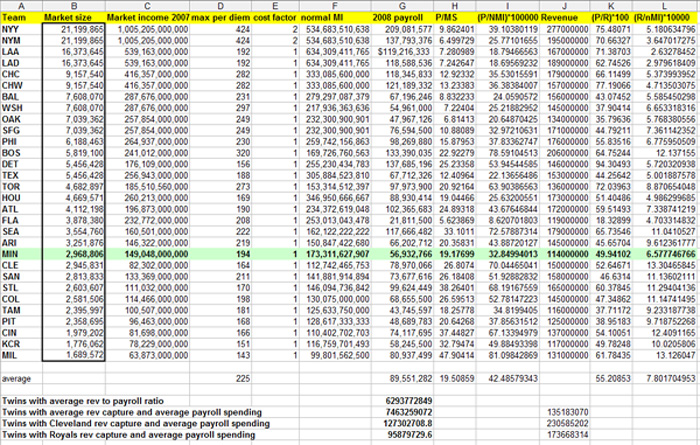
Column A is the teams, column B is the "market size" (data from here; I am not using this value for any calculations; it is there just for reference and the teams are ranked according to that. This is the number of people who live in those metropolitan areas. Column C is the total market's personal income (i.e. how much money all the people in the Twin Cities metropolitan area make). Column D is the maximum allowable per diem the US government allows for the different metropolitan areas. This is used as an indicator of cost of living in the MLB markets. Column E is the ratio of the cost of living in a single market to the average, based on per diems (for some reason excel displayed that in one significant figure, but the calculations were done correctly, as you can see). I call this the "cost factor". Column F is the normalized market income, which is the market income in column C divided by the cost factor in column E. This should be a representation of what the whole market area has to spent, if the living expenses were equal among all markets. Column G is the total player salary payroll in 2008 (all figures are in USD, btw). Ignore column H, I am not using it. Column I is the total payroll as a fraction of the total income in the market area (multiplied by 100000 so the numbers are easier to look at). This could be used as one way to compare spending among teams (but I am not doing it; it would really over-complicate things). Column J is each team's revenue in 2006, as indicated above. Column K is the percent revenue spent on player payroll. This is the measure that I am using to compare how much different teams are spending on players.
The last column (L) is the team revenue divided by the total market income and multiplied by 10,000 (so the numbers are prettier to look). I call this the "market revenue capture". If I were a bit smarter when I created the spreadsheet I would had multiplied by 50,000 to give a rough estimate of how much of an American's (or Canadian's) family income is spent as a revenue to their home MLB team (you can do this mental exercise at home. The numbers suggest that every family in the MLB metropolitan areas, contributes an average of about $39 a year to its local MLB team's revenues.) Here are all the MLB teams ranked by market revenue capture (in italics are teams in multi-team markets) :
Indians 13.30
Brewers 13.13
Reds 12.41
Red Sox 12.14
Cardinals 11.29
Rockies 11.15
Padres 11.13
Seattle 11.04
Royals 10.02
Diamondbacks 9.61
Pirates 9.72
Rays 9.23
Toronto 8.87
MLB AVERAGE 7.80
Giants 7.36
Braves 7.34
Phillies 6.77
Nationals 6.65
Athletics 5.76
Twins 6.58
Detroit 5.72
Orioles 5.59
Cubs 5.37
Yankees 5.18
Rangers 5.00
Astros 4.99
White Sox 4.71
Marlins 4.70
Mets 3.65
Dodgers 2.98
Angels 2.63
The bottom line is that the Twins do not capture as much revenue as they could from the Twin Cities market. They are capturing revenue at slightly higher rated than the teams that have to compete with other teams in their market and less than the average MLB team. This is not very good.
The projections, of how high the Twins payroll could be (without compromising or overtaxing the organization more than any other team in the market, which is a good business practice), are in the bottom of the spreadsheet:
If the Twins were spending in player salaries what the average team spends as a percentage of their revenue, they would spend $62.9 million (a number very close to their 2009 payroll)
If the Twins were capturing market revenue at the rate the average major league team captures market revenue and spend in player salaries what the average team spends as a percentage of their revenue, they could spend $74.6 million (a number very close to their 2007 payroll)
If the Twins were capturing market revenue at the rate the Kansas City Royals (a team much less successful on the field than the Twins) capture market revenue and spend in player salaries what the average team spends as a percentage of their revenue, they could spend $95.9 million
If the Twins were capturing market revenue at the rate the Cleveland Indians (the leader in revenue capture in the majors) capture market revenue and spend in player salaries what the average team spends as a percentage of their revenue, they could spend $127.3 million in player salaries, without any problem.
Clearly, those two last numbers would:
Too good to be true?
Nah, piece of cake. The next (and final) piece in this series will deal with how it can happen (and it does not really take much, just lessons learned, thinking outside the box and having fun)
Stay tuned...
(to be continued)
The Twins have a lot of good young players, several of whom are at the league minimum or close to it. In a few years the Twins might be faced with tough decisions about keeping some of these players. How far could the Twins' payroll stretch, so they will be able to pay and keep their young talent (when it makes sense). I am trying to answer this question today.
back to the spreadsheet:
again:
Column A is the teams, column B is the "market size" (data from here; I am not using this value for any calculations; it is there just for reference and the teams are ranked according to that. This is the number of people who live in those metropolitan areas. Column C is the total market's personal income (i.e. how much money all the people in the Twin Cities metropolitan area make). Column D is the maximum allowable per diem the US government allows for the different metropolitan areas. This is used as an indicator of cost of living in the MLB markets. Column E is the ratio of the cost of living in a single market to the average, based on per diems (for some reason excel displayed that in one significant figure, but the calculations were done correctly, as you can see). I call this the "cost factor". Column F is the normalized market income, which is the market income in column C divided by the cost factor in column E. This should be a representation of what the whole market area has to spent, if the living expenses were equal among all markets. Column G is the total player salary payroll in 2008 (all figures are in USD, btw). Ignore column H, I am not using it. Column I is the total payroll as a fraction of the total income in the market area (multiplied by 100000 so the numbers are easier to look at). This could be used as one way to compare spending among teams (but I am not doing it; it would really over-complicate things). Column J is each team's revenue in 2006, as indicated above. Column K is the percent revenue spent on player payroll. This is the measure that I am using to compare how much different teams are spending on players.
The last column (L) is the team revenue divided by the total market income and multiplied by 10,000 (so the numbers are prettier to look). I call this the "market revenue capture". If I were a bit smarter when I created the spreadsheet I would had multiplied by 50,000 to give a rough estimate of how much of an American's (or Canadian's) family income is spent as a revenue to their home MLB team (you can do this mental exercise at home. The numbers suggest that every family in the MLB metropolitan areas, contributes an average of about $39 a year to its local MLB team's revenues.) Here are all the MLB teams ranked by market revenue capture (in italics are teams in multi-team markets) :
Indians 13.30
Brewers 13.13
Reds 12.41
Red Sox 12.14
Cardinals 11.29
Rockies 11.15
Padres 11.13
Seattle 11.04
Royals 10.02
Diamondbacks 9.61
Pirates 9.72
Rays 9.23
Toronto 8.87
MLB AVERAGE 7.80
Giants 7.36
Braves 7.34
Phillies 6.77
Nationals 6.65
Athletics 5.76
Twins 6.58
Detroit 5.72
Orioles 5.59
Cubs 5.37
Yankees 5.18
Rangers 5.00
Astros 4.99
White Sox 4.71
Marlins 4.70
Mets 3.65
Dodgers 2.98
Angels 2.63
The bottom line is that the Twins do not capture as much revenue as they could from the Twin Cities market. They are capturing revenue at slightly higher rated than the teams that have to compete with other teams in their market and less than the average MLB team. This is not very good.
The projections, of how high the Twins payroll could be (without compromising or overtaxing the organization more than any other team in the market, which is a good business practice), are in the bottom of the spreadsheet:
If the Twins were spending in player salaries what the average team spends as a percentage of their revenue, they would spend $62.9 million (a number very close to their 2009 payroll)
If the Twins were capturing market revenue at the rate the average major league team captures market revenue and spend in player salaries what the average team spends as a percentage of their revenue, they could spend $74.6 million (a number very close to their 2007 payroll)
If the Twins were capturing market revenue at the rate the Kansas City Royals (a team much less successful on the field than the Twins) capture market revenue and spend in player salaries what the average team spends as a percentage of their revenue, they could spend $95.9 million
If the Twins were capturing market revenue at the rate the Cleveland Indians (the leader in revenue capture in the majors) capture market revenue and spend in player salaries what the average team spends as a percentage of their revenue, they could spend $127.3 million in player salaries, without any problem.
Clearly, those two last numbers would:
- Make every Twins' fan (who has not been following the team in its glory years when its payroll was on the higher echelons of the league) do silly uncontrolled gestures of happiness
- Have a strong basis for the team not to worry about picking and choosing who of its deserved players who are due for bigger contracts to keep and who to release (see: Ortiz, David)
- In combination with prudent spending (i.e. Do not do what Detroit does or what the Yankees do throwing away money at old underperforming players), could build a dynasty in the Twins Cities
Too good to be true?
Nah, piece of cake. The next (and final) piece in this series will deal with how it can happen (and it does not really take much, just lessons learned, thinking outside the box and having fun)
Stay tuned...
(to be continued)
2/23/09
Twins and Money. Part 1: Are the Twins "cheap"?
This is the first in 3 article series dealing with the overall subject of Twins and Money. In this first segment, I will be examining, whether the Twins are "cheaper" compared to the rest of the league, in the second segment I will be examining how high potentially the payroll could be stretched and in the last, how could the Twins get there. I know it is not baseball, like balls and strikes and homeruns and stolen bases, but it is essential for baseball.
The Twins' fans (or at least a sizable part of them) have the perception that the Twins (most accurately the Twins' ownership) are not willing to spend "what it takes". A google search with the keywords "cheap" and "Pohlad", returns 15500 pages (and in a lot of them several select adjectives and participles modify "cheap".) A lot of fans will never forget that Pohlad was willing to contract the team, including me. Also, a lot of fans, including me, are appreciative for the money that Pohlad spent compared to the Griffiths, which resulted in two World Championships for this team in 4 years. Letting bygones be bygones, here is what I did (and numbers for baseball are hard to find so everything is a very good approximation) :
I collected the following data:
here is what the data looks like:
For the purpose of this, please ignore everything underneath the main table; it will be discussed in the next article of the series.
Column A is the teams, column B is the "market size" (data from here; I am not using this value for any calculations; it is there just for reference. Column C is the total market's personal income as discussed above (i.e. how much money all the people in the Twin Cities metropolitan area make). Column D is the maximum allowable per diem the US government allows for the different metropolitan areas, as indicated above. This is used as an indicator of cost of living in the MLB markets. Column E is the ratio of the cost of living in a single market to the average, based on per diems (for some reason excel displayed that in one significant figure, but the calculations were done correctly, as you can see). I call this the "cost factor". Column F is the normalized market income, which is the market income in column C divided by the cost factor in column E. This should be a representation of what the whole market area has to spent, if the living expenses were equal among all markets. Column G is the total player salary payroll in 2008 (all figures are in USD, btw). Ignore column H, I am not using it. Column I is the total payroll as a fraction of the total income in the market area (multiplied by 100000 so the numbers are easier to look at). This could be used as one way to compare spending among teams (but I am not doing it, explanation on the next piece). Column J is each team's revenue in 2006, as indicated above. Column K is the percent revenue spent on player payroll. This is the measure that I am using to compare how much different teams are spending on players. I'll discuss the last column (L) in the next article, so ignore it for now.
Big Caveats as far as assumptions go (and yes they were done because of limitations, mainly lack of access to a supercomputer that could do regressions, but this is not supposed to be an academic paper ) :
An average team spends 55.21% of its revenue in player salaries.
The five biggest spenders:
Detroit 94.30
White Sox 77.19
Yankees 75.48
Dodgers 71.39
Mets 70.66
The five thriftier spenders:
Marlins 18.34
Oakland 35.80
Rays 37.71
Nationals 37.90
Pittsburgh 38.95
Team Average:
Philies 55.84, while the MLB average is 55.21
The Twins are spending 49.94 percent (using the 2008 payroll). This will get closer to league average for 2009, since a lot of teams decreased their payroll and the Twins increased theirs.
I would not call the Twins "cheap". That said, I strongly believe that the Twins are not capturing as much revenue as they can from the market and should have the opportunity to capture more, which in turn will allow them to pay more for players (and make more money) without any hardship.
One interesting piece of this data is that Detroit and the White Sox are overspending teams like the Yankees, the Dodgers and the Red Sox at this point. They are already cutting their payroll, but in the near future expect more cuts, especially in this economic climate. Their overspending cannot be sustained and I expect some years of fire sales and non-competing for both of them (this is good for the Twins)
The next part would be looking at market revenue capture and what the Twins could afford as a player salary payroll if they capture their market revenue at the level of some of their peer teams, and the last part will be looking at what would it actually take for the Twins to capture that revenue.
(to be continued...)
The Twins' fans (or at least a sizable part of them) have the perception that the Twins (most accurately the Twins' ownership) are not willing to spend "what it takes". A google search with the keywords "cheap" and "Pohlad", returns 15500 pages (and in a lot of them several select adjectives and participles modify "cheap".) A lot of fans will never forget that Pohlad was willing to contract the team, including me. Also, a lot of fans, including me, are appreciative for the money that Pohlad spent compared to the Griffiths, which resulted in two World Championships for this team in 4 years. Letting bygones be bygones, here is what I did (and numbers for baseball are hard to find so everything is a very good approximation) :
I collected the following data:
- Total Personal Income in the baseball marketplaces for 2008, from the Bureau of Economic Analysis, US Department of Commerce and from The City of Toronto (for 2006)
- To calculate the cost of living in each of those metropolitan areas and to normalize the personal income according the cost of living (the thought here is that if you make $75K a year and your mortgage costs $1000 a month in KC vs $2200 a month in NYC, you probably have more money to spent in baseball in KC), I used the per diem allowances of the US government for travel to different places for 2009
- The most recent revenues I could find (and these are kept in more secrecy than the Vatican Archives)were from a Forbes article for 2006
- Finally, I used 2008 payroll figures from Cot's Baseball Contracts
here is what the data looks like:
For the purpose of this, please ignore everything underneath the main table; it will be discussed in the next article of the series.
Column A is the teams, column B is the "market size" (data from here; I am not using this value for any calculations; it is there just for reference. Column C is the total market's personal income as discussed above (i.e. how much money all the people in the Twin Cities metropolitan area make). Column D is the maximum allowable per diem the US government allows for the different metropolitan areas, as indicated above. This is used as an indicator of cost of living in the MLB markets. Column E is the ratio of the cost of living in a single market to the average, based on per diems (for some reason excel displayed that in one significant figure, but the calculations were done correctly, as you can see). I call this the "cost factor". Column F is the normalized market income, which is the market income in column C divided by the cost factor in column E. This should be a representation of what the whole market area has to spent, if the living expenses were equal among all markets. Column G is the total player salary payroll in 2008 (all figures are in USD, btw). Ignore column H, I am not using it. Column I is the total payroll as a fraction of the total income in the market area (multiplied by 100000 so the numbers are easier to look at). This could be used as one way to compare spending among teams (but I am not doing it, explanation on the next piece). Column J is each team's revenue in 2006, as indicated above. Column K is the percent revenue spent on player payroll. This is the measure that I am using to compare how much different teams are spending on players. I'll discuss the last column (L) in the next article, so ignore it for now.
Big Caveats as far as assumptions go (and yes they were done because of limitations, mainly lack of access to a supercomputer that could do regressions, but this is not supposed to be an academic paper ) :
- I am using only the main markets here (i.e. a lot of North Dakota, South Dakota and Iowa residents attend Twins games, but only the Twins Cities metropolitan area is accounted
- In multi-team markets, I assume that the whole market is accessible to both teams equally
- In some markets (like Cincinnati), other than College sports, major league baseball is the only game in town and that should probably drive up revenues, but I have no way to account for that, esp. looking at things like NASCAR and whatnot
An average team spends 55.21% of its revenue in player salaries.
The five biggest spenders:
Detroit 94.30
White Sox 77.19
Yankees 75.48
Dodgers 71.39
Mets 70.66
The five thriftier spenders:
Marlins 18.34
Oakland 35.80
Rays 37.71
Nationals 37.90
Pittsburgh 38.95
Team Average:
Philies 55.84, while the MLB average is 55.21
The Twins are spending 49.94 percent (using the 2008 payroll). This will get closer to league average for 2009, since a lot of teams decreased their payroll and the Twins increased theirs.
I would not call the Twins "cheap". That said, I strongly believe that the Twins are not capturing as much revenue as they can from the market and should have the opportunity to capture more, which in turn will allow them to pay more for players (and make more money) without any hardship.
One interesting piece of this data is that Detroit and the White Sox are overspending teams like the Yankees, the Dodgers and the Red Sox at this point. They are already cutting their payroll, but in the near future expect more cuts, especially in this economic climate. Their overspending cannot be sustained and I expect some years of fire sales and non-competing for both of them (this is good for the Twins)
The next part would be looking at market revenue capture and what the Twins could afford as a player salary payroll if they capture their market revenue at the level of some of their peer teams, and the last part will be looking at what would it actually take for the Twins to capture that revenue.
(to be continued...)
Back to the scheduling programming...
After the Joe Crede parenthesis, back to scheduled programming. It is amazing how fast the first game of Spring Training is coming upon us and I have quite a few things to do here before the season starts, so this is what to expect from this blog during spring training:
Is there anything else you would like to see here? Please let me know. I have been toying with the idea of a chat, but the ones I have seen so far (Seth's, Aaron's, Howard's, Dierke's and the ones at ESPN) look like a set of Q&As. I feel I can do this at the comment section here... I would like to have a chat where there is no moderation (or minimal moderation to filter potentially inappropriate stuff), so there is some sort of holistic discussion at an equal sitting by the participants. I have not seen that yet at any place (other that at the Star Tribune blog comments section). So please give me your ideas.
Also, if anyone is interested in posting a guest post here (and I promise that it will be zero editing) please let me know. I'd love to be able to give people a forum to participate in any way they might like.
- As I indicated last week, this week I will start a series of articles (probably 3, the the first one coming later tonight) about Money and the Twins, mainly looking at how much they are spending, why, and how much more they could be spending (hint: the future looks bright)
- I got to finalize the season predictions. Again, like last season, I will use a variety on methods to calculate the predicted wins the Twins will have in 2009.
- Speaking of predictions, the preseason context will come to an end at the end of Spring training. I am happy to report that they are 4 guaranteed winners already, winning a copy of one of the best minor league publications for the Twins, the Minnesota Twins Prospect Handbook - 2009, by Seth Stohs of SethSpeaks.net a major authority in the Twins' blogosphere, personally autographed by Seth himself; but there is still time to participate, so please do. There will be a new contest starting soon that would take place for a month or so and be over after the season is over. It is all about predicting different things about the season. There will be a lot of categories and the winners will receive autographed balls and cards by current and former Twins' players. The grant price would be an autographed ball by a hall of famer (sorry no Twin). So look up for that and participate.
- I will be providing summaries on views of the roster, spring training battles and probably a weekly analysis of ST performance. Also, if something happens, like a transaction, I will analyze it. One of the things I am thinking of doing, is profiles for the current team, like I have done for the newcomers this season
- for the season, I am thinking of doing either series-by-series recaps or weekly recaps. There are so many places that cover the on the field stuff, and I really prefer to do a bit of digging in and cover obscurities, so no more play-by-play coverage :)
Is there anything else you would like to see here? Please let me know. I have been toying with the idea of a chat, but the ones I have seen so far (Seth's, Aaron's, Howard's, Dierke's and the ones at ESPN) look like a set of Q&As. I feel I can do this at the comment section here... I would like to have a chat where there is no moderation (or minimal moderation to filter potentially inappropriate stuff), so there is some sort of holistic discussion at an equal sitting by the participants. I have not seen that yet at any place (other that at the Star Tribune blog comments section). So please give me your ideas.
Also, if anyone is interested in posting a guest post here (and I promise that it will be zero editing) please let me know. I'd love to be able to give people a forum to participate in any way they might like.

2/21/09
Meet and Greet: Joe Crede
Bill Smith made a sizeble splash in the free agent market by singing Joe Crede late last night to a fair contract, that is loaded with incentives. I wrote about the potential risk that Crede might be. The Twins' fans are familiar with him. Is there anything more one can say as an introduction to Crede?
Well, there is: Joe Crede is one of those rare players who have spent 12 seasons with the same team. He was drafted out of high school in the 5th round of the 1996 draft and made the majors in 4 years as a 22-year old. His most impressive minor league seasons were in 1998 when as a 20 year old he hit .315/.382/.514, with 20 HR and 88 RBI for the Wiston-Salem Warthogs (Carolina League, high A) and in 2000 when in his second year as Birmingham Baron (Southern League, AA) he hit .306/.372/.490 with 21 HR and 94 RBI. That earned him a cup of coffee in the majors and annual trips the next 2 years. His breakthrough year was in 2002 with the Charlotte Knights (International League, AAA) where he hit .312/.358/.571 with 24 HR and 65 RBI in 359 AB (he had 200 AB with the White Sox that year where he hit .285/.311/.515 with 12 HR and 35 RBI) as a 24 year old. For the year, between AAA and majors, Crede hit 36 HR and drove in 89. His final career minor league line was .291/.346/.462.
Unfortunately, in the majors, he regressed from his 2002 appearance, never having another 113 OPS+ season (in 2006 when he hit .283/.323/.506 30 HR and 90 RBI, his OPS+ was 107.) Low OPS (esp. OBP) has been Crede's Achilles's heel after he left the minors for good in 2002. Let's try to look at the root causes of that and whether there is hope there:
Crede, in the majors, from 2002 to 2008 improved his BB% from a 3.8% in 2002 to a 8.2% in 2008 (which is positive) and his K% from a 20% in 2002 to a 13.4% in 2008. Thus, it is not that he strikes out and he is not taking walks what affects his OPS (Think Gomez in 2008.) He actually got better in these departments. The problem was what happened when the ball was in play after it left his bat. Here is a list of his BABIP from 2002 on:
2002: .304
2003: .274
2004: .247
2005: .253
2006: .272
2007: .230
2008: .242
Unlike pitchers, BABIP variations for batters do not signify "luck". Here is a good article that describes BABIP and hitters, in English. There are a lot of factors that might affect BABIP, but to make a long story short, the reason that Crede's BABIP decreased dramatically, is that his line drive percentage also decreased dramatically in the majors from 2002. Here are his yearly LD%:
2002: 24.2%
2003: 21.7%
2004: 16.5%
2005: 19.0%
2006: 17.8%
2007: 14.6%
2008: 14.3%
Root cause found. Crede needs to get more line drives to increase his OBP and OPS. Line drives are not necessarily the hardest hit balls, but they do fall for a hit around 75% of the time. Huge factor for one's BABIP.
Is it fixable? Why would one stop hitting line drives? I looked at various places in 2003 to see whether something happened that might have affected Crede, and I found this tidbit. Apparently the White Sox coaching stuff in order for him to stop swinging at outside pitches, they turned him into a pull hitter vs. an all field hitter (and his 2002 season, see above, indicates that he indeed has power in all fields). I need some more sources to verify this, and expect and edit as soon as I find it.
Edit: Here is an additional reference to Crede's new swing and approach in 2003.
Edit 2: Here are Crede's spray charts for the US Cellular Field in 2002 and 2008.
2002:

2008:

I am including all hits and ground outs. This confirms that in 2002 when Crede had high OPS (driven by high BABIP, which in turn was driven by high LD%) he hit the ball into the opposite field and the change in his approach sometime in 2003 that turned him into an one dimensional hitter and reduced his OPS (again, BABIP and LD% driven) but decreased his Ks and increased his walks, reduced his all field hitting ability as indicated in his 2008 spray chart. Hypothesis confirmed.
I have been voicing my disapproval for the Twins' spread the ball to all fields hitting coach philosophy, but if there is a guy who can improve from that is Crede, and if there is place that he can improve from that is in Minnesota.
Here you have it!
Well, there is: Joe Crede is one of those rare players who have spent 12 seasons with the same team. He was drafted out of high school in the 5th round of the 1996 draft and made the majors in 4 years as a 22-year old. His most impressive minor league seasons were in 1998 when as a 20 year old he hit .315/.382/.514, with 20 HR and 88 RBI for the Wiston-Salem Warthogs (Carolina League, high A) and in 2000 when in his second year as Birmingham Baron (Southern League, AA) he hit .306/.372/.490 with 21 HR and 94 RBI. That earned him a cup of coffee in the majors and annual trips the next 2 years. His breakthrough year was in 2002 with the Charlotte Knights (International League, AAA) where he hit .312/.358/.571 with 24 HR and 65 RBI in 359 AB (he had 200 AB with the White Sox that year where he hit .285/.311/.515 with 12 HR and 35 RBI) as a 24 year old. For the year, between AAA and majors, Crede hit 36 HR and drove in 89. His final career minor league line was .291/.346/.462.
Unfortunately, in the majors, he regressed from his 2002 appearance, never having another 113 OPS+ season (in 2006 when he hit .283/.323/.506 30 HR and 90 RBI, his OPS+ was 107.) Low OPS (esp. OBP) has been Crede's Achilles's heel after he left the minors for good in 2002. Let's try to look at the root causes of that and whether there is hope there:
Crede, in the majors, from 2002 to 2008 improved his BB% from a 3.8% in 2002 to a 8.2% in 2008 (which is positive) and his K% from a 20% in 2002 to a 13.4% in 2008. Thus, it is not that he strikes out and he is not taking walks what affects his OPS (Think Gomez in 2008.) He actually got better in these departments. The problem was what happened when the ball was in play after it left his bat. Here is a list of his BABIP from 2002 on:
2002: .304
2003: .274
2004: .247
2005: .253
2006: .272
2007: .230
2008: .242
Unlike pitchers, BABIP variations for batters do not signify "luck". Here is a good article that describes BABIP and hitters, in English. There are a lot of factors that might affect BABIP, but to make a long story short, the reason that Crede's BABIP decreased dramatically, is that his line drive percentage also decreased dramatically in the majors from 2002. Here are his yearly LD%:
2002: 24.2%
2003: 21.7%
2004: 16.5%
2005: 19.0%
2006: 17.8%
2007: 14.6%
2008: 14.3%
Root cause found. Crede needs to get more line drives to increase his OBP and OPS. Line drives are not necessarily the hardest hit balls, but they do fall for a hit around 75% of the time. Huge factor for one's BABIP.
Is it fixable? Why would one stop hitting line drives? I looked at various places in 2003 to see whether something happened that might have affected Crede, and I found this tidbit. Apparently the White Sox coaching stuff in order for him to stop swinging at outside pitches, they turned him into a pull hitter vs. an all field hitter (and his 2002 season, see above, indicates that he indeed has power in all fields). I need some more sources to verify this, and expect and edit as soon as I find it.
Edit: Here is an additional reference to Crede's new swing and approach in 2003.
Edit 2: Here are Crede's spray charts for the US Cellular Field in 2002 and 2008.
2002:
2008:
I am including all hits and ground outs. This confirms that in 2002 when Crede had high OPS (driven by high BABIP, which in turn was driven by high LD%) he hit the ball into the opposite field and the change in his approach sometime in 2003 that turned him into an one dimensional hitter and reduced his OPS (again, BABIP and LD% driven) but decreased his Ks and increased his walks, reduced his all field hitting ability as indicated in his 2008 spray chart. Hypothesis confirmed.
I have been voicing my disapproval for the Twins' spread the ball to all fields hitting coach philosophy, but if there is a guy who can improve from that is Crede, and if there is place that he can improve from that is in Minnesota.
Here you have it!
2/20/09
2/19/09
Baseball Prospectus Twins' Prospect list
The Baseball Prospectus released today their annual Twins' prospect list. Here it is:
Five-Star Prospects
1. Ben Revere, CF
2. Aaron Hicks, CF
Three-Star Prospects
3. Danny Valencia, 3B
4. Angel Morales, CF
5. Wilson Ramos, C
6. Shooter Hunt, RHP
7. Kevin Mulvey, RHP
8. David Bromberg, RHP
9. Carlos Gutierrez, RHP
Two-Star Prospects
10. Deolis Guerra, RHP
11. Jeff Manship, RHP
They also list Tolleson, Swarzak and Mijares as "just missed". Interesting comparison with the scout.com list that was published earlier this month. It seems that the value of Plouffe and Tyler Robinson is widely distributed among the national baseball media
2/18/09
Goodbye Bobby Korecky
Bobby Korecky was claimed off waivers by the Diamondbacks today, when he was removed off the 40-man roster to open a spot for Luis Ayala. He will have a chance to win a spot in Arizona's pen and the Twins would have a change to showcase Delaney (or Mijares if he does not make the 25-man roster) as the closer in Rochester. Korecky will be 29 this season, and would have a better opportunity to stick with the Diamondbacks than he would have had with the Twins. Good luck in Arizona, Bobby.
Subscribe to:
Posts (Atom)


