This is the eighth segment of the 2014 off-season Twins top 40
prospects, and we entered the top 10. Prospects 36-40 are here, 31-35 here, 26-30 here , 21-25 here, 16-20 here, 11-15 here, 6-10 here, and you can find all segments in reverse order here.
This is not the last post in these. For completeness sake, I will have a summary post with all 40 tomorrow.
The number 1 to 5 off-season 2014 Minnesota Twins prospects are:
5. Kohl Stewart RHSP, DOB: 10/7/1994, 6'3", 195 lbs.
Stewart was drafted by the Minnesota Twins in the 1st round (4th overall) of the 2013 from St Pius X (Houston, TX) High School. Other than a single game started in Elizabethton (4 IP, 1 H, 1 BB, 8 K) he started his pro career in the GCL at age 18, where he pitched in 7 games (4 GS) for 20 innings, walking 3 and striking out 16. He had a 1.69 ERA and 0.938 WHIP.
Stewart has 4 pitches that he commands well: A plus to plus plus mid 90s fastball that peaks at 97-98, a close to plus mid to high 80s slider, an above average high 70s low 80s curveball and a plus low to mid 80s changeup, which is an impressive arsenal for an 18 year old. Stewart draws comparisons to another Houstonian hurler and the Twins would be ecstatic if he realizes half of that potential. He is still getting a feel on how to pitch, but this is expected for someone his age. Depending on how he shows in Spring Training, I will not be surprised if he starts 2014 at age 19 in Cedar Rapids' rotation.
4. Eddie Rosario LH, 2B, DOB: 9/28/1991, 6'0", 170 lbs.
Eddie Rosario was drafted by the Twins in the 4th round of the 2010 draft from Rafael Lopez Landron (PR) High School as an OF. Rosario is one of those rare prospects who had success at every step of his pro career with his career slash line at .307/.358/.510 . His best season was his second pro, age 19 season, 2011 at Elizabethton, where he hit .337/.397/.670 with a career high 21 HRs in 67 games (298 PAs). He also swiped 17 bases that season. That was his last season as a full time center fielder before converted to a second baseman by the Twins due to their OF wealth.
He played in Beloit in 2012, with his season cut short with a line drive on the face that broke his jaw bone. Despite that he finished the season with a .296/.345/.490 slash line. He moved up to Fort Myers in 2013 (age 21 season) where he hit .329/.377/.527 before moving to New Britain mid season. In New Britain he hit .284/.330/.412. In 2013 Rosario played in a career high 122 games with a career high 544 PAs. If that was not enough, he played at the AFL after this season and continued in the PWL the winter. Right before he started his appearance in the PWL he communicated to the press that he tested positive for prescription painkillers and was given a 50-day suspension, but at the time of this writing he has yet to be charged officially.
Rosario has All-Star potential. A middle infielder with IsoP in the .200s before he hit drinking age, supplemented with good contact and decent plate discipline (he still needs some work on this tool) is rare. But the key word here is "infielder". Rosario is still mostly learning the position, but has shown a lot of promise and second base is probably the easiest position in the diamond defensively. For this, his impending suspension might be a blessing in disguise: He will give him some necessary rest after about 700 projected plate appearances this year and will give him a couple months in extended spring training to work on his fielding while serving his suspension. He will likely start 2014 in New Britain.
3. Alex Meyer, RH, DOB: 1/3/1990, 6'9", 220 lbs.
Meyer was drafted in the first round of the 2011 MLB draft by the Washington Nationals out of the University of Kentucky and traded to the Twins last off-season (2012) for Denard Span. I am not really going to give detailed statistics for the top 3 Twins' prospects, just some information and justification for the rankings. I assume that everyone knows enough about them at this point.
Meyer was ranked number 83 prospect in baseball by MLB.com before the 2012 season and number 59 from Baseball America and number 40 by MLB.com before last season. Believe it or not, Meyer is near to major league ready after just 2 professional seasons and at certain teams he would be in their 2014 MLB rotations. His repertoire includes 3 pitches: a plus plus fastball that averages 94-96 and hits 98-100, a plus to plus plus hard slider at high 80s with a sharp break and an average changeup, which right now is a complementary pitch. An likely comparable would be a right hand version of Randy Johnson, because their pitching styles and their offerings are so similar. Developing that changeup will make Meyer truly dominant. His ceiling is a top of the rotation perennial All Star starter. Likely will start 2014 (his age 24 season) in Rochester. He is not on the 40 man roster, but may still get a September call up depending on how the Twins and he is doing.
2. Byron Buxton, RH, CF, DOB: 12/18/1993, 6'2", 189 lbs
Byron Buxton was drafted by the Minnesota Twins in the first round (second overall) of the 2012 draft. He was rated number 10 prospect in Baseball by Baseball America and number 19 by MLB.com before the 2013 season. He likely is thought of as the top Twins' prospect by most people. Why he is not here? Because I think that Sano is a better player right now, because I saw him strike out in three straight change ups last spring training , because he had not a stellar performance in the AFL, and because at the same level (Fort Myers) at the same season, Miguel Sano (who is just 7 months older) was a better player. As a matter of fact, other than the Midwest League (and this could very well be Beloit vs Cedar Rapids,) Sano's production was better than Buxton's in the same stops. Another issue with Buxton's production was that his OPS dropped more than 100 points (from .990 to .887) from Cedar Rapids to Fort Myers. And his BABIP in both stops was a ridiculous .402 and .404, which is about 100 points higher than the combined .303 among the 2 rookie stops the previous 2 seasons. I don't want to rain on anyone's parade, just color me a tad worried here and not ready to jump in the top prospect in the system bandwagon, when Sano is still a prospect.
On the other hand, Buxton is more of a complete player, having better defense and speed tools than Sano. He has been compared to Mike Trout, but his overall performance in the Midwest League in the first half of 2013 at the same age (19) was better than Trout's in the same league at the same age. What is Buxton's ceiling? Rickey Henderson with a stronger arm and fewer SB (just because they do not steal this much these days.) He could be a fixture at CF and an All-Star for many years. But he has to prove himself against AA pitching first and will likely get the chance starting his age 20 2014 season in New Britain. Twins' fans are wishing for a September call up to the majors, but I think 2015 is more realistic, unless he tears the Eastern League apart and the Twins are competing in September (and both would be great things.)
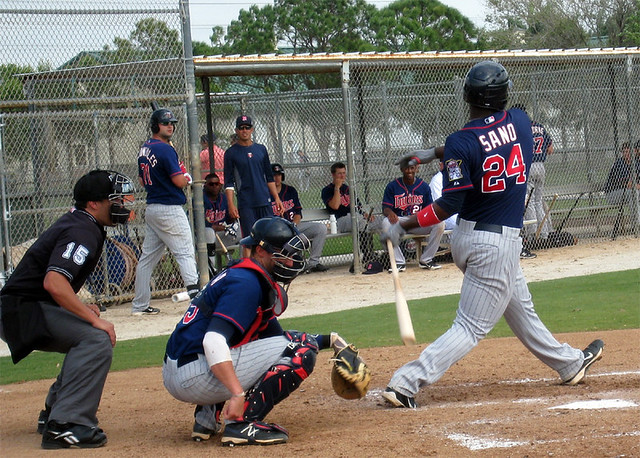
1. Miguel Sano RH, 3B, DOB: 5/11/1993, 6'3", 195 lbs.
The Twins signed Miguel Sano as a free agent from the Dominican Republic on October of 2009 to a $3.15 million signing bonus. Before the 2010 season Sano was ranked as the 94th prospect in baseball by BA, before the 2011 season the 60th, before the 2012 season the 18th by BA and 23th by MLB.com and before last season the 9th by BA and 12th by MLB.com In the Byron Buxton entry, I talked about why I think that Sano is a better prospect, but I shouldn't have need to, if I just iterated what I wrote here last August, arguing that he should be the top prospect in baseball after this season, for a great reason.
Miguel Sano is number one as far as I am concerned. And I am not going to compare him with Miguel Cabrera, like a lot of people do, because a. Miguel Cabrera is a disliked Tiger and b. I think that Sano will be better. So I will compare him to a beloved Twins' player: Harmon Killebrew. And those nit pickers who think that Sano's K% of around 25% on each of his age 17 to 20 seasons, need to go no further than realize that the Killer's K% in his age 19 to 22 seasons were 34.8%, 35.5%, 24.2%, and 36.4% respectively. There is further nit picking on Sano's defense. I am sure that many of nit pickers picked on his fellow third baseman's when he was coming up as a Senator, but he ended up alright by any measure. And next season will be Sano's age 21 season. He will like start 2014 in Rochester with a potential September callup depending on his and the Twins' performance. He is not on the 40-man roster, so a 2015 MLB appearance, like Buxton, is more likely.
EDIT: I was recently asked (after this was up) whether Sano's elbow issues might change my opinion on the rankings. The answer is categorically no, the same way that Buxton's shoulder issues do not change my opinion on him. If any of those injuries are catastrophic, it might be a different story. My original thoughts were that both Sano and Buxton will not be in the majors until at least 2015, so even that time table is not affected....
Next: Summary of all 1-40.
This is not the last post in these. For completeness sake, I will have a summary post with all 40 tomorrow.
The number 1 to 5 off-season 2014 Minnesota Twins prospects are:
5. Kohl Stewart RHSP, DOB: 10/7/1994, 6'3", 195 lbs.
Stewart was drafted by the Minnesota Twins in the 1st round (4th overall) of the 2013 from St Pius X (Houston, TX) High School. Other than a single game started in Elizabethton (4 IP, 1 H, 1 BB, 8 K) he started his pro career in the GCL at age 18, where he pitched in 7 games (4 GS) for 20 innings, walking 3 and striking out 16. He had a 1.69 ERA and 0.938 WHIP.
Stewart has 4 pitches that he commands well: A plus to plus plus mid 90s fastball that peaks at 97-98, a close to plus mid to high 80s slider, an above average high 70s low 80s curveball and a plus low to mid 80s changeup, which is an impressive arsenal for an 18 year old. Stewart draws comparisons to another Houstonian hurler and the Twins would be ecstatic if he realizes half of that potential. He is still getting a feel on how to pitch, but this is expected for someone his age. Depending on how he shows in Spring Training, I will not be surprised if he starts 2014 at age 19 in Cedar Rapids' rotation.
4. Eddie Rosario LH, 2B, DOB: 9/28/1991, 6'0", 170 lbs.
Eddie Rosario was drafted by the Twins in the 4th round of the 2010 draft from Rafael Lopez Landron (PR) High School as an OF. Rosario is one of those rare prospects who had success at every step of his pro career with his career slash line at .307/.358/.510 . His best season was his second pro, age 19 season, 2011 at Elizabethton, where he hit .337/.397/.670 with a career high 21 HRs in 67 games (298 PAs). He also swiped 17 bases that season. That was his last season as a full time center fielder before converted to a second baseman by the Twins due to their OF wealth.
He played in Beloit in 2012, with his season cut short with a line drive on the face that broke his jaw bone. Despite that he finished the season with a .296/.345/.490 slash line. He moved up to Fort Myers in 2013 (age 21 season) where he hit .329/.377/.527 before moving to New Britain mid season. In New Britain he hit .284/.330/.412. In 2013 Rosario played in a career high 122 games with a career high 544 PAs. If that was not enough, he played at the AFL after this season and continued in the PWL the winter. Right before he started his appearance in the PWL he communicated to the press that he tested positive for prescription painkillers and was given a 50-day suspension, but at the time of this writing he has yet to be charged officially.
Rosario has All-Star potential. A middle infielder with IsoP in the .200s before he hit drinking age, supplemented with good contact and decent plate discipline (he still needs some work on this tool) is rare. But the key word here is "infielder". Rosario is still mostly learning the position, but has shown a lot of promise and second base is probably the easiest position in the diamond defensively. For this, his impending suspension might be a blessing in disguise: He will give him some necessary rest after about 700 projected plate appearances this year and will give him a couple months in extended spring training to work on his fielding while serving his suspension. He will likely start 2014 in New Britain.
3. Alex Meyer, RH, DOB: 1/3/1990, 6'9", 220 lbs.
Meyer was drafted in the first round of the 2011 MLB draft by the Washington Nationals out of the University of Kentucky and traded to the Twins last off-season (2012) for Denard Span. I am not really going to give detailed statistics for the top 3 Twins' prospects, just some information and justification for the rankings. I assume that everyone knows enough about them at this point.
Meyer was ranked number 83 prospect in baseball by MLB.com before the 2012 season and number 59 from Baseball America and number 40 by MLB.com before last season. Believe it or not, Meyer is near to major league ready after just 2 professional seasons and at certain teams he would be in their 2014 MLB rotations. His repertoire includes 3 pitches: a plus plus fastball that averages 94-96 and hits 98-100, a plus to plus plus hard slider at high 80s with a sharp break and an average changeup, which right now is a complementary pitch. An likely comparable would be a right hand version of Randy Johnson, because their pitching styles and their offerings are so similar. Developing that changeup will make Meyer truly dominant. His ceiling is a top of the rotation perennial All Star starter. Likely will start 2014 (his age 24 season) in Rochester. He is not on the 40 man roster, but may still get a September call up depending on how the Twins and he is doing.
2. Byron Buxton, RH, CF, DOB: 12/18/1993, 6'2", 189 lbs
Byron Buxton was drafted by the Minnesota Twins in the first round (second overall) of the 2012 draft. He was rated number 10 prospect in Baseball by Baseball America and number 19 by MLB.com before the 2013 season. He likely is thought of as the top Twins' prospect by most people. Why he is not here? Because I think that Sano is a better player right now, because I saw him strike out in three straight change ups last spring training , because he had not a stellar performance in the AFL, and because at the same level (Fort Myers) at the same season, Miguel Sano (who is just 7 months older) was a better player. As a matter of fact, other than the Midwest League (and this could very well be Beloit vs Cedar Rapids,) Sano's production was better than Buxton's in the same stops. Another issue with Buxton's production was that his OPS dropped more than 100 points (from .990 to .887) from Cedar Rapids to Fort Myers. And his BABIP in both stops was a ridiculous .402 and .404, which is about 100 points higher than the combined .303 among the 2 rookie stops the previous 2 seasons. I don't want to rain on anyone's parade, just color me a tad worried here and not ready to jump in the top prospect in the system bandwagon, when Sano is still a prospect.
On the other hand, Buxton is more of a complete player, having better defense and speed tools than Sano. He has been compared to Mike Trout, but his overall performance in the Midwest League in the first half of 2013 at the same age (19) was better than Trout's in the same league at the same age. What is Buxton's ceiling? Rickey Henderson with a stronger arm and fewer SB (just because they do not steal this much these days.) He could be a fixture at CF and an All-Star for many years. But he has to prove himself against AA pitching first and will likely get the chance starting his age 20 2014 season in New Britain. Twins' fans are wishing for a September call up to the majors, but I think 2015 is more realistic, unless he tears the Eastern League apart and the Twins are competing in September (and both would be great things.)
1. Miguel Sano RH, 3B, DOB: 5/11/1993, 6'3", 195 lbs.
The Twins signed Miguel Sano as a free agent from the Dominican Republic on October of 2009 to a $3.15 million signing bonus. Before the 2010 season Sano was ranked as the 94th prospect in baseball by BA, before the 2011 season the 60th, before the 2012 season the 18th by BA and 23th by MLB.com and before last season the 9th by BA and 12th by MLB.com In the Byron Buxton entry, I talked about why I think that Sano is a better prospect, but I shouldn't have need to, if I just iterated what I wrote here last August, arguing that he should be the top prospect in baseball after this season, for a great reason.
Miguel Sano is number one as far as I am concerned. And I am not going to compare him with Miguel Cabrera, like a lot of people do, because a. Miguel Cabrera is a disliked Tiger and b. I think that Sano will be better. So I will compare him to a beloved Twins' player: Harmon Killebrew. And those nit pickers who think that Sano's K% of around 25% on each of his age 17 to 20 seasons, need to go no further than realize that the Killer's K% in his age 19 to 22 seasons were 34.8%, 35.5%, 24.2%, and 36.4% respectively. There is further nit picking on Sano's defense. I am sure that many of nit pickers picked on his fellow third baseman's when he was coming up as a Senator, but he ended up alright by any measure. And next season will be Sano's age 21 season. He will like start 2014 in Rochester with a potential September callup depending on his and the Twins' performance. He is not on the 40-man roster, so a 2015 MLB appearance, like Buxton, is more likely.
EDIT: I was recently asked (after this was up) whether Sano's elbow issues might change my opinion on the rankings. The answer is categorically no, the same way that Buxton's shoulder issues do not change my opinion on him. If any of those injuries are catastrophic, it might be a different story. My original thoughts were that both Sano and Buxton will not be in the majors until at least 2015, so even that time table is not affected....
Next: Summary of all 1-40.