
The general consensus is that the Achilles heel of the Twins this season has been pitching, both starters and relievers. The Front Office had tried to help the team by targeting certain pitchers before the non-waiver trading deadline, but these efforts were fruitless, probably due to the fact that most contenders this season were looking for pitching and it was a sellers market. The Twins were able to fill a lesser need, acquiring Orlando Cabrera from the Oakland Athletics for Tyler Ladendorf, a move which I analyzed here. Now the trading deadline is long passed and the Twins could add to the club through waiver trades. As a matter of fact, the Twins are in an advantage over the other American League contenders because they have the worse record of the bunch, which results in the Twins having priority on waiver calls for players placed on waivers by other American League teams. Unfortunately, unless an National League player passes through waivers, the Twins will probably not be able to add an NL player through a claim, since all National League clubs, including the Dodgers, who have the best record in the majors have priority over the AL Clubs on players waived by NL teams.
Here I will attempt to do two things:
The objective criteria I am using is Pitching Efficiency or PE, defined as: (K/9*K/BB)/WHIP and a newly devised metric, expected PE or xPE, defined as PE*(BABIP/.290). A few words about xPE: xPE is the expected pitching efficiency if a pitcher had balls in play batter for an average of .290; in other words, trying to take "bad luck" out of the equation.
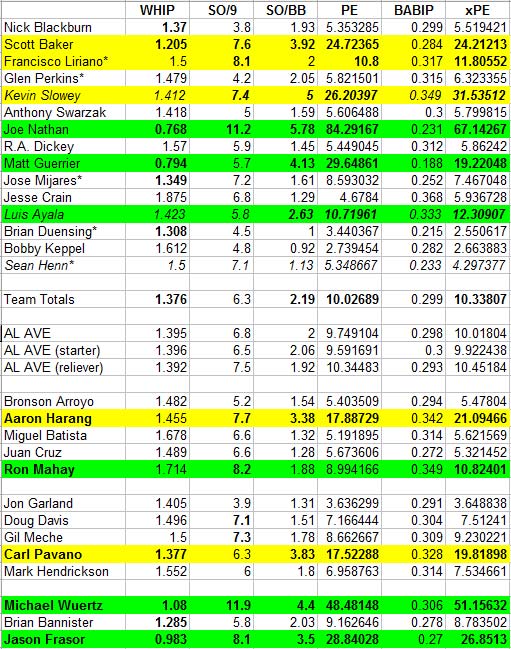
With no further ado, and because a picture (or a table) is worth more than a thousand words (add your favorite cliche), here is a table that shows each Twins' pitcher's PE and xPE in 2009 (and its components). Also the team average and the AL average, as well as the AL average for starters and the AL average for relievers are also shown. (The same table shows potential targets' metrics, but I will talk about them later) Twins' pitchers' metics better than the AL average for starters or relievers (in any individual metric) are in bold, starters with PE or xPE better than the AL average are highlighted in yellow and relievers with PE or xPE better than the AL average are highlighed in green:
Here are my conclusions:
Is there hope?
Of course, there is always hope; however, lets look at who could potentially help the Twins, instead of being existentialistic or fatalistic.
Today Joe Heyman in Sports Illustrated posted 3 lists of players:
I did the following:
The result is only 5 names, 2 starters and 3 relievers from Heyman's list, are better than the AL Average in their respective functions. Let's examine then:
So here it is: Best case scenario: Aaron Harang, Mike Wuertz and Jason Frazor. Worse case scenario: Do nothing. Realistic scenario: We'll see, but I think that it will fall in-between those two extremes...
Here I will attempt to do two things:
- Using objective criteria look at the current state of Twins' pitching
- Using the same criteria look at possible targets who might improve the Twins' pitching in the stretch run
The objective criteria I am using is Pitching Efficiency or PE, defined as: (K/9*K/BB)/WHIP and a newly devised metric, expected PE or xPE, defined as PE*(BABIP/.290). A few words about xPE: xPE is the expected pitching efficiency if a pitcher had balls in play batter for an average of .290; in other words, trying to take "bad luck" out of the equation.
With no further ado, and because a picture (or a table) is worth more than a thousand words (add your favorite cliche), here is a table that shows each Twins' pitcher's PE and xPE in 2009 (and its components). Also the team average and the AL average, as well as the AL average for starters and the AL average for relievers are also shown. (The same table shows potential targets' metrics, but I will talk about them later) Twins' pitchers' metics better than the AL average for starters or relievers (in any individual metric) are in bold, starters with PE or xPE better than the AL average are highlighted in yellow and relievers with PE or xPE better than the AL average are highlighed in green:
Here are my conclusions:
- Surprising the overall team pitching looks better than the AL average; the reason for this is that 2 starters (Slowey and Baker) and 2 relievers (Nathan and Guerrier) are much higher than the AL average
- Looking at the starters, there were only 3 starters higher than the AL starter average, Slowey, Baker, Liriano; but, unfortunately, the Twins has lost their best starter for most (or all) of the season
- Looking at the relievers, there were only 3 relievers higher than the AL reliever average, Nathan, Guerrier, Ayala; but, unfortunately, personality clashes with the coaching staff and the manager, resulted to the release of the Twins third-best reliever
- Perkins, Swarzak and Blackburn trail by far (in best to worse order) the AL starter average (about a month ago at a point where several have anointed him "the ace" or the "stopper", I indicated that Blackburn was living on the edge based on his PE, and his latest ineffectiveness did not surprise me)
- Mijares, Crain, Dickey, Keppel and Duensing trail by far (in best to worse order) the AL reliever average. Keppel and Duensing are very close to replacement level and are much worse that the pitchers they replaced (Ayala and Breslow/Henn)
Is there hope?
Of course, there is always hope; however, lets look at who could potentially help the Twins, instead of being existentialistic or fatalistic.
Today Joe Heyman in Sports Illustrated posted 3 lists of players:
- Players who are likely to pass through waivers
- Players who might pass through waivers
- Players who will not pass through waivers, but a trade could be made by the claiming team
I did the following:
- Took the pitcher's from Heyman's lists, with the exceptions of NL pitchers in his last (#3) category and pitcher like Roy Halladay and Felix Hernandez, for whom the Twins are extremely unlike to work a trade
- Calculated their PE and xPE and listed it on the table above (broken down by Heyman's 3 categories)
- As with the Twins' pitchers earlier, every metric higher than the AL average corresponding to a starter or a reliever is on bold, if a starter has higher PE and/or xPE than the AL average for starters he is highlighted in yellow and if a reliever has a higher PE and/or xPE than the AL average for relievers, he is highlighted in green
The result is only 5 names, 2 starters and 3 relievers from Heyman's list, are better than the AL Average in their respective functions. Let's examine then:
- Aaron Harang. Despite the fact that he is playing for an NL team (the Reds), his numbers are good enough to translate into a legitimate above average pitcher in the AL. For 2009 his contract is $11 million (about $4.5 million left), he is under contract for $12.5 million in 2010 and there is club option for $12.75 million in 2011 (with a $2 million buyout). I think that if he passes waivers, as Heyman suggests, with the Reds are looking to reduce payroll after the Rolen acquisition, if the Twins are willing to spend $19 million for the next 2 years, he might be part of the solution
- Ron Mahay. He barely made that list because of his high BABIP this season. He plays for an AL Central team (Royals). The Twins do not trade within the division. Is he better than Mijares? Maybe. Is he better than Duensing? Yes. Will it happen. No.
- Carl Pavano. The man who was once traded (by the Red Sox to the Expos) for Pedro Martinez is on a very nice rebound this season. He is on an one year contract with about $600,000 left, which is great. Unfortunately he is pitching for the Indians and as long as the Twins' are not trading within the division, it is not happening.
- Mike Wuertz. He is on a tear. The Twins' tried to trade for him with the A's and it did not work out before the deadline. Now that the Twins are in an advantage as far as AL-waiver claims go (because having the worst record among the contenders, they can claim him before anyone else), it will be interesting to see whether they could work a trade with the As. Wuertz (who btw is from Austin, the home of SPAM, not Texas) is under team control for 2009 and 2010, arbitration-eligible for 2010 and is owed about $400,000 for the rest of the season. The issue here is whether the Twins might be willing to give up someone like Anthony Slama and a lower level prospect for him, because that will probably be what it takes (As PTBNL) to get Wuertz in his home state Twins' uniform, give or take. He could also be part of the solution
- Jason Frasor. A lot of the things that I said earlier about Wuetz, apply to Frazor, other than the facts that Frazor is not effective as Wuertz this year, he is from the land of Lincoln (the president, not the car), he pitches for the Blue Jays and he is a free agent after this season (he has about $500,000 remaining in his contract). And, yes, he will be cheaper. Will the Twins decide to give Rene Tosoni (a Canadian OF) to the Jays and a lower prospect as PTBNL? We'll see, but he can also be part of the solution
So here it is: Best case scenario: Aaron Harang, Mike Wuertz and Jason Frazor. Worse case scenario: Do nothing. Realistic scenario: We'll see, but I think that it will fall in-between those two extremes...


