Micheal Cuddyer was one of the heroes of the 2006 Twins that won the AL Central division in dramatic fashion the last day of the regular season. That season, his age 27 season, he exceeded expectations after establishing himself as the starting right fielder, instead of being moved around in the infield, hitting .284/.362/.504 with 24 HR and 109 RBI. The Twins' organization regarded him as a power right hand bat that could split the franchise lefties, Joe Mauer and Jason Morneau and create a formidable core in the middle of the lineup for years to come. In the off-season after his 2006 season, he signed an one year $3.575 million contract to avoid arbitration. After his 2007 season, which was not as productive (.276/.356/.433 16 HR, 18 RBI), the Twins decided to keep him long term, offering him a 3 year/$25 million contract through 2010 with a team option for 2011 worth $10.5 million. This contract coincided with the departures of Torii Hunter to the Angels via free agency and Johan Santana to the Mets via a trade. The Twins needed a face for their franchise to quell disappointment by these departures and the gregarious and outspoken Cuddyer was cast into that role. There are a lot of arguments against that contract given to Cuddyer after a down season and at age 28; however, it should be clear that this contract was not only for his field production but for his franchise representation to the public. That said, here is the question that I will try to answer:
Are Michael Cuddyer's best days as a player behind him?To try to answer this question, I will try to examine the following:
- hitting through career, represented by OPS
- comparable players
- power through career, represented by isoP
- tendencies at bat through career
- monthly hitting since 2004
Career Hitting
this graph is a plot of Michael Cuddyer's OPS in the different seasons he played. Season 1 is 2001 and season 9 is his current age 30 season.
It is clear that his OPS peaked at season 6, 2006 his age 27 season, and has practically linearly declined since.
Comparable PlayersBaseball Reference has a great tool that determines the 10 most similar players to a particular player, based on production. Here I am examining
Michel Cuddyer's 10 most similar, looking at when they had their peaks, in order to potentially get additional clues about Cuddyer. Here is a list of the 10 most similar players with the age of their peak in parethesis. A couple are disqualified from this analysis, one because he is still 25 years old and the other because he played in the 50s:
1. Kevin Mench (peak age 26)
2. Jeff Francoeur (too young, just in age 25 season)
3. Walt Moryn (played in the 50s - entered MLB at 28)
4. Leon Roberts (peak age 27)
5. Gabe Kapler (peak age 24)
6. Sean Berry (peak age 29)
7. Mike Lamb (peak age 28)
8. Chris Singleton (peak age 26)
9. Butch Huskey (peak age 27)
10. Xavier Nady (peak age 29)
the average age peak of these 8 players is age 27. The exact age Michael Cuddyer was during his 2006 season.
Career Power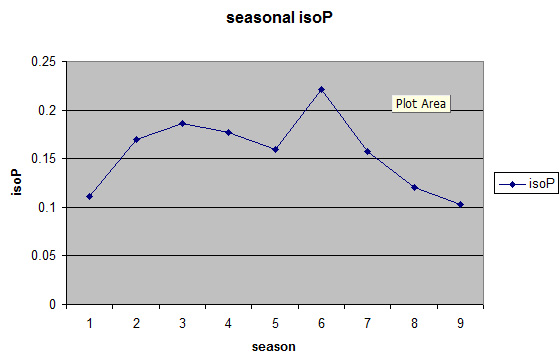
this graph is a plot of Michael Cuddyer's isoP (isolated power = SLG%-batting average) in the different seasons he played. Season 1 is 2001 and season 9 is his current age 30 season.
It is clear that his power, like his hitting ability, peaked at season 6, 2006 his age 27 season, and has declined since, however not with as dramatic a rate as his hitting ability.
Hitting Tendencies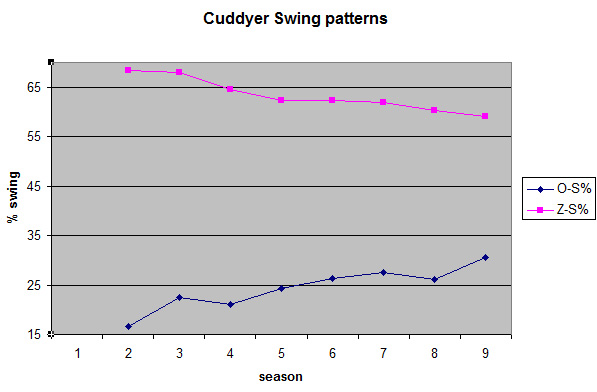
This was a big surprise to me.
The graph above is a plot of the percentage of balls inside the strike zone (Z-S%) and outside of the strike zone (O-S%) that Micheal Cuddyer has been swinging at during the different seasons. There is no data for 2001, so this is from 2002 on.
As you can see, consistently every season, Cuddyer swings at more balls than the previous season and swings at fewer strikes that the previous season. This is not a recipe for success and it really is bothersome, because it indicates that since his 2002 age 23 season, Cuddyer has become progressively worse in pitch selection.
in other words:
Cuddyer had a better judgment on balls and strikes at age 23, than he had during his age 27, 2006 season and nowCuddyer, following the example of Denard Span
underwent LASIK eye surgery in the off-season. Based on his early 2009 results, it seems that the surgery did not help him distinguish balls and stikes; if anything it made things worse.
Monthly hittingI wanted to get a bit more granular view than seasonal hitting, so I plotted Cuddyer's monthly OPS from the 2004 season to now, to help identify his peak better:
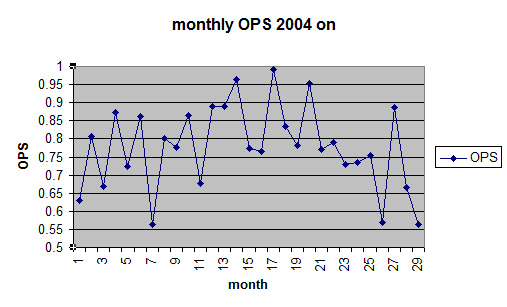
The bottom line is that since May 2007, when Cuddyer had an OPS of .954 in 100 plate appearances, with the exception of June of 2008 when his OPS was .866 in 91 plate appearances, Cuddyer a. did not have a single month with OPS higher than .800, and b. his OPS has been practically declining month by month.
This is not good news.
Is Cuddyer done?At this point, there are a lot of indicators, that Cuddyer's best days are over. The swing graphs and the monthly and seasonal OPS drops are somewhat disheartening. However, the June of 2008 provides a glimmer of hope, despite all the other negative indicators. Potentially Cuddyer might have similar months, however even these months will probably not be close to his 2006 production. I think that the Twins should focus on giving more time to Carlos Gomez and Delmon Young, whose best days are ahead of them and give Cuddyer a more limited role, similar to that of Craig Monroe and Randy Ruiz of the 2008 season. Cuddyer will be better than both of them in that role and will be positive for the team. Yes, he will be an overpaid bench/role player, however, as I indicated earlier, part of his contract was because his off-field role, so the "overpayment" for a limited on-field role is mitigated. And if he shows signs that he might have months like the June of 2008, his role could increase for that month and return to limited upon signs of decline (easy to spot based on swinging tendencies)