2/25/09

In honor of Boof

A couple of arthroscopic labrum and rotator cuff tear repair shots


this is a partial labrum tear:


and arthroscopic repair of the labrum:


here is a torn rotator cuff:


and here a repaired rotator cuff:


That's what went on with Boof Bonser today. He is out for the season.

Play ball

It really smells like spring today :)

2/24/09

Twins and Money. Part 2: How high could the Twins payroll go?

Yesterday I examined the relationship of the Twins' player salary payroll to their income, and compared it with what other teams in the league are spending. The conclusion is that the Twins were slightly below league average last year (they will be about league average this year.) Also, in the process of doing this, it was shown that the Detroit Tigers and Chicago White Sox are spending an exuberant amount of their revenue towards players salary, which suggests that fire sales of sorts and periods of non-contention might be looming in the very near future of these clubs.

The Twins have a lot of good young players, several of whom are at the league minimum or close to it. In a few years the Twins might be faced with tough decisions about keeping some of these players. How far could the Twins' payroll stretch, so they will be able to pay and keep their young talent (when it makes sense). I am trying to answer this question today.

back to the spreadsheet:


again:

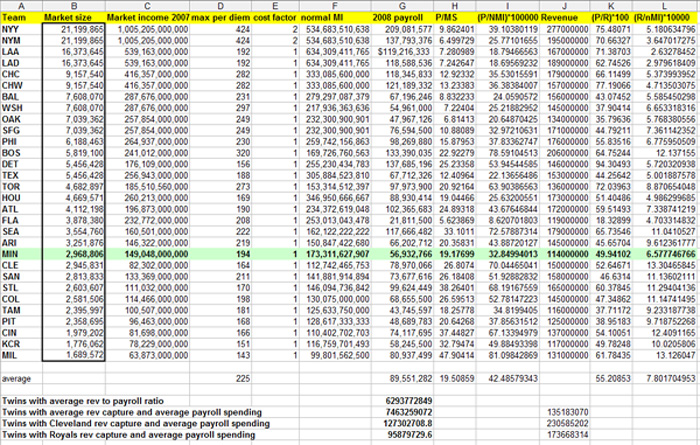
Column A is the teams, column B is the "market size" (data from here; I am not using this value for any calculations; it is there just for reference and the teams are ranked according to that. This is the number of people who live in those metropolitan areas. Column C is the total market's personal income (i.e. how much money all the people in the Twin Cities metropolitan area make). Column D is the maximum allowable per diem the US government allows for the different metropolitan areas. This is used as an indicator of cost of living in the MLB markets. Column E is the ratio of the cost of living in a single market to the average, based on per diems (for some reason excel displayed that in one significant figure, but the calculations were done correctly, as you can see). I call this the "cost factor". Column F is the normalized market income, which is the market income in column C divided by the cost factor in column E. This should be a representation of what the whole market area has to spent, if the living expenses were equal among all markets. Column G is the total player salary payroll in 2008 (all figures are in USD, btw). Ignore column H, I am not using it. Column I is the total payroll as a fraction of the total income in the market area (multiplied by 100000 so the numbers are easier to look at). This could be used as one way to compare spending among teams (but I am not doing it; it would really over-complicate things). Column J is each team's revenue in 2006, as indicated above. Column K is the percent revenue spent on player payroll. This is the measure that I am using to compare how much different teams are spending on players.

The last column (L) is the team revenue divided by the total market income and multiplied by 10,000 (so the numbers are prettier to look). I call this the "market revenue capture". If I were a bit smarter when I created the spreadsheet I would had multiplied by 50,000 to give a rough estimate of how much of an American's (or Canadian's) family income is spent as a revenue to their home MLB team (you can do this mental exercise at home. The numbers suggest that every family in the MLB metropolitan areas, contributes an average of about $39 a year to its local MLB team's revenues.) Here are all the MLB teams ranked by market revenue capture (in italics are teams in multi-team markets) :


Indians 13.30
Brewers 13.13
Reds 12.41
Red Sox 12.14
Cardinals 11.29
Rockies 11.15
Padres 11.13
Seattle 11.04
Royals 10.02
Diamondbacks 9.61
Pirates 9.72
Rays 9.23
Toronto 8.87
MLB AVERAGE 7.80
Giants 7.36
Braves 7.34
Phillies 6.77
Nationals 6.65
Athletics 5.76
Twins 6.58
Detroit 5.72
Orioles 5.59
Cubs 5.37
Yankees 5.18
Rangers 5.00
Astros 4.99
White Sox 4.71
Marlins 4.70
Mets 3.65
Dodgers 2.98
Angels 2.63

The bottom line is that the Twins do not capture as much revenue as they could from the Twin Cities market. They are capturing revenue at slightly higher rated than the teams that have to compete with other teams in their market and less than the average MLB team. This is not very good.

The projections, of how high the Twins payroll could be (without compromising or overtaxing the organization more than any other team in the market, which is a good business practice), are in the bottom of the spreadsheet:

If the Twins were spending in player salaries what the average team spends as a percentage of their revenue, they would spend $62.9 million (a number very close to their 2009 payroll)

If the Twins were capturing market revenue at the rate the average major league team captures market revenue and spend in player salaries what the average team spends as a percentage of their revenue, they could spend $74.6 million (a number very close to their 2007 payroll)

If the Twins were capturing market revenue at the rate the Kansas City Royals (a team much less successful on the field than the Twins) capture market revenue and spend in player salaries what the average team spends as a percentage of their revenue, they could spend $95.9 million

If the Twins were capturing market revenue at the rate the Cleveland Indians (the leader in revenue capture in the majors) capture market revenue and spend in player salaries what the average team spends as a percentage of their revenue, they could spend $127.3 million in player salaries, without any problem.

Clearly, those two last numbers would:

  • Make every Twins' fan (who has not been following the team in its glory years when its payroll was on the higher echelons of the league) do silly uncontrolled gestures of happiness

  • Have a strong basis for the team not to worry about picking and choosing who of its deserved players who are due for bigger contracts to keep and who to release (see: Ortiz, David)

  • In combination with prudent spending (i.e. Do not do what Detroit does or what the Yankees do throwing away money at old underperforming players), could build a dynasty in the Twins Cities


Too good to be true?

Nah, piece of cake. The next (and final) piece in this series will deal with how it can happen (and it does not really take much, just lessons learned, thinking outside the box and having fun)


Stay tuned...
(to be continued)

2/23/09

Twins and Money. Part 1: Are the Twins "cheap"?

This is the first in 3 article series dealing with the overall subject of Twins and Money. In this first segment, I will be examining, whether the Twins are "cheaper" compared to the rest of the league, in the second segment I will be examining how high potentially the payroll could be stretched and in the last, how could the Twins get there. I know it is not baseball, like balls and strikes and homeruns and stolen bases, but it is essential for baseball.

The Twins' fans (or at least a sizable part of them) have the perception that the Twins (most accurately the Twins' ownership) are not willing to spend "what it takes". A google search with the keywords "cheap" and "Pohlad", returns 15500 pages (and in a lot of them several select adjectives and participles modify "cheap".) A lot of fans will never forget that Pohlad was willing to contract the team, including me. Also, a lot of fans, including me, are appreciative for the money that Pohlad spent compared to the Griffiths, which resulted in two World Championships for this team in 4 years. Letting bygones be bygones, here is what I did (and numbers for baseball are hard to find so everything is a very good approximation) :

I collected the following data:

  • Total Personal Income in the baseball marketplaces for 2008, from the Bureau of Economic Analysis, US Department of Commerce and from The City of Toronto (for 2006)

  • To calculate the cost of living in each of those metropolitan areas and to normalize the personal income according the cost of living (the thought here is that if you make $75K a year and your mortgage costs $1000 a month in KC vs $2200 a month in NYC, you probably have more money to spent in baseball in KC), I used the per diem allowances of the US government for travel to different places for 2009

  • The most recent revenues I could find (and these are kept in more secrecy than the Vatican Archives)were from a Forbes article for 2006

  • Finally, I used 2008 payroll figures from Cot's Baseball Contracts


here is what the data looks like:


For the purpose of this, please ignore everything underneath the main table; it will be discussed in the next article of the series.

Column A is the teams, column B is the "market size" (data from here; I am not using this value for any calculations; it is there just for reference. Column C is the total market's personal income as discussed above (i.e. how much money all the people in the Twin Cities metropolitan area make). Column D is the maximum allowable per diem the US government allows for the different metropolitan areas, as indicated above. This is used as an indicator of cost of living in the MLB markets. Column E is the ratio of the cost of living in a single market to the average, based on per diems (for some reason excel displayed that in one significant figure, but the calculations were done correctly, as you can see). I call this the "cost factor". Column F is the normalized market income, which is the market income in column C divided by the cost factor in column E. This should be a representation of what the whole market area has to spent, if the living expenses were equal among all markets. Column G is the total player salary payroll in 2008 (all figures are in USD, btw). Ignore column H, I am not using it. Column I is the total payroll as a fraction of the total income in the market area (multiplied by 100000 so the numbers are easier to look at). This could be used as one way to compare spending among teams (but I am not doing it, explanation on the next piece). Column J is each team's revenue in 2006, as indicated above. Column K is the percent revenue spent on player payroll. This is the measure that I am using to compare how much different teams are spending on players. I'll discuss the last column (L) in the next article, so ignore it for now.

Big Caveats as far as assumptions go (and yes they were done because of limitations, mainly lack of access to a supercomputer that could do regressions, but this is not supposed to be an academic paper ) :

  • I am using only the main markets here (i.e. a lot of North Dakota, South Dakota and Iowa residents attend Twins games, but only the Twins Cities metropolitan area is accounted

  • In multi-team markets, I assume that the whole market is accessible to both teams equally

  • In some markets (like Cincinnati), other than College sports, major league baseball is the only game in town and that should probably drive up revenues, but I have no way to account for that, esp. looking at things like NASCAR and whatnot


An average team spends 55.21% of its revenue in player salaries.

The five biggest spenders:

Detroit 94.30
White Sox 77.19
Yankees 75.48
Dodgers 71.39
Mets 70.66

The five thriftier spenders:

Marlins 18.34
Oakland 35.80
Rays 37.71
Nationals 37.90
Pittsburgh 38.95

Team Average:
Philies 55.84, while the MLB average is 55.21

The Twins are spending 49.94 percent (using the 2008 payroll). This will get closer to league average for 2009, since a lot of teams decreased their payroll and the Twins increased theirs.

I would not call the Twins "cheap". That said, I strongly believe that the Twins are not capturing as much revenue as they can from the market and should have the opportunity to capture more, which in turn will allow them to pay more for players (and make more money) without any hardship.

One interesting piece of this data is that Detroit and the White Sox are overspending teams like the Yankees, the Dodgers and the Red Sox at this point. They are already cutting their payroll, but in the near future expect more cuts, especially in this economic climate. Their overspending cannot be sustained and I expect some years of fire sales and non-competing for both of them (this is good for the Twins)

The next part would be looking at market revenue capture and what the Twins could afford as a player salary payroll if they capture their market revenue at the level of some of their peer teams, and the last part will be looking at what would it actually take for the Twins to capture that revenue.

(to be continued...)

Back to the scheduling programming...

After the Joe Crede parenthesis, back to scheduled programming. It is amazing how fast the first game of Spring Training is coming upon us and I have quite a few things to do here before the season starts, so this is what to expect from this blog during spring training:

  • As I indicated last week, this week I will start a series of articles (probably 3, the the first one coming later tonight) about Money and the Twins, mainly looking at how much they are spending, why, and how much more they could be spending (hint: the future looks bright)

  • I got to finalize the season predictions. Again, like last season, I will use a variety on methods to calculate the predicted wins the Twins will have in 2009.

  • Speaking of predictions, the preseason context will come to an end at the end of Spring training. I am happy to report that they are 4 guaranteed winners already, winning a copy of one of the best minor league publications for the Twins, the Minnesota Twins Prospect Handbook - 2009, by Seth Stohs of SethSpeaks.net a major authority in the Twins' blogosphere, personally autographed by Seth himself; but there is still time to participate, so please do. There will be a new contest starting soon that would take place for a month or so and be over after the season is over. It is all about predicting different things about the season. There will be a lot of categories and the winners will receive autographed balls and cards by current and former Twins' players. The grant price would be an autographed ball by a hall of famer (sorry no Twin). So look up for that and participate.

  • I will be providing summaries on views of the roster, spring training battles and probably a weekly analysis of ST performance. Also, if something happens, like a transaction, I will analyze it. One of the things I am thinking of doing, is profiles for the current team, like I have done for the newcomers this season

  • for the season, I am thinking of doing either series-by-series recaps or weekly recaps. There are so many places that cover the on the field stuff, and I really prefer to do a bit of digging in and cover obscurities, so no more play-by-play coverage :)


Is there anything else you would like to see here? Please let me know. I have been toying with the idea of a chat, but the ones I have seen so far (Seth's, Aaron's, Howard's, Dierke's and the ones at ESPN) look like a set of Q&As. I feel I can do this at the comment section here... I would like to have a chat where there is no moderation (or minimal moderation to filter potentially inappropriate stuff), so there is some sort of holistic discussion at an equal sitting by the participants. I have not seen that yet at any place (other that at the Star Tribune blog comments section). So please give me your ideas.

Also, if anyone is interested in posting a guest post here (and I promise that it will be zero editing) please let me know. I'd love to be able to give people a forum to participate in any way they might like.

2/21/09

Meet and Greet: Joe Crede

Bill Smith made a sizeble splash in the free agent market by singing Joe Crede late last night to a fair contract, that is loaded with incentives. I wrote about the potential risk that Crede might be. The Twins' fans are familiar with him. Is there anything more one can say as an introduction to Crede?

Well, there is: Joe Crede is one of those rare players who have spent 12 seasons with the same team. He was drafted out of high school in the 5th round of the 1996 draft and made the majors in 4 years as a 22-year old. His most impressive minor league seasons were in 1998 when as a 20 year old he hit .315/.382/.514, with 20 HR and 88 RBI for the Wiston-Salem Warthogs (Carolina League, high A) and in 2000 when in his second year as Birmingham Baron (Southern League, AA) he hit .306/.372/.490 with 21 HR and 94 RBI. That earned him a cup of coffee in the majors and annual trips the next 2 years. His breakthrough year was in 2002 with the Charlotte Knights (International League, AAA) where he hit .312/.358/.571 with 24 HR and 65 RBI in 359 AB (he had 200 AB with the White Sox that year where he hit .285/.311/.515 with 12 HR and 35 RBI) as a 24 year old. For the year, between AAA and majors, Crede hit 36 HR and drove in 89. His final career minor league line was .291/.346/.462.

Unfortunately, in the majors, he regressed from his 2002 appearance, never having another 113 OPS+ season (in 2006 when he hit .283/.323/.506 30 HR and 90 RBI, his OPS+ was 107.) Low OPS (esp. OBP) has been Crede's Achilles's heel after he left the minors for good in 2002. Let's try to look at the root causes of that and whether there is hope there:

Crede, in the majors, from 2002 to 2008 improved his BB% from a 3.8% in 2002 to a 8.2% in 2008 (which is positive) and his K% from a 20% in 2002 to a 13.4% in 2008. Thus, it is not that he strikes out and he is not taking walks what affects his OPS (Think Gomez in 2008.) He actually got better in these departments. The problem was what happened when the ball was in play after it left his bat. Here is a list of his BABIP from 2002 on:

2002: .304
2003: .274
2004: .247
2005: .253
2006: .272
2007: .230
2008: .242


Unlike pitchers, BABIP variations for batters do not signify "luck". Here is a good article that describes BABIP and hitters, in English. There are a lot of factors that might affect BABIP, but to make a long story short, the reason that Crede's BABIP decreased dramatically, is that his line drive percentage also decreased dramatically in the majors from 2002. Here are his yearly LD%:

2002: 24.2%
2003: 21.7%
2004: 16.5%
2005: 19.0%
2006: 17.8%
2007: 14.6%
2008: 14.3%

Root cause found. Crede needs to get more line drives to increase his OBP and OPS. Line drives are not necessarily the hardest hit balls, but they do fall for a hit around 75% of the time. Huge factor for one's BABIP.

Is it fixable? Why would one stop hitting line drives? I looked at various places in 2003 to see whether something happened that might have affected Crede, and I found this tidbit. Apparently the White Sox coaching stuff in order for him to stop swinging at outside pitches, they turned him into a pull hitter vs. an all field hitter (and his 2002 season, see above, indicates that he indeed has power in all fields). I need some more sources to verify this, and expect and edit as soon as I find it.

Edit: Here is an additional reference to Crede's new swing and approach in 2003.

Edit 2: Here are Crede's spray charts for the US Cellular Field in 2002 and 2008.

2002:


2008:


I am including all hits and ground outs. This confirms that in 2002 when Crede had high OPS (driven by high BABIP, which in turn was driven by high LD%) he hit the ball into the opposite field and the change in his approach sometime in 2003 that turned him into an one dimensional hitter and reduced his OPS (again, BABIP and LD% driven) but decreased his Ks and increased his walks, reduced his all field hitting ability as indicated in his 2008 spray chart. Hypothesis confirmed.

I have been voicing my disapproval for the Twins' spread the ball to all fields hitting coach philosophy, but if there is a guy who can improve from that is Crede, and if there is place that he can improve from that is in Minnesota.


Here you have it!

2/19/09

The (potentially good) problem with the Twins minor league system is this:

Baseball Prospectus Twins' Prospect list

The Baseball Prospectus released today their annual Twins' prospect list. Here it is:

Five-Star Prospects

1. Ben Revere, CF
2. Aaron Hicks, CF

Three-Star Prospects

3. Danny Valencia, 3B
4. Angel Morales, CF
5. Wilson Ramos, C
6. Shooter Hunt, RHP
7. Kevin Mulvey, RHP
8. David Bromberg, RHP
9. Carlos Gutierrez, RHP

Two-Star Prospects

10. Deolis Guerra, RHP
11. Jeff Manship, RHP

They also list Tolleson, Swarzak and Mijares as "just missed". Interesting comparison with the scout.com list that was published earlier this month. It seems that the value of Plouffe and Tyler Robinson is widely distributed among the national baseball media

2/18/09

Goodbye Bobby Korecky

Bobby Korecky was claimed off waivers by the Diamondbacks today, when he was removed off the 40-man roster to open a spot for Luis Ayala. He will have a chance to win a spot in Arizona's pen and the Twins would have a change to showcase Delaney (or Mijares if he does not make the 25-man roster) as the closer in Rochester. Korecky will be 29 this season, and would have a better opportunity to stick with the Diamondbacks than he would have had with the Twins. Good luck in Arizona, Bobby.

2/17/09

A bit of an update

The day almost passed and there were news about any roster moves for the Twins, so that Ayala can start being integrated with the team. As is he can run around the field and practice with the Twins (like Corey Koskie is doing) but cannot participate in team drills and team activities (the latter at this point of the Spring training are zero.) This delay is screaming to me that there is a trade brewing some place. Stay Put.

On other division news, after La Velle Neall III broke the possibility that the league and the union might agree to a sign-and-deal for type A free agents, there is more than a word from both Chicago and Kansas City that Orlando Hudson might end up with one of the Twins' division rivals.

Not sure what to think about Boof's and Mauer's injuries, but they seem more worrisome than previously thought.

The Crede situation is still brewing.

Liriano, will not pitch for the Dominican Republic in the WBC.

I will update as news come in, but so far this is soaking sun time for the Twins...

2/15/09

Transaction alert

The Twins have to announce a new transaction by tomorrow. They held making official the signing of Luis Ayala, because their 40-man roster is full. Neshek cannot move to the 60 day DL to create an opening because the DL does not start before the season. To participate in spring training Ayala needs to be in the roster.

Who will go?

Stay tuned

2/13/09

Teaser: Can you imagine the Twins having a payroll of $95 million? How about $125 million?

Believe it or not it is possible.

This is just a teaser for a 3 series posts that I will start next week about why this could be within the Twins' reach and within their means and how they can make it happen.

Stay tuned

The case for the Twins adding a couple of free agents

Spring training is almost here, and the Twins' additions have been Luis Ayala, R.A. Dickey, Jason Jones and some minor league free agents. Even though Ayala's contract has not become official yet, he is the one of this off-season's additions most likely to stick with the major league club.

An interesting fact is that there are still the following free agents available (from here) :

Catchers
Gary Bennett (37)
Johnny Estrada (33)
Paul Lo Duca (37) - Type B, not offered arb
Ivan Rodriguez (37) - Type B, not offered arb

First basemen
Miguel Cairo (35)
Nomar Garciaparra (35)
Doug Mientkiewicz (35)
Richie Sexson (34)
Mark Sweeney (39)

Second basemen
Ray Durham (37)
Damion Easley (39)
Mark Grudzielanek (39) - Type B, offered arb
Orlando Hudson (31) - Type A, offered arb
Adam Kennedy (33)

Shortstops
Orlando Cabrera (34) - Type A, offered arb
Nomar Garciaparra (35)

Third basemen
Joe Crede (31)
Nomar Garciaparra (35)

Left fielders
Moises Alou (42) - Type B, not offered arb
Garret Anderson (37) - Type B, not offered arb
Emil Brown (34)
Luis Gonzalez (41) - Type B, not offered arb
Jay Payton (36)
Manny Ramirez (37) - Type A, offered arb

Center fielders
Jim Edmonds (39)

Right fielders
Emil Brown (34)
Ken Griffey Jr. (39) - Type B, not offered arb

DHs
Frank Thomas (41) - Type B, not offered arb
Jose Vidro (34)

Starting pitchers
Kris Benson (33)
Paul Byrd (38) - Type B, offered arb
Tom Glavine (43)
Livan Hernandez (34)
Orlando Hernandez (43)
Chuck James (27)
Jon Lieber (39)
Rodrigo Lopez (33)
Pedro Martinez (37)
Mark Mulder (31)
Sidney Ponson (32)
Kenny Rogers (44)
Curt Schilling (42)
Ben Sheets (30) - Type A, offered arb
Kip Wells (32)

Relievers
Joe Beimel (32) - Type B, not offered arb
Joe Borowski (38)
Shawn Chacon (31)
Chad Cordero (27)
Juan Cruz (30) - Type A, offered arb
Scott Elarton (33)
Keith Foulke (35)
Eric Gagne (33) - Type B, not offered arb
Jason Isringhausen (36) - Type B, not offered arb
Jon Lieber (39)
Aquilino Lopez (34)
Will Ohman (31)
Al Reyes (38)
Dennys Reyes (32) - Type B, offered arb
Ricardo Rincon (39)
Rudy Seanez (40) - Type B, not offered arb
Julian Tavarez (36)
Mike Timlin (43)
Ron Villone (39)
Kip Wells (32)
Matt Wise (33)

I have been making the case that the Twins still have holes at third base (where they are much bellow league average) and at the starting rotation. One of my proposed targets for the starting rotation, Pedro Martinez is still out there and the Twins should try to sign him. I have very little confidence in Perkins as I indicated in my analysis, based on his performance last season and on his stuff. Another consideration is that Tolbert and Buscher are at or below replacement level and being in their primes are not expected to get any better. One of the interesting names, who the Twins should offer a contract as a bench player, PH, part time DH, part time 1B, part time 3B, part time SS is Nomar Garciaparra. I would feel better seeing Nomar instead of Tolbert as a pinch hitter in the 8th inning for Punto when necessary. Nomar last year he hit .264/.326/.466, 105 OPS+ in limited action. Those numbers are better than Crede's last year across the board and Nomar will not cost much. Given that the Twins will not sign Hudson and Cabrera due to their type A status, and Crede does not really add that much (other than getting Buscher to Rochester), bring thing in the former Red Sox, will be a very wise and cost-effective route for the Twins to improve the team as spring training approaches

Twins' prospects from Scout.com

I just received the scout.com annual preview publication that includes a list of the Twins' top prospects according to them (the rankings are -or will soon be- at their web site for non-subscribers, so I thought there was no problem to share.) In the website they are eventually counting down the top 50, but the magazine has the top 20. That list was made by Brad Weiss. Their is also a list of the top 300 prospects in the minors made by Melissa Lockhard. What follows is Weiss' list with Lockhard's placement in the top 300 in parenthesis where is applicable:

  1. Ben Revere (49)

  2. Aaron Hicks (61)

  3. Danny Valencia (208)

  4. Anthony Swarzak (206)

  5. Jose Mijares (109)

  6. Tyler Robertson (127)

  7. Trevor Plouffe

  8. Angel Morales (274)

  9. Wilson Ramos (118)

  10. Kevin Mulvey

  11. Shooter Hunt (271)

  12. Deolis Guerra

  13. Jeff Manship (286)

  14. Robert Delaney

  15. Steven Tolleson

  16. Carlos Gutierrez

  17. Luke Hughes

  18. Dustin Martin

  19. Michael McCardell

  20. Joe Benson


Interesting to see the variation of evaluations between the local and the national viewpoints.

The Baseball Prospectus will release their list of the Twins' top prospects within days and I will re-post it when I have it.


Spring Training starts in 3 days.

2/10/09

Steroids, ARod, asterisks, crucifictions and the integrity of the game

These days it seems that baseball fans and more so sports media and popular media are circling like hawks for the discovery of the newest star associated with steroid use and beating war drums in the upcoming trials of Barry Bonds and Miguel Tejada and the future trial of Roger Clemens in a manner similar to that of paparazzi around LA's hotspots trying to capture the next embarrassing picture of Paris Hilton or Lindsay Lohan. Why? There are cries or cheating, of committing the felony of perjury and of giving back the records to people who should have them.

Let's examine some of those arguments:

Perception: Steroids have become available to athletes first time in the early 90s and the steroid era in baseball started about that time.

Truth: Anabolic Steroids came to the market in 1958 after Dianabol, manufactured by CIBA got approval by the FDA for use with elderly and burn victims. Its use was wide spread among bodybuilders and track athletes. The international olympic committee banned its use in 1976. So, potentially, baseball players in the 60s could have used steroids. Hank Aaron was in his 5th of the 23 major league seasons in 1958.

Perception: Steroids and other PEDs are available by seedy people who frequent gyms and street corners.

Truth: No. One can get them all over the internet (that was a working link for a site that calls itself an "online pharmacy" and actually sells PEDs out of the European Union; then I thought twice about putting that live link up).

Popular Opinion: Baseball Players are role models and the government should go out with all their resources to catch players like Barry Bonds, Roger Clemens, Miguel Tejada and others who committed perjury.

My Opinion: The country is in a recession and going after baseball players is probably in the bottom list of the priorities here. People are losing jobs and homes left and right and that money is better spent for other reasons. As far as the role model bit, a president (who arguably should be held to higher standards that ballplayers as a role model), not only was never tried for perjury, but still holds his law practicing license (which is a no no for attorneys who committed perjury).

The bottom line:

Yes, steroids are bad and baseball players should not be using them. I wholeheartedly hope that the sport develops a new steroid policy that makes baseball a drug-free workplace (like most workplaces) and adopts the one strike, you are out policy of most workplaces and adopts a IOC-like testing methodology (including blood tests performed in unannounced variable intervals during the season and the off-season). If this is not done soon, it better be done by the CBA renewal after the 2011 season. This will cost money. That will be money better spent that prosecuting some of the steroid users, like they are attempting to do today. The government should try to close the loopholes of imported PEDs obtained over the internet (there are some heavy penalties associated with drug trafficking through the mail system and that is another more worthwile target than Bonds or Clemens or Tejara or Rodriguez). Live and let live. Whatever happened happened, these players did not did anything more wrong than Bill Clinton and now there is a chance for baseball and the federal government to stop looking backwards but start looking forward and learn the past lessons and try to stop future use.

What about records and asterisks? Who cares? Nobody can guarantee that ball players in the 50s did not take PDEs. Catchers and pitchers are reporting in 4 days...

2/6/09

Meet and Greet: Luis Ignacio Ayala

Today the Twins ended their off-season futility by signing Luis Ayala, formerly of the Mets and Nationals to an one year, $1.3 million contract with up to $575 thousand in additional incentives. Last year Ayala made 1.7 million dollars and, depending on his performance, he would have a chance to exceed it in 2009. Luis was born on January 12, 1978

The road that brought Louis to the states from his native Mexico and to the majors has been an interesting one. His professional baseball career started as a successful starting pitcher at the Saraperos de Saltillo (Saltillo Sarape Makers). In his first 2 years in the States, American Baseball was like a summer job for him, singing contracts in 2001 and 2002 with the Rockies and the Expos. In 2001 he pitched 13 games in relief with Salem Avalanche of the Carolina (A+) league collecting 7 saves and in 2002 he was a set up man for the Ottawa Lynx of the International (AAA) League where he appeared in 6 games. His next "summer job" contract for the 2003 season was deemed to be with the Arizona Diamondbacks; however the Expos either saw something they liked in his 6-game stint with Ottawa or, most likely, were impressed with his real job performance as a starter, that selected him in the Rule 5 draft from the Diamondbacks. Other than rehab assignments, Ayala played only 19 games in the minors and pitched 21 innings. He did not disappoint the Expos in his first year, assuming the set-up role, playing in 65 games and pitching 71 innings collecting 3 saves while producing a 2.92 ERA, 1.10 WHIP, 5.83 K/9 and 3.54 K/BB. He has a very deceptive delivery (see picture below) that has been very hard for right handers, but extremely easy for lefties. In his inaugural season RHB hit .188/.221/.267 and LHB .337/.398/.564 off Ayala.

2004 was his best season in the majors so far (hopefully this will change next year). Pitching 90.3 innings in 81 games as a set up man, Ayala accumulated a 2.69 ERA, 6.28 K/9, 4.20 K/BB and 1.18 WHIP. The move of the Nationals was not kind to him. He regressed slightly in 2005, but was still a very good pitcher (68 games, 71 IP, 2.66 ERA, 5.07 K/9, 2.86 K/BB, 1.25 WHIP). However, in 2006 Ayala became the poster boy of the detractors of the WBC: He blew his elbow in a WBC game and sat the 2006 out with Tommy John surgery. Ayala himself in an interview by the Washing Post said that he regretted playing to the WBC. In 2007 he started slowly, partly because he suffered a neck injury while trying to rehabilitate his surgically repaired elbow in extended spring training. By April his fastball velocity was only 85 mph and needed improvement. After a couple of rehab assignments he was activated and joined the Nationals in late June. He appeared in 44 games for the Nationals, pitching 42.1 innings producing respectable numbers: 3.19 ERA, 5.95 K/9, 2.33 K/BB, 1.30 WHIP. His rehab and return from Tommy John surgery is very similar to that of Fransisco Liriano (other than the part where the Nationals kept Ayala in extended spring training while the Twins rushed Liriano).

2008 was even less kind for Ayala. In a hunting trip in the off-season in Mexico (January 4th), he was shot by mistake by one of his buddies on his left (non-throwing) bicep (There still is one pellet in there; no word about airport metal detector issues). The Nationals doctors diagnosed "a bruised nerve" (btw, nerves don't "bruise") and gave him a clean bill of health. In addition to the "bruised nerve", in 2008, Ayala suffered a bruised ego when he his wife filed for and was awarded a divorce. In all respects, 2008 was a regrettable season for Ayala (who was traded to the Mets in a waiver trade August 17th for Anderson Hernandez, a AAA utility infielder, after he requested to be traded): 81 games, 71.7 IP, 5.71 ERA, 5.95 K/9, 2.08 K/BB, 1.45 WHIP. On an "exit interview" in Fredericksburg Free Lance Star, Ayala suggested that he lost his focus because of his off-field problems; however, an unnamed source told MLB.com back then that Ayala's problems came about by the fact that he was bypassed as the closer replacement for Chad Cordero.


Ayala has 3 pitches that he mixes regularly with good command (esp. before his surgery): a 91 mph sinker, an 85 mph hard slider and a 84 mph change up, which he throws anywhere in the count and spots locations. His out pitch had been his 2-seamer, but the last couple of years he has been relying on the slider as an out pitch more and more (with not much success). This singing makes the crowded Twins bullpen even more crowded, but Ayala (with his deceptive delivery) has the ability to replace Neshek (and his deceptive delivery). Whether or not his apparently fragile ego will clash with the brash personality of Gardy, remains to be seen.

Here is a video of Luis Ayala in his native Saltillo:


2/4/09

Book review: The King's Game, by John Nemo

I am trying something different here, which will hopefully be the first in a series of posts in this space: A book review. I am planning on reviewing baseball-related books and when feasible do a question and answer session with the author.

I am happy to present you the first book in the series, The King's Game by John Nemo as well as a Q&A session with the author.

Review

John Nemo’s book, The King's Game (available from Amazon.com just click on the link to order), really surprised me. From bylines and reviews I read prior to reading the book, I thought that it would be based on a story line similar to that of The Natural (A grizzled veteran player comes in out of nowhere and becomes the major star in a clinching game). Little that I knew…

The King’s Game is like a baseball: a solid core of pitch by pitch action in a futuristic game seven of a World Series inside (think rubber core), enveloped by an allegory (think leather), stitched together by a thread of Christian Spirituality (think red stitches in a ball). A great line in the book (in the “postgame” chapter; the book is cleverly structured in chapters based on baseball innings) perfectly describes the use of baseball in the book: “Baseball is a wonderfully submerged metaphor. A study of its subtleties reveals endless truths about our world.” Frankly, I have never read a single statement that can summarize the single more powerful force that makes someone a baseball fan… The baseball action in the book is spellbinding. The mind of the main protagonist, one of the most highly regarded pitchers of his era, is dissected as he delivers each pitch in the game seven of the World Series. I cannot think of a single baseball fan that would not like to have a insider’s view of such a situation. How much would you pay to sit on single synapse of Jack Morris’ brain in the game seven of the 1991 World Series? Well, this book is pretty close to that. Nemo is faithful to his baseball (he even has a box score of the game at the end of the book). I utterly enjoyed the exaltation of a game of baseball (albeit game 7 of the World Series; and we all know what those mean) into something more than baseball. And this is really what the book is all about. If I ran a bookstore and had to place the book under one single section, I couldn’t do it. I would place some copies under “Sports” and some under “Christian Spirituality” to be fair to Nemo’s work, because he excels in both. And for the people who automatically think “Christian Spirituality” is a preconceived red flag of sorts, this book is more than that. There is no “preaching” in this book. This book speaks to intelligent spiritual audiences of any (and no) religions. The two parallels that crossed my mind (more than crossed, actually, kind of smacked it like a fat curve that doesn’t break enough) when I was reading it were: Kafka’s Metamorphosis, while experiencing Cody King’s character’s development; and that huge Dylanesque rain allegorical overtones through out the story line (albeit, I suspect that“rain” –or water- has more of a “baptismal” notation for John Nemo than it has for Bob Dylan.) Yes, this is an existentialist book…

Go buy it (it is offered at Amazon, click the picture of the book below) and read it; if not for any other reason, get it because this is one of the extremely few places that perfectly describes a palmball. This book will make you think a bit more than balls and strikes and E-7s and has an amazing baseball action (it even make me grab a score card and keep score); it is a very fast read (I started and finished it last Saturday, a lazy morning, over a cup of coffee or two) that you don’t want to put down before the end. A total winner; but don’t listen to me, listen to Joe Nathan and Mike Cuddyer who both provided testimonials on the book.


Q&A with the author


The Tenth Inning Stretch: You describe baseball action like someone who actually pitched. Do you have any experience playing baseball?

John Nemo: Not beyond eighth grade baseball for the venerable St. Rose of Lima squad. However, I did grow up with a father who was a baseball fanatic and an English professor, and he used to hold court in the upper reaches of the Hubert H. Humphrey Metrodome during the 1980s and early 1990s, teaching me everything he knew about the game - its beauty, poetry, symmetry, etc. Along with that, I spent 10 years covering the Twins and other MLB teams for media outlets including Minnesota Twins Magazine, the Associated Press, MLB.com and others. I spent many, many hours in the press box, on the field and in the clubhouse talking with players and getting inside their heads. Because of that I was able to get some of the Twins players - Torii Hunter, Michael Cuddyer and Joe Nathan in particular - to look over portions of The King's Game for me and give me feedback on the baseball action and authenticity.

TTIS:My understanding is that the game describes takes place in the future. One of the teams is the visiting St Louis Cardinals and the other is the Warriors from an undetermined city. There are some hints that you are describing the Cleveland Indians. Fictional team or do the Indians change their nickname sometime in the future?

JN:Actually in my mind's eye the game takes place in the present day or perhaps in the past. The Warriors are a fictional team - definitely inspired in part by the New York Knights in "The Natural." I intentionally left their city unnamed - it didn't feel right to put them in any one place.

TTIS:A friend of mine who is a writer told me that he always models his characters after people he knows. When you build your characters do you model them after particular ball players or are they imaginary, composed by different things you see in different players? Also, how do you decide on names for your characters?

JN:Some players are shadows of real guys - including David Eckstein, Rick Ankiel (the young stud pitcher version, not the current slugging outfielder edition) and others. Other players in the book embody certain characteristics - great bat/frying pan for a glove, great glove/toothpick for a bat, etc. - you see all the time in MLB. Names are usually done quite random - whatever pops into mind, really. The big thing is I try to avoid using names of real people I know - I'm not a fan of that at all, and it makes the book lose its magic for me. I also try to come up with names that I like the sound of, or names that seem to fit the personality of a character. Things like that.


TTIS:The World Series in the King's Game, took me back to the two Twins' World Series appearances. Was there any particular game 7 you watched that inspired the baseball action in the book?

JN:Definitely Game 7 of the 1991 World Series. Can anybody forget Jack Morris going 10 innings and looking ready for 10 more? Lonnie Smith getting faked out by Knoblauch? That was a game where you literally felt the pressure on every single pitch - a true Game 7, its outcome in doubt until the very final moments. Another one, though not a Game 7, is probably Game 6 of the 1986 World Series - the insanity and craziness of a New York crowd, everyone going nuts when Ray Knight scored the winning run, the chaos of it all - I love that atmosphere, and it shows up at times in The King's Game.

TTIS:You perfectly described the action of a palmball. This is very intriguing to me because the pitch, which I believe is one of the most effective pitches out there, has become obsolete, like the screwball. The only current pitchers who uses it (very rarely, are Roy Halladay and Trevor Hoffman) and the last pitcher of note to use it with any frequency was Mike Cuellar. Today, most people (even pitching coatches) think of a palmball as another changeup grip (which is of course wrong) Why a palmball?

JN:I've always been a fan of sneaky, tricky pitchers - Luis Tiant gets mentioned early on as someone the book's main character, Cody King, models his pitching style after. I always fooled with it playing in the backyard and especially playing wiffle ball with my buddies. I've always been a fan of it, and having artistic license with The King's Game, I decided to let it fly, so to speak.

TTIS:Let's change gears for a second. I could not help notice the rain/water allegory in the book. My first thought was that it was a baptismal symbolism. The more and more I got into the book, I had more and more doubts about that. What is the water symbolism in your book?

JN:The way I write, I am really not conscious or intentionally putting any type of metaphors or symbolism into my stories. It just happens. I literally just begin with a scene and then let the film in my mind begin to roll, and I just try to keep up with it, describing what I am seeing as the story beings to unfurl. The characters in the scene just start saying and doing things. It really is magic - a gift from God. Looking back at The King's Game, what comes to mind is the idea of a flood, of being overwhelmed, drowning, desperate, fighting against an unforgiving, rising tide. There are several instances in the book where that happens, and other scenes where water brings about great fear for Cody King.

TTIS:A couple of personal questions: Twins Fan? Since when? Who are your favorite all time and current players?

JN:Twins fan since moving to the Twin Cities at the age of 6 in 1981. Grew up on Gaetti, Hrbek, Bruno, Viola, Blyleven and the rest. Loved Kirby Puckett - what Minnesotan fan didn't? He was my favorite player of all time, hands down. When I was in college (early 1990s) I interned for Minnesota Twins Magazine and walked onto the field for the first time as a bona fide journalist. I had to interview Puckett for a feature on the magazine's kid's page, and I was so nervous. My job was to find out how Kirby broke in new gloves. He looked at me, straight-faced, and said, "I run my truck over it." I stuttered and stammered, thinking he was going to bust out laughing, but Kirby was dead serious - he said he put new gloves down in his driveway, then ran over them a few times with his truck. My favorite current Twins are Denard Span, Mauer, Morneau and Cuddyer.

TTIS:Are you currently working on any other books? When should we expect to see them in print?

JN:I do have a couple other novels that were recently published. "Miller's Miracle" is the story of a young man who discovers quite by accident that he's been given an incredible gift when it comes to the game of golf. "Jumper" is the story of how a teenager's curiosity about a dark family secret ends up propelling him back in time to the Roaring Twenties in gangster-friendly St. Paul, Minnesota.

For a complete biographical information on John Nemo and for information about his books, make sure to visit his web site johnnemobooks.com

The timeline of a rumor - Delmon for Washburn + Clement

This time of the year, especially this year where there is not much coal in the coffers and the usually hot off-season stove is colder than usual, rumors about impeding transactions fly left and right. I make a practice of neither propagating nor analyzing rumors (like there are not about 100 more places to go for that). I am not making an exception here with this post. I am just presenting it as an example of how rumors are propagated.

Case study: Delmon Young to the Mariners for Jake Washburn and Jeff Clement.

This rumor started here at 8:14 PM ET on February the second by John Hickey, a Seattle Post-Intelligencer reporter, who wrote on his blog: "One deal discussed in the last week or so involved sending Washburn and catcher Jeff Clement to Minnesota in exchange for 23-year-old outfielder Delmon Young."

At 8:46 PM ET, half an hour after the rumor was started. There was a compete analysis, including a major thumbs down here by Dave Cameron of USS Mariner, the most read independent Mariner's blog.

At 9:49 PM ET, Drew Silva of Tim Dierkes' MLBtraderumors.com picked up the rumor and posted it here at the MLB rumor mill clearing house.

One it got there, the most visited place by fans in the off-season, it started propagating like crazy with fans reaction abound: By 10:07 PM ET the first comment regarding it appeared at LEN3's blog, in an unrelated post about the MLB Network.

Next day, February the 3rd at 10:20 AM ET, Joe Christiansen, Twins Beat writer in Start Tribune, picks up the rumor and offers his thoughts

By 7:52 PM of the same day, Joe who is a real journalist, tried to confirm the rumor through his connections with the Twins who categorically said "no way" and he posts an entry on his blog to this effect. Kelly Thesier at MLB.com, piggybacks on Joe's post at 8:07 PM and ups the ante, contradicting Hickey, saying that the particular trade was never proposed.

At 8:37, Dierkes' team over the MLBtraderumors clearing house, picks Joe's article up and rehashes that the "deal" is dead.

You'd think that the rumor would be dead and buried by then, right? Nope. At 8:19 AM ET Today (February 4th), Yahoo's MLB rumor site, picks up and rehashes Christiansen's 10:20 AM post of the previous day, suggesting that the rumor is alive (but totally ignores to look at the second post that kills the rumor).

This is the main reason I do not try to propagate rumors here... In the days of internet and RSS, things that come out of a blogger's head move fast (and esp. if that blogger is affiliated with the traditional press) spread as truths everywhere (anyone remember the Cuddyer for Atkins rumors out of Denver?). It is better to wait and see something actually reported about a trade that happened that get nuts about a trade that might make sense if it happens.

The best think that came out of this particular rumor (the seed of course was planted by Sid Hartman and Charlie Walters in the early off-season) is the newest Twins-related internet site, Keep Delmon!. Go have a look and vocalize your support, it is a worthy cause :)