
There is not much talk about minor league free agents, but here in the list of all the minor league free agents this off season from Baseball America. Are there any potential diamonds in the rough for the Twins to consider?
Given the Twins system needs for major-league ready righty relievers, better fielding middle infielders, third basemen and power right handed bats, the following might be good fits. I do not expect anything to happen before the Rule 5 draft in December.
The age listed is projected age on opening day 2009 (I am not including players 30 and in the list, even though someone like Jason Lane, Jay Gibbons, Bobby Scales, Ben Broussard, Mike Koplove, Jeff Weaver or Michael Burns might be of interest to some teams) :
Right Hand Relievers:
Jose Garcia RHP, 24. Career: 2.82 ERA, 1.04 WHIP, 9.24 K/9, 3.98 K/BB. Garcia took the Marlins organization by storm moving from the Rookie Gulf Coast league to the AAA Pacific Coast league and earned a September call up as a starter in only 2 seasons. He then needed Tommy John surgery and lost all 2007. Came back in the Athletics' organization in 2008 and pitched 19 innings of relief accumulating a 3.32 ERA with a 0.84 WHIP, 4 BB and 20 K. The numbers suggest that his elbow is fine. Very young for his progress, he is a no-brainer signee for any organization.
Brandon Medders, RHP, 29. Good arm but somewhat erratic. Career 4.44 ERA, 1.42 WHIP, 9.49 K/9, 2.5 K/BB. Most of it the last 5 years in the hitter friendly Pacific Coast league. Four years MLB (NL) experience 3.52 ERA, 1.391 WHIP, 6.50 K/9, 1.65 K/BB. He will be in a major league bullpen in 2009.
Paul Bush RHP, 29. Might be a steal. Career 3.23 ERA, 1.18 WHIP, 9.39 K/9, 2.70 K/BB
Oneli Perez RHP, 26. Career: 2.99 ERA, 1.23 WHIP, 9.72 K/9, 3.15 K/BB. Other than a horrible 2007, which made the Indians take him off their 40-man roster and the Yankees claiming him with similar results, Oneli Perez has been a lights out reliever in the minors. He has a very heavy sinker complemented by a nasty slider. He is a lot rike a right handed version of Jose Mijares. If he regains his confidence from the sub-par 2008, he could be a good set up man in the majors. An interesting factoid is that Perez was born with 12 fingers. Update: 12/24/08: Signed with the San Diego Padres.
David ShaferRHP, 27. Career 3.17 ERA, 1.22 WHIP, 8.93 K/9, 2.49 K/BB. Once a touted closing prospect for the Reds (2.34 ERA, 1.06 WHIP, 26 saves in Chattanooga, Southern league) was traded to the As for Kirk Saarloos before the 2007 season. Of course, in the A's organization he met the Pacific Coast League where he disappointed. He has a 92 mph fastball a decent slider and an immature change up. He could benefit from a chance inscenery.
Ferdin Tejeda RHP, 26. Made the transition from a light hitting SS to a pitcher in 2005, so his arm is not abused. Career 2.60 ERA, 1.00 WHIP, 6.93 K/9, 3.74 K/BB. Excellentcontrol, never made it above A+ (Carolina league), definitely worth a look to supplement the minor league system.
Cory Doyne RHP, 27. Career 3.31 ERA, 1.25 WHIP, 8.74 K/9, 1.94 K/BB. Was the closer for the Norfolk Tides (International League) in 2007 producing a great season with 2.23 ERA and 0.88 WHIP. Had rotator cuff surgery last year and came back fine producing a 3.43 ERA, 1.10 WHIP, 11.57 K/9 and 3.86 K/BB in 21 innings in 4 levels. Another potential steal, he very likely be a middle reliever in the majors next year. He also is quite a character.
Jose Capellan RHP, 28. Career: 3.26 ERA, 1.27 WHIP, 8.14 K/9, 2.38 K/BB. Spent parts of 4 season and the whole 2006 in the Majors as a middle reliever with the Brewers appearing in 61 games, pitching 71.7 innings, 31 BB, 58 K, 4.40 ERA and 1.34 WHIP. His career MLB numbers are 4.89 ERA, 1.435 WHIP, 7.17 K/9, 1.96. Once a great prospect in the Braves' organization was traded to Milwaukee for Danny Kolb, the post season after 2004 when Danny Kolb was an All Star and saved 39 games. Up to that point, he was a great starting pitcher advancing from Rookie league to AAA in just 3 seasons. He missed all of 2002 with Tommy John surgery. His best pitch is a 100 mph rising four seamer. He does have control problems and needs to develop his secondary pitches (slider and change up) better to be a more effective reliever, but he can produce as a middle reliever in a major league club (preferably with a good pitching coach) next season. A sure bet to sign a minor league contract and get invited to Spring Training with a club.
Nic Ungs RHP, 29. Career: 3.70 ERA, 1.25 WHIP, 5.98 K/9, 2.97 K/BB. Nic Ungs, a starter, is tale of two stories: He is a very good pitcher in any other league than the Pacific Coast League and he is awful in the Pacific Coast League. Last season, in Huntsville (Southern League) he had an ERA of 1.96 and a WHIP of 1.00; after his promotion to Nashville (Pacific Coast league) his numbers ballooned to 7.49 ERA and 1.54 WHIP. Similarly in 2006 and 2007 in Albuquerque he posted a 4.00 ERA/1.46 WHIP and 4.98 ERA/1.49 WHIP respectively. His stuff is soft and the hitter's league exposes it. A transition to a reliever might be beneficial as would be playing time in leagues other than the Pacific Coast League.
Matt Peterson 27, RHP. Career: 3.93 ERA, 1.37 WHIP, 7.44 K/9, 1.91 K/BB. A second round draft pick by the Mets and ranked as the 4th best Mets' prospect in 2004 by Baseball America, was the centerpiece of the trade that brought Kris Benson to the Mets. A starter with the Mets, made the transition to the pen with the Pirates where he served as the Altoona (Eastern league) closer in 2007, producing 1.98 ERA, 1.21 WHIP, 29 saves, 56 K and 27 BB in 63.2 innings. Blocked in the Pirates' system he just had a cup of coffee in AAA with Indianapolis that season, then released and signed by Kansas City playing in 4 different teams in that organization. Still relatively young, will need work with his control to make it to the bigs but he has the talent.
Felix Romero 28, RHP. Career: 3.52 ERA, 1.25 WHIP, 10.87 K/9, 3.77 K/BB. A strikeout machine with excellent control but a steroid violation suspension in 2005 as well.
Tim Spooneybarger 29, RHP. Career: 1.79 ERA, 1.07 WHIP, 10.98 K/9, 2.70 K/BB. The primary closer for Richmond Braves (international league) in 2001 and 2002 where he dominated the league at a rate of 0.71 ERA and 1.06 WHIP in 2001 and 0.90 ERA and 1.05 WHIP in 2002. Earned a promotion to the Braves in 2002 where he delivered producing 2.63 ERA and 1.247 WHIP. He was the main trading chip to Florida for Mike Hampton in that off season, where he produced a 0.905 WHIP. He stated a band (Mad Ink) with his former teammate AJ Burnett. With all those numbers, and a name like that, where is the catch? 2 Tommy John surgeries back to back in 2004 and 2005, missing most of 2005 and all of 2006 and 2007. He played in 6 games in low A in 2008, pitching 7 innings, striking out 12 and walking 4 (3.68 ERA, 1.77 WHIP). Clearly not 100% percent but also clearly the biggest potential bargain among the listed. A team should take the risk an play him in A ball and by September might end up with a solid set up man in the majors.
J.D. Martin RHP, 26. Career 3.50 ERA, 1.19 WHIP, 7.76 K/9, 3.14 K/BB. Not flashy, but steady. A first round Cleveland pick out of high school had great potential until he underwent Tommy John surgery in 2005 and transitioned into a reliever. He had to change his delivery and lost some of his effectiveness. Another gamble that might pay off huge for a team that is good about mechanics coaching. Update 12/13/2009: Signed with the Nationals
Lee Gronkiewicz RHP, 30. Career: 2.44 ERA, 1.15 WHIP, 9.41 K/9, 3.82 K/BB. Just a cup of coffee in the majors. His biggest problem was that he pitched for clubs that had great bullpens (CLE, TOR, BOS) so he was stuck in the minors. Now his biggest problem is that he just underwent Tommy John surgery and will be out in 2009. He might come back as a 31 year old in 2010. I doubt that he will find any takers this off season, but maybe next.
Erick Abreu RHP, 25. Career: 3.34 ERA, 1.24 WHIP, 7.41 K/9, 2.90 K/BB. A relatively young part-time starter in the Yankees' system and last season in the Astros' organization, never made it above High A. No health problems, he might be a guy that a team might take a flier on to work as a middle reliever in ahigh A or AA club.
Middle Infielders:
Tony Granadillo, 2B, 24, SH. Career .287/.375/.441. Good eye, some pop. Decent second baseman, bad third baseman. Young enough to fill a spot at AA. Last year he regressed in Portland (Eastern League) hitting .232/.342/.338. 2004 rule 5 draftee, a couple times Minor League All star (2004 Appy League, 2007 California League)
Callix Crabbe 2B, 26, SH. Career: .276/.368/.382. The diminutive (5'7" 171lbs) second baseman from the Milwaukee organization showed enough potential on the field and the base paths that was picked in the 2007 Rule 5 draft by the Padres; however, his light hitting led to his return to Milwaukee after a month an a half in the bigs. A great fielder, selected to the All-star team in the California league in 2004 and has been in the top 5 in his respective leagues in assists, putouts, triples and stolen bases since. Good plate discipline but not great contact. His strong defense will make him a useful part of an organization. Crabbe won a community service award for the Nashville Sounds in 2007. Update 12/5/2008: Signed with the Seattle Mariners.
Jesus Guzman 2B/3B, 24, RH. Career: .295/.365/.463. Jesus Guzman is a better bat than a glove and part of his career numbers are inflated by his career year with the High Desert Maverics (California league in 2007) where he hit .301/.370/.539 with 25 Home runs and 112 RBI. He, however, improved in 2008 with the Midland Rockhounds (Texas league) hitting .364/.419/.560. There were defensive concerns at third base (his original position) but the switch in 2B paid dividends. A high ceiling player who is just 24 years old. Update 12/4/08: Singed with the San Fransisco Giants
Pedro Lopez SS, 24, RH. Career: .275/.324/.352. Pedro is a great shortstop with the glove. Great hands, great range, decent arm. His bat lacks and he was rushed through the White Sox' and Reds' systems before he learned to hit. He was in low Rookie at 17 and at the majors at 21, playing mostly in AAA (International League) afterwards. The Intenation League is not the best place to develop a 21 year old prospect, because it has some of the best pitchers in the minors. Pedro should probably start 2009 in a AA league and work his way up. His glove and flashes of offensive potential (.322/.358/.453 with 5 HR in Birmingham, Southern league in 2006) prove that. He would be a very good signing for the right team that will not rush him.
Don Kelly, 2B, 29, LH. Good field, average hit, think Punto. Career .282/.355/.378
Jesus Merchan, SS, 28. RH. Decent field, better hit. Started his career in the Twins organization and when departed learned to hit. Career .295/.344/.389. Update: 12/23/08. Singed with the Cleveland Indians
Doug Bernier SS/2B, 28, SH. Career .244/.357/.322 hitter and he played the last two season in Colorado Springs (Pacific Coast League). Probably the best fielding middle infielder in the list, excellent range and hands in both SS (his primary position) and 2B. His hitting is his weakness. Prototypical all field, light hit middle infielder; however he always had good plate discipline and drawn a bunch of walks. Update 12/5/08: Singed with the New York Yankees
Third Basemen:
Vasili Spanos 3B, 28, RH. Career: .291/.379/.454. Excellent plate disipline and adequate fielding at 3B made him ascent the Oakland system very fast. An All-American from Indiana University, a minor league All Star and a former Olympian (with the Greek Baseball team) is probably the best third baseman in this list. He is diabetic, and a sounds like a good guy. Stagnated and blocked in the Oakland system, played for Juniper (Florida State League) last season, hitting .271/.353/.432. A prime candidate for change of scenery improvement.
Tony Blanco 3B/1B/OF, 27, RH. Career .279/.331/.496. Even though Blanco is just 27 he amassed a full 9 seasons of minor league ball. Last season with the Tulsa Drillers (Texas League) he batted .323/.385/.587 with 23 HR and 88 RBI. In 2004 as a 22 year old he hit 29 home runs split between the Potomac Cannons (Carolina League) and Chattanooga (Southern League). This made the Nationals draft him next winter in the minor league portion of the Rule 5 draft, giving him a spot in New Orleans (Pacific Coast League) and 40-men rosters and calling himup to the bigs for most of the season. Blanco is very bad at third base. He has a career .845 fielding percentage. He mostly projects as a 1B/LF/DH type, but has some pop in his bat and is young enough to find takers.
Joel Guzman 3B/SS, 24, RH. Career .264/.311/.446. Joel joined the Dodger's organization as a Shortstop at 17, but at 6'6" and 225 lbs, he does not have the prototypical middle infielder body and was switched to third base in his fourth season in the minors. He was rushed through the Dodgers organization and reached his first cup of coffee in the bigs as a September call up at age 21 in 2006. The next post season he was traded to the Rays for Julio Lugo. His best season was 2004 where as a 19 year old he hit for .297/.341/.540 with 23 HR and 86 RBI splitting time between Vero Beach (Florida State League) and Jacksonville (Southern league). Joel was rushed before he could develop plate discipline or could improve his fielding. He would be a perfect fit for an organization like the Twins that would allow him to do so. He is just 23 and has a lot of potential. A demotion to AA allowing him to work his way up could do wonders for him. Another no-brainer signee. Update 12/13/2009: Signed with the Nationals
Andrew Pinckney 3B, 26, SH. Career: .277/.332/.444. Decent range, strong arm, average glove. Andrew is somewhat of an enigma. He was an all star in the South Atlantic League as a 23 year old in 2005 batting .311/.362/.535 with 21 HRs and 98 RBI but could not have guessed his power numbers from his college track record where he hit .415/.480/.721 with 7 HRs in his senior year at Emory. Nevertheless he did not put similar power numbers again and never made it above the AA level. Still a respectable player to have as organizational depth and young enough at 26 to take a flier on. Update: 12/5/2008: Singed with the Toronto Blue Jays
Matt Craig 3B/1B, 27, SH. Career .283/.368/.464. Buscher-like on the field at 3B, better at 1B. Former 3rd round draft pick by the Cubs; had 20 HR in 376 AB for the Diamond Jaxx in 2004 (Southern League) and 19 HR in 248 AB his last year of College. Not much of a third baseman on the field, and not much power the last few years to fit in the next category, but a team might consider him. Update 12/8/2008: signed with the Florida Marlins
Power Right Hand Bats:
Victor Diaz OF, 27, RH. Career: .291/.344/.476 (minors, 7 seasons) .256/.309/.487 (majors, parts of 4 seasons). Diaz was once a highly touted Mets prospect who as a 22 year old in AAA hit .292/.331/.491 with 24 HRs and 94 RBI. He earned a September call up and spend most of 2005 in the majors where he hit .257/.329/.468. Diaz has power. He hit a total of 24 HR and drove in 73 runs in the majors in 147 games and 446 AB (parts of 4 seasons). These are pretty decent numbers, given the fact that he produced them between ages 22 and 25. His problem has been plate discipline. In the majors he struck out 135 times and walked 32. This is a lot in 446 AB. He is just entering his prime and last season in the Pacific Coast League his K:BB ratio dropped from his usual 4:1 to 3:1. This is some improvement. If he gets it down to 2:1 territory and makes better contract, he will be a big contributor in the majors, because he has a lot of raw power.
Jason Dubois OF/1B, 29, RH. Career .288/.361/.529. Prototypical power hitter (6'5" 220lbs). Drafted by Toronto in the rule 5 draft in 2002 but did not stick. Traded by the Cubs to the Indians for Jody Gerut in 2005 but did not meet expectations. Career .233/.286/.443 in the majors, but mashed minor league pitching starting his minor league career at A ball and climbing a level a year until he had 30 HR and 99 RBI in 385 AB for Iowa (Pacific Coast league) in 2004 and got his call to the majors. Had 30 HRs in AAA last year spitting time between Columbus (international League) and Iowa. His slash line in Iowa was .307/.399/.664. Even though he is on the older side, he could help a major league team next year. Has been a minor league free agent the last 3 years, signing but not sticking with 2 different oranizations including the Orioles and Nationals.
Brad Eldred 1B, 28, RH. Career .263/.321/.538. Brad is a big bopper (6'5" 270 lbs). Last season in Charlotte (International league) he hit 35 home runs, drove in 100 and slugged .546. The down side is that he also had 144 strikeouts and only 28 walks. His record is 38 home runs in a season (in 2005 split between Altoona, Eastern League, and Lynchburg, Carolina League) Hit all and miss all mentality that is common to power hitters but not sure how it would sit with the Twins' brass. UPDATE 12/4/08: Singed with the Washington Nationals
Nate Gold 1B/DH, 28, RH. Career .268/.348/.489. Nate is a power hitter in the Randy Ruiz mold. Nate was a star collegiate first baseman hitting .333/.416/.842 with 33 HR and 76 RBI in 228 AB in his senior year at Gonzaga. His best season in the minors was in 2006 with Frisco (Texas league) when he hit .292/.376/.582 with 34 HR and 103 RBI in 452 AB. He projects mostly as a DH but has a lot of raw power. As with most power hitters plate discipline (esp. with breaking pitches) has been a problem for Nate.
Javier Brito, OF/1B, 26, RH. Career .306/.398/.481; great plate discipline, 16 HR in 264 AB in California league in 2006. Think a younger version of Randy Ruiz with a little less power and much better (i.e. average) on the field
Todd Linden OF/1B, 28, RH. Career .289/.382/.489. Claim to fame: one of 12 players to ever slash a home run ball into the Dodger Stadium upper deck. He also had a .321/.437/.682 30 HR season in Fresno in 2005, but that's in the Pacific Coast League, and by this part of this post you should know what it means ;) . Someone will sign him, but should not expect more than his .231/.303/.335 slash line in the majors for parts of 5 seasons.
Matt Whitney 1B, 25, RH. Career: .260/.340/.431.
These numbers do not make him belonging in this list, but his 2007 performance (.299/.364/.545 32 HR 113 RBI split between Lake County, South Atlantic League and Kinston, Carolina League) does. He might have been promoted too soon but he is a first round draft pick (2002, Indians) who is young enough to find an organization
that would let him reach his potential. Strike this, he just signed with the Nationals...
So here you have it: my list of the most intriguing minor league free agents. Who will be the diamond in the rough? We will found out soon.


11/20/08
Twins batters prospect list
Earlier, I attempted to make a list of the top Twins starting and reliever pitching prospects using objective criteria. I knew that trying to attempt a similar endeavor with the batting prospects would be a much more daunting task. And it were. What you'll see here is a compromise, mainly because there are not any reliable fielding measures for minor league position players. So my list is really focuses on the batting part of the equation (like treating everyone as a DH.) That given, and using the same criteria I used for pitchers, here is the formula I used to evaluate batters:

The raw scores were:
Angel Morales, 18, OF, Rk (Elz) 6.05
Jairo Perez, 20, 1B, Rk (DSL) 5.34
Josmil Pinto, 19, C, Rk (GCL) 5.3
Anderson Hidalgo, 19, 2B/3B, Rk (GCL) 4.98
Alexander Soto, 21, C, Rk (GCL) 4.77
Jonathan Waltenbury, 20, 1B, Rk (GCL), 4.19
Aaron Hicks, 18, OF, Rk (GCL) 4.10
Ben Revere, 20, OF, A, 4.09
Evan Bigley, 21, OF, Rk (Elz), 3.69
Michael Gonzales, 20, 1B, Rk (GCL) 3.62
Chris Parmelee, 20, 1B, A, 3.61
Jason Pridie, 24, OF, AAA, 3.58
Juan Sanchez, 21, 3B, Rk (GCL) 3.58
Luke Hughes, 23, 3B, AAA, 3.49
Daniel Valencia, 23, 3B, AA, 3.41
Matthew Macri, 26, 3B, AAA, 3.29
Rene Tosoni, 21, OF, A+, 3.02
Dustin Martin, 24, OF, AA, 2.91
Steven Tolleson, 24, 2B, AA, 2.85
Daniel Berg, 23, OF, AA 2.83
Wilson Ramos, 20, C, A+, 2.79
Jeff Christy, 24, AAA, C, 2.75
Steven Singleton, 22, 2B, A+, 2.62
Brock Peterson, 24, 1B, AAA, 2.59
Brian Dinkelman, 24, 2B, AA, 2.45
Trevor Plouffe, 22, SS, AAA, 2.43
Jose Morales, 25, C, AAA, 2.30
Erik Lis, 24, 1B, AA, 2.23
Whitney Robbins, 23, 1B, A+, 2.04
Drew Butera, 24, C, AA, 2.04
Felix Molina, 25, 2B, AAA, 1.96
Ramon Santana, 22, SS, A, 1.95
Edward Ovalle, 23, OF, A+, 1.84
Michael Harrington, 22, OF, Rk (Elz) 1.83
Rene Leveret, 22, 1B, A, 1.79
Mark Dolenc, 23, OF, A, 1.74
Deibinson Romero, 21, 3B, A, 1.72
Reggie Williams, 19, 2B, Rk (ELZ) 1.71
David Winfree, 22, OF, AA, 1.71
Alejandro Machado, 26, SS, AAA, 1.64
Joe Benson, 20, OF,A, 1.63
Daniel Lehmann, 22, C, A+, 1.60
Oswaldo Arcia, 17, OF, Rk (DSL), 1.60
Toby Gardenhire, 25, 1B, AA, 1.58
Rodolfo Palacios, 23, C, AA, 1.55
Jeff Lanning, 21, C, Rk (ELZ) 1.55
Yangervis Solarte, 20, OF, A+, 1.51
Daniel Santana, 17, SS, Rk (DSL) 1.48
Nicholas Romero, 20, 3B, Rk (ELZ) 1.47
Juan Portes, 22, OF, A+, 1.44
Dominic De La Osa, 22, 2B, Rk (Elz), 1.44
Eli Tintor, 23, OF, A+, 1.44
Daniel Rams, 19, C, Rk (ELZ) 1.43
Johnny Woodard, 23, 1B, A+, 1.12
Yancarlos Ortiz, 23, SS, A+, 1.03
Daniel Ortiz, 18, OF, Rk (GCL) 1.04
Allan de San Miguel, 20, C, A+, 0.94
Starling De Los Santos, 21, SS, A, 0.92
Adan Severino, 21, OF, Rk (ELZ), 0.87
Jonathan Goncalves, 19, OF, Rk (DSL) 0.84
Andrew Schmiesing, 22, OF, A, 0.83
Brandon Roberts, 23, OF, AA, 0.81
Jair Fernandez, 21, C, A, 0.79
Garrett Olson, 23, 3B, A+, 0.79
Eliel Sierra, 22, OF, RK (DSL) 0.66
Andres Diaz, 19, 1B, Rk (GCL), 0.46
Chris Cates, 23, SS, A, 0.44
Lesther Galvan 18, DH, Rk (DSL) 0.44
Jeanfred Brito, 20, 2B, A, 0.43
Ozzie Lewis, 22, OF, A, 0.32
Nathan Hanson, 21, 3B, Rk (Elz) 0.29
Gregory Yersich, 21, C, A, 0.26
Matt Moses, 23, OF, AA, 0.11
James Beresford, 19, SS, Rk (Elz), 0.03
Jean Carlos Mercedes, 20, OF, Rk (DSL) 0.02
Juan Richardson, 21, 3B, A, -0.12
Wilfy Gil, 18, OF, Rk (DSL) -0.14
Herbert Lara, 20, OF, Rk (GCL) -0.26
Ben Petsch, 23, OF, A, -0.31
Hyun-wook Choi, 18, OF, Rk (GCL) -0.34
Manuel Soliman, 18, 3B, Rk (DSL) -0.70
Juan Blanco, 19, OF, Rk (DSL) -0.99
Felix Caro, 18, OF, Rk (DSL) -1.06
Jhonatan Arias, 19, C, Rk (DSL), -1.22
Daniel Rohlfing, 19, C, Rk (GCL) -1.31
Hyeong-rok Choi, 18, 2B, Rk (GCL) -1.36
Jairo Rodriguez, 19, C, Rk (DSL) -1.74
Tyler Ladendorf, 20, SS, Rk (GCL) -1.88
Yorby Martinez, 19, SS, Rk (DSL) -2.27
Jakub Hajtmar, 21, 1B, Rk (GCL) -2.32
Yancarlo Franco, 19, 2B, Rk (DSL) -3.76
Xavier Gonzalez, 19, 2B, Rk (DSL) -4.62
And the tidy list of the Twins' top 30 batting prospects is:
I have Angel Morales listed higher than most people out there, but he did perform better and is younger than fellow outfielders Revere and Hicks. Jairo Perez is probably a surprise to most people, but most people do not pay much attention to the Dominican Summer League (check the pitching list for more ranting about that fact).
So here you have it. This is the official tenth inning stretch Twins' 2009 batting prospect list.
If you want more information on these any many more of the Twins' prospects, go, run, refresh your browser and buy Seth Stohs' Minnesota Twins Prospect Handbook – 2009; the best prospect handbook ever written for Twins' Prospects. Alternatively (not really, just go buy one now), be the first person to answer the current contest question correctly and get one.
The raw scores were:
Angel Morales, 18, OF, Rk (Elz) 6.05
Jairo Perez, 20, 1B, Rk (DSL) 5.34
Josmil Pinto, 19, C, Rk (GCL) 5.3
Anderson Hidalgo, 19, 2B/3B, Rk (GCL) 4.98
Alexander Soto, 21, C, Rk (GCL) 4.77
Jonathan Waltenbury, 20, 1B, Rk (GCL), 4.19
Aaron Hicks, 18, OF, Rk (GCL) 4.10
Ben Revere, 20, OF, A, 4.09
Evan Bigley, 21, OF, Rk (Elz), 3.69
Michael Gonzales, 20, 1B, Rk (GCL) 3.62
Chris Parmelee, 20, 1B, A, 3.61
Jason Pridie, 24, OF, AAA, 3.58
Juan Sanchez, 21, 3B, Rk (GCL) 3.58
Luke Hughes, 23, 3B, AAA, 3.49
Daniel Valencia, 23, 3B, AA, 3.41
Matthew Macri, 26, 3B, AAA, 3.29
Rene Tosoni, 21, OF, A+, 3.02
Dustin Martin, 24, OF, AA, 2.91
Steven Tolleson, 24, 2B, AA, 2.85
Daniel Berg, 23, OF, AA 2.83
Wilson Ramos, 20, C, A+, 2.79
Jeff Christy, 24, AAA, C, 2.75
Steven Singleton, 22, 2B, A+, 2.62
Brock Peterson, 24, 1B, AAA, 2.59
Brian Dinkelman, 24, 2B, AA, 2.45
Trevor Plouffe, 22, SS, AAA, 2.43
Jose Morales, 25, C, AAA, 2.30
Erik Lis, 24, 1B, AA, 2.23
Whitney Robbins, 23, 1B, A+, 2.04
Drew Butera, 24, C, AA, 2.04
Felix Molina, 25, 2B, AAA, 1.96
Ramon Santana, 22, SS, A, 1.95
Edward Ovalle, 23, OF, A+, 1.84
Michael Harrington, 22, OF, Rk (Elz) 1.83
Rene Leveret, 22, 1B, A, 1.79
Mark Dolenc, 23, OF, A, 1.74
Deibinson Romero, 21, 3B, A, 1.72
Reggie Williams, 19, 2B, Rk (ELZ) 1.71
David Winfree, 22, OF, AA, 1.71
Alejandro Machado, 26, SS, AAA, 1.64
Joe Benson, 20, OF,A, 1.63
Daniel Lehmann, 22, C, A+, 1.60
Oswaldo Arcia, 17, OF, Rk (DSL), 1.60
Toby Gardenhire, 25, 1B, AA, 1.58
Rodolfo Palacios, 23, C, AA, 1.55
Jeff Lanning, 21, C, Rk (ELZ) 1.55
Yangervis Solarte, 20, OF, A+, 1.51
Daniel Santana, 17, SS, Rk (DSL) 1.48
Nicholas Romero, 20, 3B, Rk (ELZ) 1.47
Juan Portes, 22, OF, A+, 1.44
Dominic De La Osa, 22, 2B, Rk (Elz), 1.44
Eli Tintor, 23, OF, A+, 1.44
Daniel Rams, 19, C, Rk (ELZ) 1.43
Johnny Woodard, 23, 1B, A+, 1.12
Yancarlos Ortiz, 23, SS, A+, 1.03
Daniel Ortiz, 18, OF, Rk (GCL) 1.04
Allan de San Miguel, 20, C, A+, 0.94
Starling De Los Santos, 21, SS, A, 0.92
Adan Severino, 21, OF, Rk (ELZ), 0.87
Jonathan Goncalves, 19, OF, Rk (DSL) 0.84
Andrew Schmiesing, 22, OF, A, 0.83
Brandon Roberts, 23, OF, AA, 0.81
Jair Fernandez, 21, C, A, 0.79
Garrett Olson, 23, 3B, A+, 0.79
Eliel Sierra, 22, OF, RK (DSL) 0.66
Andres Diaz, 19, 1B, Rk (GCL), 0.46
Chris Cates, 23, SS, A, 0.44
Lesther Galvan 18, DH, Rk (DSL) 0.44
Jeanfred Brito, 20, 2B, A, 0.43
Ozzie Lewis, 22, OF, A, 0.32
Nathan Hanson, 21, 3B, Rk (Elz) 0.29
Gregory Yersich, 21, C, A, 0.26
Matt Moses, 23, OF, AA, 0.11
James Beresford, 19, SS, Rk (Elz), 0.03
Jean Carlos Mercedes, 20, OF, Rk (DSL) 0.02
Juan Richardson, 21, 3B, A, -0.12
Wilfy Gil, 18, OF, Rk (DSL) -0.14
Herbert Lara, 20, OF, Rk (GCL) -0.26
Ben Petsch, 23, OF, A, -0.31
Hyun-wook Choi, 18, OF, Rk (GCL) -0.34
Manuel Soliman, 18, 3B, Rk (DSL) -0.70
Juan Blanco, 19, OF, Rk (DSL) -0.99
Felix Caro, 18, OF, Rk (DSL) -1.06
Jhonatan Arias, 19, C, Rk (DSL), -1.22
Daniel Rohlfing, 19, C, Rk (GCL) -1.31
Hyeong-rok Choi, 18, 2B, Rk (GCL) -1.36
Jairo Rodriguez, 19, C, Rk (DSL) -1.74
Tyler Ladendorf, 20, SS, Rk (GCL) -1.88
Yorby Martinez, 19, SS, Rk (DSL) -2.27
Jakub Hajtmar, 21, 1B, Rk (GCL) -2.32
Yancarlo Franco, 19, 2B, Rk (DSL) -3.76
Xavier Gonzalez, 19, 2B, Rk (DSL) -4.62
And the tidy list of the Twins' top 30 batting prospects is:
- Angel Morales
- Jairo Perez
- Josmil Pinto
- Anderson Hidalgo
- Alexander Soto
- Jonathan Waltenbury
- Aaron Hicks
- Ben Revere
- Evan Bigley
- Michael Gonzales
- Chris Parmelee
- Jason Pridie
- Juan Sanchez
- Luke Hughes
- Daniel Valencia
- Matthew Macri
- Rene Tosoni
- Dustin Martin
- Steven Tolleson
- Daniel Berg
- Wilson Ramos
- Jeff Christy
- Steven Singleton
- Brock Peterson
- Brian Dinkelman
- Trevor Plouffe
- Jose Morales
- Erik Lis
- Whitney Robbins
- Drew Butera
I have Angel Morales listed higher than most people out there, but he did perform better and is younger than fellow outfielders Revere and Hicks. Jairo Perez is probably a surprise to most people, but most people do not pay much attention to the Dominican Summer League (check the pitching list for more ranting about that fact).
So here you have it. This is the official tenth inning stretch Twins' 2009 batting prospect list.
If you want more information on these any many more of the Twins' prospects, go, run, refresh your browser and buy Seth Stohs' Minnesota Twins Prospect Handbook – 2009; the best prospect handbook ever written for Twins' Prospects. Alternatively (not really, just go buy one now), be the first person to answer the current contest question correctly and get one.
Some food for thought:
Alcides Escobar has been mentioned by many as a can't miss infield prospect for the Brewers, a player who can push JJ Hardy to third base or even outside the Brewers' organization.
Here is a comparison:
Alcides Escobar:
2008 Southern League (AA): .328/.363/.434 (.797 OPS) .971 FP.
Steven Tolleson:
2008 Eastern League (AA): .300/.382/.466 (.848 OPS) .982 FP (2B), .930 FP (SS)
Should the Twins be thinking of Tolleson's major league potential in similar terms?
Here is a comparison:
Alcides Escobar:
2008 Southern League (AA): .328/.363/.434 (.797 OPS) .971 FP.
Steven Tolleson:
2008 Eastern League (AA): .300/.382/.466 (.848 OPS) .982 FP (2B), .930 FP (SS)
Should the Twins be thinking of Tolleson's major league potential in similar terms?
11/19/08
Where have you gone Aaron Heilman? (And a contest and a plug)
One of the biggest disappointments last season for the New York Mets was Aaron Heilman. Aaron was one of the greatest college pitchers in his time and the Mets used a first round draft pick for him. In his first 3 years he was mainly used as a starter and has a one hitter complete game in his books. He finished 2007 as the Mets' primary set up man with 3.03 ERA and 1.070 WHIP. Last season he took a huge step back performing at a 5.21 ERA and 1.592 WHIP rate. He definitely is expendable by the Mets and is arbitration eligible. Is he someone that the Twins should consider for their pen?
His biggest problem last year was that, even though he increased his K/9 to a very good 9.47, his K/BB dropped to 1.74. Scouting reports show that his fastball velocity increased to an average of 93.3 mph and was his out pitch, but his change up velocity also increased to 84 mph, making it a less ineffective pitch. In his effective 2007 Heilman threw 62% fastballs, 37.5% changeups and 0.5% sliders. In his ineffective 2008, Heilman developped an unexpected love with his not that effective slider (as an off-spead pitch), throwing it 15% of the time and decreasing his changeup rate to 24%. His changeup has location problems and this was the main reason for the decreased use. Is Heilman "fixable"? Until I looked at the pictures below, I had my questions:
2007:

2008:

Now I don't. I think that there is a good probability for improvement of his change up and becoming a great set up reliever again.
Any guesses why I think that?
The person who would be the first to guess the answer correctly and completely, would receive a copy of Seth Stohs' Minnesota Twins Prospect Handbook – 2009. the best Twins Prospect handbook ever written. And if you do not win, make sure you order one. The price is right and no Twins' fan should be left without it.
I'll close the contest a week from today. And here is a hint: It is not the fact that his BABIP was .326, which is way too high and will certainly go down next year.
EDIT 12/1/2008:
Contest closed. And it was probably more esoteric and hard that I thought... It's all in the grip. In 2007 he was throwing a circle change and for some reason in 2008 he changed (pun not intended) to a three-finger change grip. Also notice that in his 3-finger grip, the index and middle finger are gripping the ball on the seams (like a sinker) instead of gripping across the seams (like a 4-seamer fastball), which is the proper grip for a 3-finger change up.
Not to worry, I ordered five copies of Seth's book and will give 4 of them away in monthly contests before the season starts
His biggest problem last year was that, even though he increased his K/9 to a very good 9.47, his K/BB dropped to 1.74. Scouting reports show that his fastball velocity increased to an average of 93.3 mph and was his out pitch, but his change up velocity also increased to 84 mph, making it a less ineffective pitch. In his effective 2007 Heilman threw 62% fastballs, 37.5% changeups and 0.5% sliders. In his ineffective 2008, Heilman developped an unexpected love with his not that effective slider (as an off-spead pitch), throwing it 15% of the time and decreasing his changeup rate to 24%. His changeup has location problems and this was the main reason for the decreased use. Is Heilman "fixable"? Until I looked at the pictures below, I had my questions:
2007:
2008:
Now I don't. I think that there is a good probability for improvement of his change up and becoming a great set up reliever again.
Any guesses why I think that?
The person who would be the first to guess the answer correctly and completely, would receive a copy of Seth Stohs' Minnesota Twins Prospect Handbook – 2009. the best Twins Prospect handbook ever written. And if you do not win, make sure you order one. The price is right and no Twins' fan should be left without it.
I'll close the contest a week from today. And here is a hint: It is not the fact that his BABIP was .326, which is way too high and will certainly go down next year.
EDIT 12/1/2008:
Contest closed. And it was probably more esoteric and hard that I thought... It's all in the grip. In 2007 he was throwing a circle change and for some reason in 2008 he changed (pun not intended) to a three-finger change grip. Also notice that in his 3-finger grip, the index and middle finger are gripping the ball on the seams (like a sinker) instead of gripping across the seams (like a 4-seamer fastball), which is the proper grip for a 3-finger change up.
Not to worry, I ordered five copies of Seth's book and will give 4 of them away in monthly contests before the season starts
11/12/08
Stop the presses: I made a prospect list (or 2)
Top prospect lists are more of a form of art than a science, since they use observational rather than numerical data as an input. There are several prospect lists out there, so is there a need for another?
I have been trying to devise a way to evaluate prospects objectively, without gut feeling rankings that once made Tod Van Poppel the best prospect in baseball. Also, I strongly believe that starting pitching, relief pitching and position playing are different beasts, so lists that contain all 3 of them are mixing apples and oranges and tangerines. So, let's talk about oranges and tangerines and leave the apples for another day.
I created a preliminary formula mid-season, taking a cut in rating the Twins prospects after 2007. I knew that it was rough and extremely preliminary. Since, I devised the PE measurement, components of which were in the pitching evaluating formula and I think that this one is a bit more accurate, so I am willing to share with a bit more confidence.
The formula I use to evaluate Minor league pitching prospects is containing the following criteria
The formula is:

Where PE is pitching efficiency this year, the MLB average PE is the average starter or reliever PE in the majors in 2008, depending on whether the prospect is a reliever (def: more games in relief than started) or a starter, the level is the highest level the player played that year described by as follows: Rk (DSL/GCL) 1, Rk (APP) 1.5, A 2, A+ 2.5, AA 3, AAA 4, MLB 5, and the levels ascended is the difference of the highest level played from the lowest level played the last 3 years (using the former numbers) + 1 (i.e. if a player started at A+ and assented to AAA, the levels ascended would be 4-2.5 = 1.5 + 1 = 2.5). The + 1 is there to avoid dividing by zero issues. Players that stay at the same level have level ascended = 1. Age is the age of the player in the beginning of a season. The effectiveness has a higher weight than improvement and improvement between this season and the last has a higher weight than improvement between last season and the season before. In order to keep the integrity of the results, players who showed a negative improvement were scored as 0; however negative effectiveness compared to MLB PE was scored as was.
Here is how the Twins' starting pitchers rank using this formula:
Daniel Osterbrock, 21, Rk (ELZ), 28.01
Pedro Guerra, 18, Rk (DSL), 14.18
Miguel Munoz, 19, Rk (GCL) 10.23
Adrian Salcedo, 17, Rk (DSL), 10.00
Eliecer Cardenas, 20 (Rk, DSL) 9.91
Ramon Acosta, 21, Rk (DSL) 8.70
Bobby Lanigan, 21, A, 7.99
Michael McCardell, 23, A, 7.53
David Bromberg, 20, A. 5.39
Anthony Swarzak, 22, AAA, 2.34
Tyler Robertson, 20, A+, 2.25
Shooter Hunt, 21, A, 2.23
Errol Simonitsch, 25, AA, 2.17 (released)
Angelo Sanchez, 19, Rk (GCL), 1.93
Martire Garcia, 18, Rk (GCL), 1.87
Michael Tarsi, 21, A, 1.60
Jeffrey Manship, 23, AA, 1.54
Kevin Mulvey, 23,AAA, 1.53
Cole Devries, 23, A+, 1.16
Philip Humber 25, AAA, 1.14
Brian Duensing, 25, AAA, 0.67
Ryan Mullins, 24, AA, 0.49
Steven Hirschfeld, 22, A, 0.41
Alex Burnett, 20, A+, 0.31
Yohan Pino, 24, AA, 0.26
Jay Rainville, 22, AA, 0.18
Daniel Berlind, 20, A, -0.19
Deolis Guerra, 19, A+, -0.46
Oswaldo Sosa, 22, AA, -0.95
Brian Kirwan, 20, A+, -0.96
Before the newly drafted class had a chance to make a dent I indicated that in my opinion, Pedro Guerra was the best arm in the Twins minor leagues, and that the DSL Twins have some of the best pitching prospects.Using these results, that statement proved to be pretty accurate. However, Dan Osterbrock who was drafted on the seventh round this year from University of Cinncinaty, put incredible numbers in Elizabethton (7-2, 13 GS, 75 IP, 104 K, 8 BB, 3.00 ERA, 1.04 WHIP) easily earning him the title of the best Twins starting pitching prospect.

Dan Osterbrock is a 6'3", 186 lbs, lefty from Cincinnati, OH. He has an 87-91 mph fastball with plus location and a great changeup, which is his out pitch. He needs to develop and improve his breaking pitches. Think of a lefty version of Kevin Slowey with a better change up and not as good breaking stuff. He helped lead Elizabethton to the best record in the Appalachian League.
The DSL wealth needs to be taken more seriously and the players need to be included in the prospect list pool; this is a fact.
As far as relievers go, here is the ranking:
Robert Delaney, 23, AA, 13.65
Jose Gonzalez, 18, Rk (DSL) 12.02
Andrei Lobanov, 18 Rk (GCL) 10.52
Leonardo Parra, 21, Rk (DSL), 10.42
Anthony Slama, 24, A+, 9.72
Michael Allen, 21, A+ 9.15
Edison Alvarez, 19, Rk (DSL) 8.07
Jose Mijares, 23, AA, 7.37
Curtis Leavitt, 21 Rk (Elz) 4.45
Joe Testa, 22, A+, 4.31
Bobby Korecky, 28, AAA 4.11
Matthew Williams, 21, A+. 4.09
David Martin, 22, A, 3.67
Steven Blevins, 21, A+, 3.14
Blair Erickson, 23, A+, 2.92
David Shinskie, 24, AA 2.85
Danny Rondon, 21, Rk (Elz) 2.69
Ben Julianel, 28, AA, 2.49
Renzo Reverol, 17, Rk (DSL) 2.25
Jose Lugo, 24, A+, 1.74
Santos Arias 21, A, 1.73
Matthew Fox, 25, A+, 1.28
Bradley Tippett, 20, A, 1.27
Kelvin Mota, 20, Rk (GCL) 1.17
Timothy Lahey, 26, AAA, 1.08
Carlos Gutierrez, 21, A+, 1.04
Charles Nolte, 22, A, 0.98
Spencer Steedley, 23, A+ 0.84
Ludovicus Van Mil, 23, A, 0.69
Thomas Wright, 20, Rk (Elz), 0.64
Mariano Gomez, 25, AAA, 0.55
Ricky Barrett, 27, AAA, 0.36
Frank Mata, 24, AA, 0.23
Armando Gabino, 24, AA, 0.07
Henry Reyes, 23, A+, 0.04
Jean Mijares, 20, Rk (GCL) 0.01
Bruce Pugh, 19, Rk (GCL) -0.06
Jay Sawatski, 26, AA, -0.18
Carlos Carrillo, 18, Rk (DSL), -0.27
Kyle Aselton 25, AA, -0.31
Chris Anderson 22, A, -0.72
Eddy Santana, 20, Rk (DSL) -0.83
Lesmir Vargas, 21, Rk (DSL), -0.84
Lee Martin, 22, Rk (Elz) -0.98
Michael Mopas, 20, Rk (GCL) -1.12 (released)
Danny Hernandez, 22, A+, -1.15
The ranking of the relievers indicates the the winner of the MiLB pitcher of the year award, Robert Delaney, is the best Twins' reliever prospect, which is not a surprise.
Back to the formula. Do I think it's perfect? Nope. But I think that if a pitcher has actualized a 12.48 K/9, 13 K/BB, and 1.04 WHIP season (Osterbrock) should be valued more and ranked higher than a pitcher who supposedly has better tools but has been regressing every year in his professional career (Deolis Guerra). Think of it as a car race: If a driver with a stock Chevy Impala beats a driver with a stock Ferrari Testarossa more kudos to him. The Ferrari guy needs to know how to use his car and until he proves so, he should not be taken seriously. And this is not a list of who is the most ready for the majors, but of who has the most potential based on actualized potential and improvement throughout his minor league career, factoring in his age and level of play.
Because people would like to see tidy lists, here is my list of the top 15 starting pitching prospects and the top 20 relief prospects.
Starters
Relievers
Now that I am done with the oranges and tangerines, next will take a look at the apples, but, alas, there are a lot of varieties of them, so they will need to be sorted out.
I have been trying to devise a way to evaluate prospects objectively, without gut feeling rankings that once made Tod Van Poppel the best prospect in baseball. Also, I strongly believe that starting pitching, relief pitching and position playing are different beasts, so lists that contain all 3 of them are mixing apples and oranges and tangerines. So, let's talk about oranges and tangerines and leave the apples for another day.
I created a preliminary formula mid-season, taking a cut in rating the Twins prospects after 2007. I knew that it was rough and extremely preliminary. Since, I devised the PE measurement, components of which were in the pitching evaluating formula and I think that this one is a bit more accurate, so I am willing to share with a bit more confidence.
The formula I use to evaluate Minor league pitching prospects is containing the following criteria
- Overall effectiveness compared to the average MLB starter or reliever
- Effectiveness improvement each of the last 2 years compared to the previous year
- level of play (i.e. AAA, AA, A etc)
- number of levels ascended
- Age
The formula is:
Where PE is pitching efficiency this year, the MLB average PE is the average starter or reliever PE in the majors in 2008, depending on whether the prospect is a reliever (def: more games in relief than started) or a starter, the level is the highest level the player played that year described by as follows: Rk (DSL/GCL) 1, Rk (APP) 1.5, A 2, A+ 2.5, AA 3, AAA 4, MLB 5, and the levels ascended is the difference of the highest level played from the lowest level played the last 3 years (using the former numbers) + 1 (i.e. if a player started at A+ and assented to AAA, the levels ascended would be 4-2.5 = 1.5 + 1 = 2.5). The + 1 is there to avoid dividing by zero issues. Players that stay at the same level have level ascended = 1. Age is the age of the player in the beginning of a season. The effectiveness has a higher weight than improvement and improvement between this season and the last has a higher weight than improvement between last season and the season before. In order to keep the integrity of the results, players who showed a negative improvement were scored as 0; however negative effectiveness compared to MLB PE was scored as was.
Here is how the Twins' starting pitchers rank using this formula:
Daniel Osterbrock, 21, Rk (ELZ), 28.01
Pedro Guerra, 18, Rk (DSL), 14.18
Miguel Munoz, 19, Rk (GCL) 10.23
Adrian Salcedo, 17, Rk (DSL), 10.00
Eliecer Cardenas, 20 (Rk, DSL) 9.91
Ramon Acosta, 21, Rk (DSL) 8.70
Bobby Lanigan, 21, A, 7.99
Michael McCardell, 23, A, 7.53
David Bromberg, 20, A. 5.39
Anthony Swarzak, 22, AAA, 2.34
Tyler Robertson, 20, A+, 2.25
Shooter Hunt, 21, A, 2.23
Errol Simonitsch, 25, AA, 2.17 (released)
Angelo Sanchez, 19, Rk (GCL), 1.93
Martire Garcia, 18, Rk (GCL), 1.87
Michael Tarsi, 21, A, 1.60
Jeffrey Manship, 23, AA, 1.54
Kevin Mulvey, 23,AAA, 1.53
Cole Devries, 23, A+, 1.16
Philip Humber 25, AAA, 1.14
Brian Duensing, 25, AAA, 0.67
Ryan Mullins, 24, AA, 0.49
Steven Hirschfeld, 22, A, 0.41
Alex Burnett, 20, A+, 0.31
Yohan Pino, 24, AA, 0.26
Jay Rainville, 22, AA, 0.18
Daniel Berlind, 20, A, -0.19
Deolis Guerra, 19, A+, -0.46
Oswaldo Sosa, 22, AA, -0.95
Brian Kirwan, 20, A+, -0.96
Before the newly drafted class had a chance to make a dent I indicated that in my opinion, Pedro Guerra was the best arm in the Twins minor leagues, and that the DSL Twins have some of the best pitching prospects.Using these results, that statement proved to be pretty accurate. However, Dan Osterbrock who was drafted on the seventh round this year from University of Cinncinaty, put incredible numbers in Elizabethton (7-2, 13 GS, 75 IP, 104 K, 8 BB, 3.00 ERA, 1.04 WHIP) easily earning him the title of the best Twins starting pitching prospect.
Dan Osterbrock is a 6'3", 186 lbs, lefty from Cincinnati, OH. He has an 87-91 mph fastball with plus location and a great changeup, which is his out pitch. He needs to develop and improve his breaking pitches. Think of a lefty version of Kevin Slowey with a better change up and not as good breaking stuff. He helped lead Elizabethton to the best record in the Appalachian League.
The DSL wealth needs to be taken more seriously and the players need to be included in the prospect list pool; this is a fact.
As far as relievers go, here is the ranking:
Robert Delaney, 23, AA, 13.65
Jose Gonzalez, 18, Rk (DSL) 12.02
Andrei Lobanov, 18 Rk (GCL) 10.52
Leonardo Parra, 21, Rk (DSL), 10.42
Anthony Slama, 24, A+, 9.72
Michael Allen, 21, A+ 9.15
Edison Alvarez, 19, Rk (DSL) 8.07
Jose Mijares, 23, AA, 7.37
Curtis Leavitt, 21 Rk (Elz) 4.45
Joe Testa, 22, A+, 4.31
Bobby Korecky, 28, AAA 4.11
Matthew Williams, 21, A+. 4.09
David Martin, 22, A, 3.67
Steven Blevins, 21, A+, 3.14
Blair Erickson, 23, A+, 2.92
David Shinskie, 24, AA 2.85
Danny Rondon, 21, Rk (Elz) 2.69
Ben Julianel, 28, AA, 2.49
Renzo Reverol, 17, Rk (DSL) 2.25
Jose Lugo, 24, A+, 1.74
Santos Arias 21, A, 1.73
Matthew Fox, 25, A+, 1.28
Bradley Tippett, 20, A, 1.27
Kelvin Mota, 20, Rk (GCL) 1.17
Timothy Lahey, 26, AAA, 1.08
Carlos Gutierrez, 21, A+, 1.04
Charles Nolte, 22, A, 0.98
Spencer Steedley, 23, A+ 0.84
Ludovicus Van Mil, 23, A, 0.69
Thomas Wright, 20, Rk (Elz), 0.64
Mariano Gomez, 25, AAA, 0.55
Ricky Barrett, 27, AAA, 0.36
Frank Mata, 24, AA, 0.23
Armando Gabino, 24, AA, 0.07
Henry Reyes, 23, A+, 0.04
Jean Mijares, 20, Rk (GCL) 0.01
Bruce Pugh, 19, Rk (GCL) -0.06
Jay Sawatski, 26, AA, -0.18
Carlos Carrillo, 18, Rk (DSL), -0.27
Kyle Aselton 25, AA, -0.31
Chris Anderson 22, A, -0.72
Eddy Santana, 20, Rk (DSL) -0.83
Lesmir Vargas, 21, Rk (DSL), -0.84
Lee Martin, 22, Rk (Elz) -0.98
Michael Mopas, 20, Rk (GCL) -1.12 (released)
Danny Hernandez, 22, A+, -1.15
The ranking of the relievers indicates the the winner of the MiLB pitcher of the year award, Robert Delaney, is the best Twins' reliever prospect, which is not a surprise.
Back to the formula. Do I think it's perfect? Nope. But I think that if a pitcher has actualized a 12.48 K/9, 13 K/BB, and 1.04 WHIP season (Osterbrock) should be valued more and ranked higher than a pitcher who supposedly has better tools but has been regressing every year in his professional career (Deolis Guerra). Think of it as a car race: If a driver with a stock Chevy Impala beats a driver with a stock Ferrari Testarossa more kudos to him. The Ferrari guy needs to know how to use his car and until he proves so, he should not be taken seriously. And this is not a list of who is the most ready for the majors, but of who has the most potential based on actualized potential and improvement throughout his minor league career, factoring in his age and level of play.
Because people would like to see tidy lists, here is my list of the top 15 starting pitching prospects and the top 20 relief prospects.
Starters
- Daniel Osterbrock
- Pedro Guerra
- Miguel Munoz
- Adrian Salcedo
- Eliecer Cardenas
- Ramon Acosta
- Bobby Lanigan
- Michael McCardell
- David Bromberg
- Anthony Swarzak
- Tyler Robertson
- Shooter Hunt
- Errol Simonitsch
- Angelo Sanchez
- Martire Garcia
Relievers
- Robert Delaney
- Jose Gonzalez
- Andrei Lobanov
- Leonardo Parra
- Anthony Slama
- Michael Allen
- Edison Alvarez
- Jose Mijares
- Curtis Leavitt
- Joe Testa
- Bobby Korecky
- Matthew Williams
- David Martin
- Steven Blevins
- Blair Erickson
- David Shinskie
- Danny Rondon
- Ben Julianel
- Renzo Reverol
- Jose Lugo
Now that I am done with the oranges and tangerines, next will take a look at the apples, but, alas, there are a lot of varieties of them, so they will need to be sorted out.
Something about pitching or why Kevin Slowey was more effective than Johan Santana
In order to evaluate position players more effectively, a couple of weeks ago I introduced a new statistic, bating and fielding efficiency (BFE). There are some established statistical measure that can tell you about a pitcher's performance, independent of the fielding of the team behind him. A couple of those are Fielding Independent Pitching (FIP) and eXpected Fielding Independent Pitching (xFIP) and Defense-Independent Component ERA (DICE). You can see the formulae for these measurement in this excellent Wikipedia article. I have 2 problems with these formulae:
Let's clarify the last point:
One of the statistics I will use to evaluate pitching is WHIP. Arguably, WHIP might be defense dependent, but how much?
Defense has 2 flavors:
a. accuracy - reflected by Errors. Errors do not count on WHIP, so that is out.
b. range - let’s use the plus minus system for this to understand the impact:
in 2008 the best defender in baseball as far as plus-minus goes was Chace Utley with a total score of 49 (i.e. he made 49 plays the average player does not make). He made a total of 803 plays (340 POs and 463 assists) even if we assume that all those +49 plays took a hit away (which is a stretch, because some of those were to get the lead runner in a double play or fielder’s choice, both of which do not take hits away from a pitcher’s WHIP).
49 is 6.1% of his total plays. If you divide that by 5 starting pitchers you get 1.2%.
So the best defender in baseball saved 1.2% of the hits for a particular starting pitcher (stretch). If you take the MLB average for 2008 pitchers 0.37 BB/Hits, 0.37 of a pitcher’s WHIP is a factor of BB and 0.73 a factor of hits. So the difference that the best ranging defender can potentially make on a pitcher’s WHIP is 0.88%
With examples:
Perkins’ WHIP in 2008 was 1.470, in that theoretical best case scenario would have been 1.457
Let’s go more extreme: here are the best plus minus numbers per position in 2008 (2B was Utley): 1B +24, 3B + 32, SS +23, LF +23, CF +32, P +16.
If you build a team with those people as defenders, the 0.88% difference above due to just Utley would become 2.8%
In other words, Perkins with the best defense in the MLB Universe of 2008 would have a WHIP of 1.429 instead of 1.470 (even with the best case scenario that all plus plays take hits away). Not much difference. Certainly not enough to discount the hits a pitcher gives as part of how effectively he pitches.
I created a new measurement, called Pitching Effectiveness (PE) which is simply: (K/9*K/BB)/WHIP. All these factors take into account how a pitcher is performing without extraneous factors. Here is a list of the 2008 MLB pitchers who pitched more than 20 innings and had a PE over 20, broken down by starters and relievers and sorted by decreasing PE (I included all Twins pitchers for comparison):
Starters
Dan Haren, AZ 39.13
Josh Beckett, BOS 37.83
Roy Halladay, TOR 37.81
Ervin Santana, LAA 35.79
CC Sabathia, MIL 34.08
Ricky Nolasco, FLA 31.68
Cliff Lee, CLE 30.84
Rich Harden, CHC 30.77
Kevin Slowey, MIN 30.67
Tim Lincecum, SF 28.29
Randy Johnson, AZ 26.85
Mike Musina, NYY 26.66
Cole Hamels, PHI 26.52
James Shields, TBR 23.23
Johan Santana, NYM 22.54
Javier Vasquez, CHW 21.46
Roy Oswalt, HOU 21.19
Scott Baker, MIN 20.98
Ben Sheets, MIL 20.97
Zack Greike, KCR 20.86
Jake Peavy, SD 20.50
Other Twins:
Boof Bonser: 13.44
Fransisco Liriano: 11.91
(Matt Garza 10.91)
Nick Blackburn: 8.09
Glenn Perkins: 5.69
(Livan Hernandez: 3.13)
Relievers
Mariano Riviera, NYY 189.22
Jonathan Papelbon, BOS 101.06
Billy Wagner, NYM 57.94
Sergio Romo, SFG 51.05
Kerry Wood, CHC 49.00
Hong-Chih Kuo, LAD 48.76
Grand Balfour, TB 48.49
Trevor Hoffman, SD 45.02
Joe Nathan, MIN 44.89
Scott Eyre, PHI 43.89
Matt Thorton, CHW 41.92
Brian Fuentes, COL 39.87
Mike Adams, SD 38.14
Joey Devine, OAK 37.91
Tagashi Saito, LAD 36.16
Joakim Soria, KCR 35.56
Carlos Marmol, CHC 35.22
Frank Francisco, TEX 32.67
Octavio Dotel, CHW 32.43
Rafael Perez, CLE 32.16
Scott Linebrink CHW 32.00
Chad Qualls AZ, 31.91
Jonathan Broxton, LAD 31.87
Jose Valverde, HOU 31.71
Mike Gonzalez, ATL 31.14
Jon Raunch, AZ 28.83
Max Scherzer, AZ 27.06
Brad Lidge, PHI 25.61
Joba Chamberlain, NYY 25.50
Neal Cotts, CHC 25.10
Taylor Buchholz, COL 24.89
Wade Corey, LAD 23.65
Joe Nelson, FLA 23.01
JUan Cruz, AZ 22.52
Jeremy Affeldt, CIN 22.37
Damaso Marte, NYY 22.36
Ramon Troncoso, LAD 22.10
Edwar Ramirez, NYY 21.89
Jesse Carlson, TOR 20.91
Doug Brocail, HOU 20.90
Arthur Rhodes, FLA 20.45
Brandon Morrow, SEA 20.12
Manny Delcarmen, BOS 20.08
Other Twins:
(Pat Neshek: 31.64 less than 20 innings)
Dennys Reyes: 16.59
Craig Breslow: 13.59
Jesse Crain: 10.90
Matt Guerrier: 7.00
(Juan Rincon: 6.27)
(Brian Bass: 4.58)
The MLB averages for 2008 were:
MLB starter average WHIP 1.39
MLB starter average K/9 6.20
MLB starter average K/BB 2.06
MLB Starter average PE: 9.19
MLB reliever average WHIP 1.39
MLB reliever average K/9 7.80
MLB reliever average K/BB 1.94
MLB reliever average PE: 10.89
It is expected that relievers would have higher PE numbers than starters and they do. A couple of observations: Slowey and Baker were the best Twins starters. Slowey is among the pitching elite. BTW, for those who are lamenting the Delmon Young trade, Matt Garza's PE was 10.91, placing him as the 5th best potential Twins starter. Glenn Perkins is trailing the starting group and Nick Blackburn's numbers are below MLB average, making Perkins and potentially both expendable. Bonser should get another chance to make the rotation and Liriano's PE was hurt by his horrid first few starts.
The Twins need at least 2 relievers above 20 in 2009 now that they lost Neshek. Mijares could be there, but at least another right handed reliever would be welcomed. From the list of relievers here, Jeremy Affeldt (22.37), Doug Brocail (20.90), Juan Cruz (22.52), Brian Fuentes (39.89, probably a closer someplace other than the Twins), Trevor Hoffman (45.02, probably a closer someplace other than the Twins), Bobby Howry (23.40), Damaso Marte (22.36), Arthur Rhodes (20.45) and Kerry Wood (49.00, probably a closer someplace other than the Twins) are free agents; so are Kyle Farnsworth (16.55), Brandon Lyon (15.23), Will Ohman (15.74), Darren Oliver (15.62) and Russ Springer (17.26), all with PE higher than the remaining Twins. Given the facts that the Twins would probably like a right hander and some of the above players will sign as closers, the list gets smaller, but there are still more than a few potential targets remaining. Other than Guerrier, the remaining bullpen arms were above league average in 2008.
One last parting thought: The PE is a useful tool to identify future closers. I think that PE > 40 equals good closer material. From the above list:
Sergio Romo, SFG 51.05
Hong-Chih Kuo, LAD 48.76
Scott Eyre, PHI 43.89 and
Matt Thorton, CHW 41.92
show closer potential.
- They use arbitrary numericals to factor and add to the statistical measurements within their equations (3, 13, 2, 3.2)
- For some strange reason, hits given are not included, but home runs are, factored by a huge 13-times factor
- Bases on balls are factored by 3, strikeouts are factored by 2
- Home runs are based mostly on a hitters capability and the park and not on the pitcher, whereas the defense does not have that much of a role for a hit.
Let's clarify the last point:
One of the statistics I will use to evaluate pitching is WHIP. Arguably, WHIP might be defense dependent, but how much?
Defense has 2 flavors:
a. accuracy - reflected by Errors. Errors do not count on WHIP, so that is out.
b. range - let’s use the plus minus system for this to understand the impact:
in 2008 the best defender in baseball as far as plus-minus goes was Chace Utley with a total score of 49 (i.e. he made 49 plays the average player does not make). He made a total of 803 plays (340 POs and 463 assists) even if we assume that all those +49 plays took a hit away (which is a stretch, because some of those were to get the lead runner in a double play or fielder’s choice, both of which do not take hits away from a pitcher’s WHIP).
49 is 6.1% of his total plays. If you divide that by 5 starting pitchers you get 1.2%.
So the best defender in baseball saved 1.2% of the hits for a particular starting pitcher (stretch). If you take the MLB average for 2008 pitchers 0.37 BB/Hits, 0.37 of a pitcher’s WHIP is a factor of BB and 0.73 a factor of hits. So the difference that the best ranging defender can potentially make on a pitcher’s WHIP is 0.88%
With examples:
Perkins’ WHIP in 2008 was 1.470, in that theoretical best case scenario would have been 1.457
Let’s go more extreme: here are the best plus minus numbers per position in 2008 (2B was Utley): 1B +24, 3B + 32, SS +23, LF +23, CF +32, P +16.
If you build a team with those people as defenders, the 0.88% difference above due to just Utley would become 2.8%
In other words, Perkins with the best defense in the MLB Universe of 2008 would have a WHIP of 1.429 instead of 1.470 (even with the best case scenario that all plus plays take hits away). Not much difference. Certainly not enough to discount the hits a pitcher gives as part of how effectively he pitches.
I created a new measurement, called Pitching Effectiveness (PE) which is simply: (K/9*K/BB)/WHIP. All these factors take into account how a pitcher is performing without extraneous factors. Here is a list of the 2008 MLB pitchers who pitched more than 20 innings and had a PE over 20, broken down by starters and relievers and sorted by decreasing PE (I included all Twins pitchers for comparison):
Starters
Dan Haren, AZ 39.13
Josh Beckett, BOS 37.83
Roy Halladay, TOR 37.81
Ervin Santana, LAA 35.79
CC Sabathia, MIL 34.08
Ricky Nolasco, FLA 31.68
Cliff Lee, CLE 30.84
Rich Harden, CHC 30.77
Kevin Slowey, MIN 30.67
Tim Lincecum, SF 28.29
Randy Johnson, AZ 26.85
Mike Musina, NYY 26.66
Cole Hamels, PHI 26.52
James Shields, TBR 23.23
Johan Santana, NYM 22.54
Javier Vasquez, CHW 21.46
Roy Oswalt, HOU 21.19
Scott Baker, MIN 20.98
Ben Sheets, MIL 20.97
Zack Greike, KCR 20.86
Jake Peavy, SD 20.50
Other Twins:
Boof Bonser: 13.44
Fransisco Liriano: 11.91
(Matt Garza 10.91)
Nick Blackburn: 8.09
Glenn Perkins: 5.69
(Livan Hernandez: 3.13)
Relievers
Mariano Riviera, NYY 189.22
Jonathan Papelbon, BOS 101.06
Billy Wagner, NYM 57.94
Sergio Romo, SFG 51.05
Kerry Wood, CHC 49.00
Hong-Chih Kuo, LAD 48.76
Grand Balfour, TB 48.49
Trevor Hoffman, SD 45.02
Joe Nathan, MIN 44.89
Scott Eyre, PHI 43.89
Matt Thorton, CHW 41.92
Brian Fuentes, COL 39.87
Mike Adams, SD 38.14
Joey Devine, OAK 37.91
Tagashi Saito, LAD 36.16
Joakim Soria, KCR 35.56
Carlos Marmol, CHC 35.22
Frank Francisco, TEX 32.67
Octavio Dotel, CHW 32.43
Rafael Perez, CLE 32.16
Scott Linebrink CHW 32.00
Chad Qualls AZ, 31.91
Jonathan Broxton, LAD 31.87
Jose Valverde, HOU 31.71
Mike Gonzalez, ATL 31.14
Jon Raunch, AZ 28.83
Max Scherzer, AZ 27.06
Brad Lidge, PHI 25.61
Joba Chamberlain, NYY 25.50
Neal Cotts, CHC 25.10
Taylor Buchholz, COL 24.89
Wade Corey, LAD 23.65
Joe Nelson, FLA 23.01
JUan Cruz, AZ 22.52
Jeremy Affeldt, CIN 22.37
Damaso Marte, NYY 22.36
Ramon Troncoso, LAD 22.10
Edwar Ramirez, NYY 21.89
Jesse Carlson, TOR 20.91
Doug Brocail, HOU 20.90
Arthur Rhodes, FLA 20.45
Brandon Morrow, SEA 20.12
Manny Delcarmen, BOS 20.08
Other Twins:
(Pat Neshek: 31.64 less than 20 innings)
Dennys Reyes: 16.59
Craig Breslow: 13.59
Jesse Crain: 10.90
Matt Guerrier: 7.00
(Juan Rincon: 6.27)
(Brian Bass: 4.58)
The MLB averages for 2008 were:
MLB starter average WHIP 1.39
MLB starter average K/9 6.20
MLB starter average K/BB 2.06
MLB Starter average PE: 9.19
MLB reliever average WHIP 1.39
MLB reliever average K/9 7.80
MLB reliever average K/BB 1.94
MLB reliever average PE: 10.89
It is expected that relievers would have higher PE numbers than starters and they do. A couple of observations: Slowey and Baker were the best Twins starters. Slowey is among the pitching elite. BTW, for those who are lamenting the Delmon Young trade, Matt Garza's PE was 10.91, placing him as the 5th best potential Twins starter. Glenn Perkins is trailing the starting group and Nick Blackburn's numbers are below MLB average, making Perkins and potentially both expendable. Bonser should get another chance to make the rotation and Liriano's PE was hurt by his horrid first few starts.
The Twins need at least 2 relievers above 20 in 2009 now that they lost Neshek. Mijares could be there, but at least another right handed reliever would be welcomed. From the list of relievers here, Jeremy Affeldt (22.37), Doug Brocail (20.90), Juan Cruz (22.52), Brian Fuentes (39.89, probably a closer someplace other than the Twins), Trevor Hoffman (45.02, probably a closer someplace other than the Twins), Bobby Howry (23.40), Damaso Marte (22.36), Arthur Rhodes (20.45) and Kerry Wood (49.00, probably a closer someplace other than the Twins) are free agents; so are Kyle Farnsworth (16.55), Brandon Lyon (15.23), Will Ohman (15.74), Darren Oliver (15.62) and Russ Springer (17.26), all with PE higher than the remaining Twins. Given the facts that the Twins would probably like a right hander and some of the above players will sign as closers, the list gets smaller, but there are still more than a few potential targets remaining. Other than Guerrier, the remaining bullpen arms were above league average in 2008.
One last parting thought: The PE is a useful tool to identify future closers. I think that PE > 40 equals good closer material. From the above list:
Sergio Romo, SFG 51.05
Hong-Chih Kuo, LAD 48.76
Scott Eyre, PHI 43.89 and
Matt Thorton, CHW 41.92
show closer potential.
11/7/08
Twins minor league free agents
RHP: Julio DePaula (AAA), Danny Graves (AAA), Tom Shearn (AAA)
LHP: Ricky Barrett (AAA), Carmen Cali (AAA), Mariano Gomez (AAA), Jason Miller (AA)
1B: Garrett Jones (AAA)
2B: Felix Molina (AA)
SS: Sergio Santos (AAA)
OF: Joe Gaetti (AA), Darnell McDonald (AAA), Tommy Watkins (AAA)
I hope that Mariano Gomez gets re-signed. Other than that, it is about time that younger players with more potential play at Rochester.
LHP: Ricky Barrett (AAA), Carmen Cali (AAA), Mariano Gomez (AAA), Jason Miller (AA)
1B: Garrett Jones (AAA)
2B: Felix Molina (AA)
SS: Sergio Santos (AAA)
OF: Joe Gaetti (AA), Darnell McDonald (AAA), Tommy Watkins (AAA)
I hope that Mariano Gomez gets re-signed. Other than that, it is about time that younger players with more potential play at Rochester.
11/6/08
Do stolen bases and GIDP matter for Gardy's Twins to win?
A couple of weeks ago I examined what makes the Gardenhire Twins win, looking for potential improvements in that caterogy. I was recently asked to examine the effect of SB and GIDP and its correlation with Twins wins. The following should be familiar. It basically lists all the statistical measurements examined in the previous post with the addition of SB and GIDP and their correlation to wins.

One surprise: Stolen bases have a negative correlation to wins for the Gardy Twins, which is actually stronger than the positive correlation of runs scored (compare the pink boxes). In plain english, this means that this team has less chance to win if they steal. By first glance this looks like a paradox, albeit an interesting one. OPS still has the higher correlation to wins and GIDP does have an expected negative correlation (albeit not extremely strong) with wins.
I dug further and examined the correlation of both GIDP and SB with the other offensive statistic measurements as well as with wins:
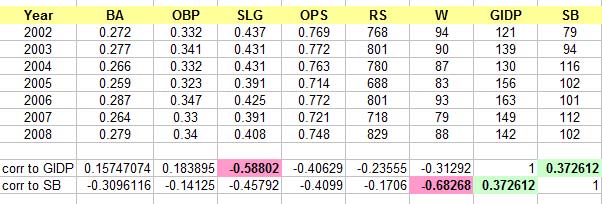
GIDP (top line in the bottom of the table) has the highest negative correlation with SLG and the highest positive correlation with SB. SB, has the highest positive correlation with GIDP and the highest negative correlation with wins.
In other words:
1. The higher the number of stolen bases the less wins the team has
2. The higher the number of stolen bases the more GIDP (and the reverse) the higher the number of GIDP, the higher the number of SB
3. The higher the number of GIDP the lower the SLG.
Statement 3 makes absolute empirical sense. Statement 2 is fine also: the more a team grounds into double plays, the more it wants to run to prevent DP so the more SB. Statement 1 is the kicker that defies empirical knowledge and bit of further discussion is necessary.
Regardless the perception that stolen bases increase the probability of a team to win, James Click of Baseball Prospectus has shown that this is not a case in an article called What if Ricky Henderson Had Pete Incavilia's Legs?, Published in the Baseball Prospectus' book Baseball Between the Numbers. The previous link is a link to the whole book (pointing at the pertinent chapter) available free at google books. Great read. A must for stat fans. So despite the popular empirical opinion, stolen bases have been proven to decrease win probability and the 2002-2008 Twins, confirm this fact.
As a conclusion, OPS is still the best correlating measurement to Wins for these Twins. And OPS (and projected OPS) could be used as a leading indicator to predict wins as I did here. This is fine for these Twins, but how about the rest of the league? What if you wanted to start a team from scratch or select a fantasy team? What would be the best league indication away from the context of the Gardy Twins?
To answer this question I looked at the same statistic measurements I examined for the 2002-2008 Twins, with the addition of Pythagorian Wins a Bill James measurement that predicts wins based on runs scored and allowed. Pythagorian Wins is a lagging indicator, which it means that it confirms trends and events rather than predict them (in other words, a game has to be played before you get the RS and RA measurements, whereas you can use historical or predicted OPS values to predict future performance). The following chart will probably look like an eye-chart:
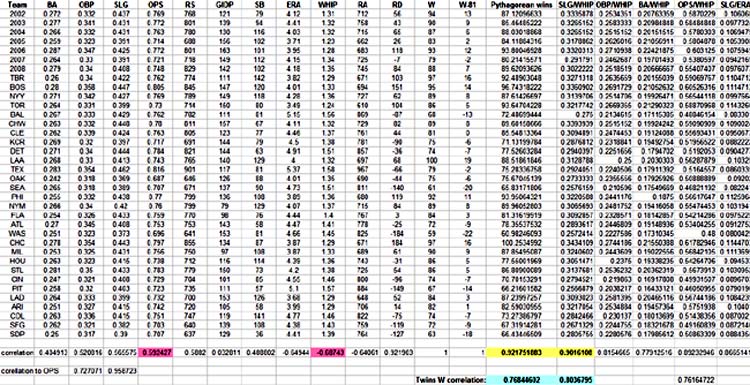
Here is the summary. Looking across the MLB teams in 2008. The best correlating measurement with Wins is Pythagorian Wins (0.922). The correlation of other categories were: BA:0.405, OBP:0.521, SLG:0.566, OPS: 0.592, RS: 0.588, GIDP: 0.033 (practically non correlated), SB: 0.489 (surprisingly a + correlation), ERA: -0.649 (the higher the ERA the fewer wins), WHIP: -0.687 and RA: -0.641. Unfortunately, not a single statistic that could be used as a leading indicator has similar correlation to wins as Pythagorian Wins (runs cannot be used as leading indicators). Plan B: create a composite measurement. I created 8 measurements dividing each of the 4 offensive categories (BA, OBP, SLG, OPS) with the 2 pitching categories (ERA, WHIP). Here is their correlation to Wins: SLG/WHIP: 0.907, OBP/WHIP: 0.815, BA/WHIP: 0.779, OPS/WHIP: 0.892, SLG/ERA: 0.867, OBP/ERA: 0.763, BA/ERA: 0.765 and OPS/ERA: 0.835.
As you can see SLG/WHIP has a correlation of 0.907, close to that of Pythagorian Wins 0.922) and could be used as a leading indicator for team wins. In other words, if you assemble a team from scratch, real life or fantasy look for batter with high SLG and pitchers with low WHIP.
But how about them Twins? Well, for the Gardy Twins, the correlation of wins with Pythagorian wins was 0.768 and the correlation of SLG/WHIP with wins was 0.804, both lower than the correlation of OPS with wins (0.886). So, in other words, if you want to make the Twins better, look for batters with high OPS, esp the SLG part of OPS, because that correlates with OPS for these Twins at a close to absolute 0.959 rate.
Why is that discrepancy between the Gardy Twins and the rest of the league? Here is my theory and deemed to be vastly unpopular but not surprising to the people who have been following this blog. Look at this table for the Gardy Twins:
The harder the division has gotten in the Gardy ERA (right column is the record of the rest of the division) the harder time the Twins have to achieve their predictive record. They fell short a win or two, but a win or two would have gotten the Twins in the postseason this year. Why does this happen? Methinks is the manager who does not realize the full potential of the team. But this is another long discussion.
Next: evaluating pitchers.
One surprise: Stolen bases have a negative correlation to wins for the Gardy Twins, which is actually stronger than the positive correlation of runs scored (compare the pink boxes). In plain english, this means that this team has less chance to win if they steal. By first glance this looks like a paradox, albeit an interesting one. OPS still has the higher correlation to wins and GIDP does have an expected negative correlation (albeit not extremely strong) with wins.
I dug further and examined the correlation of both GIDP and SB with the other offensive statistic measurements as well as with wins:
GIDP (top line in the bottom of the table) has the highest negative correlation with SLG and the highest positive correlation with SB. SB, has the highest positive correlation with GIDP and the highest negative correlation with wins.
In other words:
1. The higher the number of stolen bases the less wins the team has
2. The higher the number of stolen bases the more GIDP (and the reverse) the higher the number of GIDP, the higher the number of SB
3. The higher the number of GIDP the lower the SLG.
Statement 3 makes absolute empirical sense. Statement 2 is fine also: the more a team grounds into double plays, the more it wants to run to prevent DP so the more SB. Statement 1 is the kicker that defies empirical knowledge and bit of further discussion is necessary.
Regardless the perception that stolen bases increase the probability of a team to win, James Click of Baseball Prospectus has shown that this is not a case in an article called What if Ricky Henderson Had Pete Incavilia's Legs?, Published in the Baseball Prospectus' book Baseball Between the Numbers. The previous link is a link to the whole book (pointing at the pertinent chapter) available free at google books. Great read. A must for stat fans. So despite the popular empirical opinion, stolen bases have been proven to decrease win probability and the 2002-2008 Twins, confirm this fact.
As a conclusion, OPS is still the best correlating measurement to Wins for these Twins. And OPS (and projected OPS) could be used as a leading indicator to predict wins as I did here. This is fine for these Twins, but how about the rest of the league? What if you wanted to start a team from scratch or select a fantasy team? What would be the best league indication away from the context of the Gardy Twins?
To answer this question I looked at the same statistic measurements I examined for the 2002-2008 Twins, with the addition of Pythagorian Wins a Bill James measurement that predicts wins based on runs scored and allowed. Pythagorian Wins is a lagging indicator, which it means that it confirms trends and events rather than predict them (in other words, a game has to be played before you get the RS and RA measurements, whereas you can use historical or predicted OPS values to predict future performance). The following chart will probably look like an eye-chart:
Here is the summary. Looking across the MLB teams in 2008. The best correlating measurement with Wins is Pythagorian Wins (0.922). The correlation of other categories were: BA:0.405, OBP:0.521, SLG:0.566, OPS: 0.592, RS: 0.588, GIDP: 0.033 (practically non correlated), SB: 0.489 (surprisingly a + correlation), ERA: -0.649 (the higher the ERA the fewer wins), WHIP: -0.687 and RA: -0.641. Unfortunately, not a single statistic that could be used as a leading indicator has similar correlation to wins as Pythagorian Wins (runs cannot be used as leading indicators). Plan B: create a composite measurement. I created 8 measurements dividing each of the 4 offensive categories (BA, OBP, SLG, OPS) with the 2 pitching categories (ERA, WHIP). Here is their correlation to Wins: SLG/WHIP: 0.907, OBP/WHIP: 0.815, BA/WHIP: 0.779, OPS/WHIP: 0.892, SLG/ERA: 0.867, OBP/ERA: 0.763, BA/ERA: 0.765 and OPS/ERA: 0.835.
As you can see SLG/WHIP has a correlation of 0.907, close to that of Pythagorian Wins 0.922) and could be used as a leading indicator for team wins. In other words, if you assemble a team from scratch, real life or fantasy look for batter with high SLG and pitchers with low WHIP.
But how about them Twins? Well, for the Gardy Twins, the correlation of wins with Pythagorian wins was 0.768 and the correlation of SLG/WHIP with wins was 0.804, both lower than the correlation of OPS with wins (0.886). So, in other words, if you want to make the Twins better, look for batters with high OPS, esp the SLG part of OPS, because that correlates with OPS for these Twins at a close to absolute 0.959 rate.
Why is that discrepancy between the Gardy Twins and the rest of the league? Here is my theory and deemed to be vastly unpopular but not surprising to the people who have been following this blog. Look at this table for the Gardy Twins:
year         actual wins      pythagorian wins    AL Central Record- Twins

2002            94                  87                 .421
2003            90                  85                 .432
2004            87                  88                 .452
2005            83                  84                 .492
2006            93                  94                 .502
2007            79                  80                 .502
2008            88                  90                 .492
The harder the division has gotten in the Gardy ERA (right column is the record of the rest of the division) the harder time the Twins have to achieve their predictive record. They fell short a win or two, but a win or two would have gotten the Twins in the postseason this year. Why does this happen? Methinks is the manager who does not realize the full potential of the team. But this is another long discussion.
Next: evaluating pitchers.
10/31/08
Middle infield revisited:
After devising the BFE measurement to apply to third basemen, I am examining the ranking of MLB second basemen and short stops based on their 2007 BFE numbers (Twins in bold, SS free agents in italics) Minimum 200 innings at the position and 250 AB:
Short Stops:
Rafael Furcal, LA: 1.331 (fewer than 250AB)
Hanley Ramirez, Fla: 1.194
Jerry Hairston Jr., Cin: 0.983
Mike Aviles, KC: 0.959
Jose Reyes, NYM: 0.949
J.J. Hardy, Mil: 0.890
Stephen Drew, Ari: 0.871
Jhonny Peralta, Cle: 0.854
Jimmy Rollins, Phi: 0.853
Derek Jeter, NYY: 0.852
Yunel Escobar, Atl: 0.848
Cristian Guzman, Was: 0.845
Jed Lowrie, Bos: 0.824
Clint Barmes, Col: 0.821
15.Nick Punto, Min: 0.808
Michael Young, Tex: 0.773
Miguel Tejada, Hou: 0.766
Ryan Theriot, ChC: 0.758
Marco Scutaro, Tor: 0.746
MLB AVERAGE: .745
Troy Tulowitzki, Col: 0.717
Maicer Izturis, LAA: 0.716
22.Brendan Harris, Min: 0.701
Erick Aybar, LAA: 0.690
Orlando Cabrera, CWS: 0.683
Jason Bartlett, TB: 0.682
Yuniesky Betancourt, Sea: 0.672
Edgar Renteria, Det: 0.661
David Eckstein, Tor/Ari: 0.645
Jack Wilson, Pit: 0.629
Julio Lugo, Bos: 0.622
Bobby Crosby, Oak: 0.610
Cesar Izturis, StL: 0.558
Jeff Keppinger, Cin: 0.539
Khalil Greene, SD: 0.527
Angel Berroa, LA: 0.507
36.Adam Everett, Min: 0.497
Omar Vizquel, SF: 0.407
Juan Castro, Bal/Cin: 0.279
Second basemen:
Mike Fontenot, CHI: 1.131 (246 AB)
Chase Utley, Phi: 1.105
Ian Kinsler, Tex: 1.069
Dustin Pedroia, Bos: 1.042
Dan Uggla, Fla: 1.024
Brian Roberts, Bal: 0.967
Mark DeRosa, ChC: 0.953
Ray Durham, Mil/SF: 0.867
Kelly Johnson, Atl: 0.858
Placido Polanco, Det: 0.849
Orlando Hudson, Ari: 0.846
Alexei Ramirez, CWS: 0.834
Joe Inglett, Tor: 0.825
Jose Lopez, Sea: 0.824
Kazuo Matsui, Hou: 0.823
Ronnie Belliard, Was: 0.812
Clint Barmes, Col: 0.804
Howie Kendrick, LAA: 0.796
Aaron Miles, StL: 0.794
MLB AVERAGE: 0.792
Mark Grudzielanek, KC: 0.782
Mark Ellis, Oak: 0.776
Akinori Iwamura, TB: 0.771
Mark Loretta, Hou: 0.770
Brandon Phillips, Cin: 0.760
Jeff Baker, Col: 0.755
Edgar Gonzalez, SD: 0.745
28.Nick Punto, Min: 0.744
Rickie Weeks, Mil: 0.739
Felipe Lopez, Was/StL: 0.737
31.Alexi Casilla, Min: 0.736
Marco Scutaro, Tor: 0.721
Asdrubal Cabrera, Cle: 0.720
Jeff Kent, LA: 0.719
35.Brendan Harris, Min: 0.716
Robinson Cano, NYY: 0.701
Adam Kennedy, StL: 0.693
Jamey Carroll, Cl: 0.689
Juan Uribe, CWS: 0.654
Damion Easley, NYM: 0.629
Freddy Sanchez, Pit: 0.604
Luis Castillo, NYM: 0.591
Eugenio Velez, SF: 0.573
Tadahito Iguchi, Phi/SD: 0.516
Some observations:
How does this change my previous assessment of the middle infield needs? Not much. I did propose changes in both 2B and SS, and the numbers reinforce the need for change in 2B. I also think that Punto with his performance last year, plus the high contract offers for middle infielders (see: Ellis, Mark) has priced his way out of the Twins' organization. Steve Tolleson with a spectacular ALF performance (.426/.463/.590, 2HR, 16 RBI in 61 AB as of this post) and a solid minor league season will be in the mix and potentially fight with Tolbert for a position in the 25-men roster.
Short Stops:
Rafael Furcal, LA: 1.331 (fewer than 250AB)
Hanley Ramirez, Fla: 1.194
Jerry Hairston Jr., Cin: 0.983
Mike Aviles, KC: 0.959
Jose Reyes, NYM: 0.949
J.J. Hardy, Mil: 0.890
Stephen Drew, Ari: 0.871
Jhonny Peralta, Cle: 0.854
Jimmy Rollins, Phi: 0.853
Derek Jeter, NYY: 0.852
Yunel Escobar, Atl: 0.848
Cristian Guzman, Was: 0.845
Jed Lowrie, Bos: 0.824
Clint Barmes, Col: 0.821
15.Nick Punto, Min: 0.808
Michael Young, Tex: 0.773
Miguel Tejada, Hou: 0.766
Ryan Theriot, ChC: 0.758
Marco Scutaro, Tor: 0.746
MLB AVERAGE: .745
Troy Tulowitzki, Col: 0.717
Maicer Izturis, LAA: 0.716
22.Brendan Harris, Min: 0.701
Erick Aybar, LAA: 0.690
Orlando Cabrera, CWS: 0.683
Jason Bartlett, TB: 0.682
Yuniesky Betancourt, Sea: 0.672
Edgar Renteria, Det: 0.661
David Eckstein, Tor/Ari: 0.645
Jack Wilson, Pit: 0.629
Julio Lugo, Bos: 0.622
Bobby Crosby, Oak: 0.610
Cesar Izturis, StL: 0.558
Jeff Keppinger, Cin: 0.539
Khalil Greene, SD: 0.527
Angel Berroa, LA: 0.507
36.Adam Everett, Min: 0.497
Omar Vizquel, SF: 0.407
Juan Castro, Bal/Cin: 0.279
Second basemen:
Mike Fontenot, CHI: 1.131 (246 AB)
Chase Utley, Phi: 1.105
Ian Kinsler, Tex: 1.069
Dustin Pedroia, Bos: 1.042
Dan Uggla, Fla: 1.024
Brian Roberts, Bal: 0.967
Mark DeRosa, ChC: 0.953
Ray Durham, Mil/SF: 0.867
Kelly Johnson, Atl: 0.858
Placido Polanco, Det: 0.849
Orlando Hudson, Ari: 0.846
Alexei Ramirez, CWS: 0.834
Joe Inglett, Tor: 0.825
Jose Lopez, Sea: 0.824
Kazuo Matsui, Hou: 0.823
Ronnie Belliard, Was: 0.812
Clint Barmes, Col: 0.804
Howie Kendrick, LAA: 0.796
Aaron Miles, StL: 0.794
MLB AVERAGE: 0.792
Mark Grudzielanek, KC: 0.782
Mark Ellis, Oak: 0.776
Akinori Iwamura, TB: 0.771
Mark Loretta, Hou: 0.770
Brandon Phillips, Cin: 0.760
Jeff Baker, Col: 0.755
Edgar Gonzalez, SD: 0.745
28.Nick Punto, Min: 0.744
Rickie Weeks, Mil: 0.739
Felipe Lopez, Was/StL: 0.737
31.Alexi Casilla, Min: 0.736
Marco Scutaro, Tor: 0.721
Asdrubal Cabrera, Cle: 0.720
Jeff Kent, LA: 0.719
35.Brendan Harris, Min: 0.716
Robinson Cano, NYY: 0.701
Adam Kennedy, StL: 0.693
Jamey Carroll, Cl: 0.689
Juan Uribe, CWS: 0.654
Damion Easley, NYM: 0.629
Freddy Sanchez, Pit: 0.604
Luis Castillo, NYM: 0.591
Eugenio Velez, SF: 0.573
Tadahito Iguchi, Phi/SD: 0.516
Some observations:
- Surprisingly, second base seems to be a bigger problem for the Twins in 2008, than SS
- Punto was an above average SS, ranking 15th out of 34 players, surpassing players like Michael Young and Miguel Tejada, while Harris at 23 was 3 spots below MLB average
- Punto was the highest ranking 2B at #28 but still well-below the MLB-average. Castillo (despite the fact that he is projected as a lock for the position in 2009, in most people's minds) was ranked at #31 and Harris at #35.
- Tolbert did not have enough innings or ABs to qualify for ranking in any position, while Everett was ranked close to the bottom in the SS rankings
How does this change my previous assessment of the middle infield needs? Not much. I did propose changes in both 2B and SS, and the numbers reinforce the need for change in 2B. I also think that Punto with his performance last year, plus the high contract offers for middle infielders (see: Ellis, Mark) has priced his way out of the Twins' organization. Steve Tolleson with a spectacular ALF performance (.426/.463/.590, 2HR, 16 RBI in 61 AB as of this post) and a solid minor league season will be in the mix and potentially fight with Tolbert for a position in the 25-men roster.
10/29/08
Third base revisited
In order to give an objective (see: measurable) application of the criteria, I previously suggested for potential third basemen targets, I devised a measurement that combines the performance of a player as a batter and as a fielder. This measurement (let's call it Batting and Fielding Effectiveness, BFE for the lack of a better name) is defined as (OPS+/100)*(FP)*(ZR).
As a reminder the 3 criteria for a potential third baseman target were defined as:
a. the Twins should not look at anyone with less production than the current Buscher/Harris platoon
b. Danny Valencia is thought by many insiders and fans to be the Twins 3rd baseman of the future, so any choice should potentially leave the door open for him
c. Any new third baseman should provide better power (in the numbers below expressed as SLG%), be right handed batter and provide better defense.
The definition of a "third baseman" I am using here is a player with at least 250 AB and at least 250 innings at third base. 56 players in the majors satisfy this definition, here is how they rank according to BFE (potential targets discussed before are indicated with italics, the Twins' third basemen are indicated with bold) :
Chipper Jones, Braves: 1.390
Kevin Youkilis, Red Sox: 1.168
Alex Rodriguez, Yankees: 1.167
Russell Branyan, Brewers: 1.087
David Wright, Mets: 1.052
Aubrey Huff, Orioles: 1.032
Evan Longoria, Rays: .998
Ty Wiggington, Astros: .973
Troy Glaus, Cardinals: .966
Chris Davis, Rangers: .948
Aramis Ramirez, Cubs: .923
Carlos Guillen, Tigers: .903
Adrian Beltre, Mariners: .887
Hank Blalock, Rangers: .873
Melvin Mora, Orioles: .865
Ron Belliard, Nationals: .848
Mike Lowell Red Sox: .828
Scott Rollen Blue Jays: .825
Casey Blake, Indians/Dodgers: .810
20. Ryan Zimmerman, Nationals .794
Gregg Dobbs, Phillies: .783
Ramon Vasquez, Rangers: .773
Omar Infante, Braves: .773
Willie Aybar, Rays: .765
MLB AVERAGE: .764
Jorge Cantu, Marlins: .756
Ian Steward, Rockies: .755
Joe Crede, White Sox: .744
Edwin Encarnancion, Reds: .738
Alex Gordon, Royals: .736
Marco Scutaro, Blue Jays: .736
Garett Atkins, Rockies: .728
Kevin Kouzmanoff, Padres: .726
Rich Aurilia, Giants: .708
34. Brian Buscher, Twins: .704
35. Brendan Harris, Twins: .699
Blake DeWitt, Dodgers: .686
Chone Figgins, Angels: .681
Jose Bautista, Pirates: .680
Jed Lowrie, Red Sox: .679
Brandon Inge, Tigers: .677
Doug Mientkiewicz, Pirates: .676
Jeff Blum, Astros: .666
Mark Reynolds, Diamondbacks: .659
Craig Council, Brewers: .656
Pedro Feliz, Phillies: .632
Jamie Caroll, Indians: .609
Bill Hall, Brewers: .606
Jose Castillo, Giants: .599
Juan Uribe, White Sox: .595
Jack Hannahan, As: .586
Wes Helms, Marlins: .560
German Duran, Rangers: .467
Rob Quinlan, Angels: .456
Mike Lamb, Twins: .432
Andy Marte, Indians: .414
Andy LaRoche, Dodgers/Reds: .276
There were a few surprises:
Do the results make me amend my list of 4+1 real targets? Based on the above 3 criteria (RH batter included), and the fact that to make a serious difference the Twins should not look below the top 20 players (#20 is Ryan Zimmerman), I would gladly add Melvin Mora, Ron Belliard and Casey Blake to the list that includes Troy Glaus, Ty Wiggington, Adrian Beltre, Scott Rolen and Mike Lowell.
I will use the same analysis to the 2B/SS situation
As a reminder the 3 criteria for a potential third baseman target were defined as:
a. the Twins should not look at anyone with less production than the current Buscher/Harris platoon
b. Danny Valencia is thought by many insiders and fans to be the Twins 3rd baseman of the future, so any choice should potentially leave the door open for him
c. Any new third baseman should provide better power (in the numbers below expressed as SLG%), be right handed batter and provide better defense.
The definition of a "third baseman" I am using here is a player with at least 250 AB and at least 250 innings at third base. 56 players in the majors satisfy this definition, here is how they rank according to BFE (potential targets discussed before are indicated with italics, the Twins' third basemen are indicated with bold) :
Chipper Jones, Braves: 1.390
Kevin Youkilis, Red Sox: 1.168
Alex Rodriguez, Yankees: 1.167
Russell Branyan, Brewers: 1.087
David Wright, Mets: 1.052
Aubrey Huff, Orioles: 1.032
Evan Longoria, Rays: .998
Ty Wiggington, Astros: .973
Troy Glaus, Cardinals: .966
Chris Davis, Rangers: .948
Aramis Ramirez, Cubs: .923
Carlos Guillen, Tigers: .903
Adrian Beltre, Mariners: .887
Hank Blalock, Rangers: .873
Melvin Mora, Orioles: .865
Ron Belliard, Nationals: .848
Mike Lowell Red Sox: .828
Scott Rollen Blue Jays: .825
Casey Blake, Indians/Dodgers: .810
20. Ryan Zimmerman, Nationals .794
Gregg Dobbs, Phillies: .783
Ramon Vasquez, Rangers: .773
Omar Infante, Braves: .773
Willie Aybar, Rays: .765
MLB AVERAGE: .764
Jorge Cantu, Marlins: .756
Ian Steward, Rockies: .755
Joe Crede, White Sox: .744
Edwin Encarnancion, Reds: .738
Alex Gordon, Royals: .736
Marco Scutaro, Blue Jays: .736
Garett Atkins, Rockies: .728
Kevin Kouzmanoff, Padres: .726
Rich Aurilia, Giants: .708
34. Brian Buscher, Twins: .704
35. Brendan Harris, Twins: .699
Blake DeWitt, Dodgers: .686
Chone Figgins, Angels: .681
Jose Bautista, Pirates: .680
Jed Lowrie, Red Sox: .679
Brandon Inge, Tigers: .677
Doug Mientkiewicz, Pirates: .676
Jeff Blum, Astros: .666
Mark Reynolds, Diamondbacks: .659
Craig Council, Brewers: .656
Pedro Feliz, Phillies: .632
Jamie Caroll, Indians: .609
Bill Hall, Brewers: .606
Jose Castillo, Giants: .599
Juan Uribe, White Sox: .595
Jack Hannahan, As: .586
Wes Helms, Marlins: .560
German Duran, Rangers: .467
Rob Quinlan, Angels: .456
Mike Lamb, Twins: .432
Andy Marte, Indians: .414
Andy LaRoche, Dodgers/Reds: .276
There were a few surprises:
- The Twins situation at third base, which is thought as "serviceable" by many is more dire than thought, with the Twins' platoon ranking 34th and 35th out of 56 players
- Players like Russell Branyan, Chris Davis and Ron Belliard, who flew under the radar had surprisingly good years
- Players like Garrett Atkins, Edwin Encarnancion and Kevin Kouzmanoff, who are touted as the potential 3B solution for the Twins are not that much better than what the Twins currently have
Do the results make me amend my list of 4+1 real targets? Based on the above 3 criteria (RH batter included), and the fact that to make a serious difference the Twins should not look below the top 20 players (#20 is Ryan Zimmerman), I would gladly add Melvin Mora, Ron Belliard and Casey Blake to the list that includes Troy Glaus, Ty Wiggington, Adrian Beltre, Scott Rolen and Mike Lowell.
I will use the same analysis to the 2B/SS situation
10/23/08
The bottom line with the prosposed 2009 changes (and a bunch of stats to boot)
How many wins will the changes in the Twins’ lineup will produce? To answer this question we have to examine what makes the Twins’ teams under Gardenhire and his coaches win games and how many potential games will the Twins win in 2009 if they make these changes.
Keep in mind that before last season started I used different methodologies to predict that the Twins will win 89 games in 2008, amidst wild speculation from the 'experts' that they will finish 4th or 5th and barely crack 70 wins. Also, using game by game arguments, I predicted that Detroit will win a maximum of 79 games in 2008, while everyone else had them sweeping their way to the World Series. After much ridicule upon publication of these things last spring, I can now just say, “I told you so. And numbers do not lie if you know how to take advantage of them and use them correctly.”
But enough self-patting on the back. Self-induced high-fives look a lot like clapping and cannot clap when Tampa Bay instead of the Twins is playing today in the World Series.
That was then, this is now and there will be more game-to-game predictions coming next spring after the roster is settled, but I wanted to device a statistical way that would allow me to a. see what makes these Twins win (i.e. The Gardenhire era Twins) and b. what effect certain moves have on the Twins W-L record.
It is generally accepted that W-L record is related to the run differential of a team. Heck, Bill James devised his Pythagorean Wins Expectation formula based on Runs Scores (RS) and Runs Allowed (RA), and who the hell am I to doubt the word of the baseball statistics God? Nah, I am not doubting Bill James, but it is all about context (and a warning, from here on this is going to be pretty statistically intense, so if you want the bottom line skip at the end of the post.) One cannot predict how many games the Twins will win in 2008 and 2009 based on a formula constructed that includes data from the number of games the Babe Ruth- and Lou Gheric-led Yankee teams won in the deadball era. Context is extremely important in Baseball of all sports. Different teams have different philosophies and different practices. Thus, I am just looking at statistical samples of the Twins under Gardenhire, and this is what the quasi-big picture looks like:
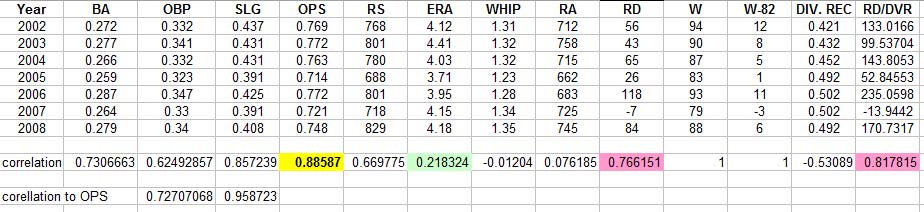
Back to English:
What I did here was to look at several statistical measures (stats) from the Twins from 2002 on (listed as a table year by year) and see how they correlate with the Twins' W-L record that year (Because the Twins had a negative run differential in 2007, I had to correlate that to wins-82 to balance the scales in order for the algebra gods to not give me biased numbers)
What the results show is that the Gardenhine Twins W-L record correlates better (BTW, 1 is perfect correlation) not with ERA (light green/blue box), not with Run Differential (left pink box), even when the RD was normalized for the other teams of the AL Central winning percentage (far right pink box), but it correlated better with team OPS (yellow box).
OPS has two components: OBP and SLG. In the line underneath the year-by-year numbers, I correlated OPS for the Gardy Twins with OBP and SLG. As you can see,for the Gardy years, OPS is very closely correlated to SLG rather than OBP. I am not going to use this fact again (or against anyone other than Billy Bean and he is out of context, anywaya) but the take home lesson is that these Twins succeed when they have a higher slugging percentage (and this was quasi-empirically covered here, albeit in a very dry way.)
Alright... you buy it or not :) this is leading us to potentially formulate a relationship between OPS and wins for the Gardenhire Twins:
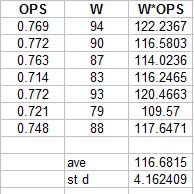
and based on the average and standard deviation, one can formulate an OPS vs. wins chart that would look like that:
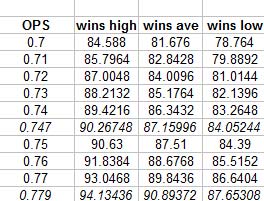
(forget the italics for a moment) This basically allows you to calculate the maximum, average, and minimum wins expected based on a particular team OPS.
Aright. We got our formula, let's put in into play:
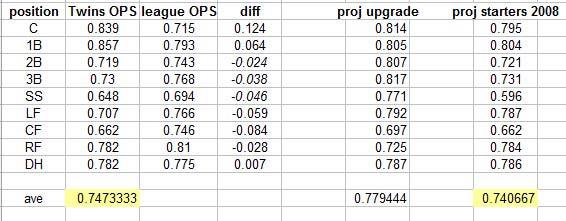
This figure turned up a little more complex than I wanted it (heck, I can't help it), so please ignore columns 3 and 4 (league OPS and diff). Column 1 is the field positions. Column 2 is their OPS. The column titled projected update is the projected OPS numbers of the Twins lineup with the proposed changes in the previous post. The projected OPS values I used are the projected PECOTA OPS values for the proposed Twins' lineup. To see whether that makes any sense, I had to do the control showing the projections of the 2008 starters column (far right), where I used the PECOTA projections for the 2008 Twins starters to predict team OPS. Using that, the Twins' team OPS was predicted to be .741 which is very close to the actual .747 and that makes me a bit more confident about the use of PECOTA projections for 2009.
So, the bottom line is (go to the previous table and look at the italics): with the proposed changes the Twins should win 4 more games than 2008.
Methinks that 92 games will lead the Twins to win the AL Central in 2009.
PS. I'd love to correlate the stat of your choice with the Twins' wins if you don't see it above. Just drop a comment and I'll make it happen...
Keep in mind that before last season started I used different methodologies to predict that the Twins will win 89 games in 2008, amidst wild speculation from the 'experts' that they will finish 4th or 5th and barely crack 70 wins. Also, using game by game arguments, I predicted that Detroit will win a maximum of 79 games in 2008, while everyone else had them sweeping their way to the World Series. After much ridicule upon publication of these things last spring, I can now just say, “I told you so. And numbers do not lie if you know how to take advantage of them and use them correctly.”
But enough self-patting on the back. Self-induced high-fives look a lot like clapping and cannot clap when Tampa Bay instead of the Twins is playing today in the World Series.
That was then, this is now and there will be more game-to-game predictions coming next spring after the roster is settled, but I wanted to device a statistical way that would allow me to a. see what makes these Twins win (i.e. The Gardenhire era Twins) and b. what effect certain moves have on the Twins W-L record.
It is generally accepted that W-L record is related to the run differential of a team. Heck, Bill James devised his Pythagorean Wins Expectation formula based on Runs Scores (RS) and Runs Allowed (RA), and who the hell am I to doubt the word of the baseball statistics God? Nah, I am not doubting Bill James, but it is all about context (and a warning, from here on this is going to be pretty statistically intense, so if you want the bottom line skip at the end of the post.) One cannot predict how many games the Twins will win in 2008 and 2009 based on a formula constructed that includes data from the number of games the Babe Ruth- and Lou Gheric-led Yankee teams won in the deadball era. Context is extremely important in Baseball of all sports. Different teams have different philosophies and different practices. Thus, I am just looking at statistical samples of the Twins under Gardenhire, and this is what the quasi-big picture looks like:
Back to English:
What I did here was to look at several statistical measures (stats) from the Twins from 2002 on (listed as a table year by year) and see how they correlate with the Twins' W-L record that year (Because the Twins had a negative run differential in 2007, I had to correlate that to wins-82 to balance the scales in order for the algebra gods to not give me biased numbers)
What the results show is that the Gardenhine Twins W-L record correlates better (BTW, 1 is perfect correlation) not with ERA (light green/blue box), not with Run Differential (left pink box), even when the RD was normalized for the other teams of the AL Central winning percentage (far right pink box), but it correlated better with team OPS (yellow box).
OPS has two components: OBP and SLG. In the line underneath the year-by-year numbers, I correlated OPS for the Gardy Twins with OBP and SLG. As you can see,for the Gardy years, OPS is very closely correlated to SLG rather than OBP. I am not going to use this fact again (or against anyone other than Billy Bean and he is out of context, anywaya) but the take home lesson is that these Twins succeed when they have a higher slugging percentage (and this was quasi-empirically covered here, albeit in a very dry way.)
Alright... you buy it or not :) this is leading us to potentially formulate a relationship between OPS and wins for the Gardenhire Twins:
and based on the average and standard deviation, one can formulate an OPS vs. wins chart that would look like that:
(forget the italics for a moment) This basically allows you to calculate the maximum, average, and minimum wins expected based on a particular team OPS.
Aright. We got our formula, let's put in into play:
This figure turned up a little more complex than I wanted it (heck, I can't help it), so please ignore columns 3 and 4 (league OPS and diff). Column 1 is the field positions. Column 2 is their OPS. The column titled projected update is the projected OPS numbers of the Twins lineup with the proposed changes in the previous post. The projected OPS values I used are the projected PECOTA OPS values for the proposed Twins' lineup. To see whether that makes any sense, I had to do the control showing the projections of the 2008 starters column (far right), where I used the PECOTA projections for the 2008 Twins starters to predict team OPS. Using that, the Twins' team OPS was predicted to be .741 which is very close to the actual .747 and that makes me a bit more confident about the use of PECOTA projections for 2009.
So, the bottom line is (go to the previous table and look at the italics): with the proposed changes the Twins should win 4 more games than 2008.
Methinks that 92 games will lead the Twins to win the AL Central in 2009.
PS. I'd love to correlate the stat of your choice with the Twins' wins if you don't see it above. Just drop a comment and I'll make it happen...
Recap: proposed changes, 25 man roster and payroll for 2009.
To recap & summarize the previous posts, here are the proposed off-season changes and their cost to the Twins:
total cost: $29 M, which will bring the Twins' 2009 payroll to $76 Million, or $4.5 million more than their 2007 payroll.
Thus, the Twins projected 25-man roster would be:
lineup (and batting order):
LF Span
RF Young
C Mauer
3B Glaus
1B Morneau
2B Uggla
DH Kubel
SS Greene
CF Gomez
bench:
C Redmond
IF Harris
IF Tolbert/Tolleson
OF/DH/1B Cuddyer
rotation:
SP Liriano
SP Slowey
SP Baker
SP Martinez
SP Blackburn
bullpen:
Joe Nathan RH
Pat Neshek RH
Jose Mijares LH
Craig Breslow LH
Jesse Crain RH
Robert Deleaney RH (or Korecky/Swarzak/Mulvey)
Matt Guerrier RH
Next posts: a. How many wins will this team get and b. changes in the minors & organization
- Glenn Perkins, Brian Buscher and a prospect to the Cardinals for Troy Glaus ($12M)
- Boof Bonser and Trevor Plouffe to the Padres for Khalil Greene ($6.5M)
- Alexi Casilla, Brian Duensing, Phillip Humber and Sergio Santos to the Marlins for Dan Uggla ($5M)
- Sign Pedro Martinez ($6M)
total cost: $29 M, which will bring the Twins' 2009 payroll to $76 Million, or $4.5 million more than their 2007 payroll.
Thus, the Twins projected 25-man roster would be:
lineup (and batting order):
LF Span
RF Young
C Mauer
3B Glaus
1B Morneau
2B Uggla
DH Kubel
SS Greene
CF Gomez
bench:
C Redmond
IF Harris
IF Tolbert/Tolleson
OF/DH/1B Cuddyer
rotation:
SP Liriano
SP Slowey
SP Baker
SP Martinez
SP Blackburn
bullpen:
Joe Nathan RH
Pat Neshek RH
Jose Mijares LH
Craig Breslow LH
Jesse Crain RH
Robert Deleaney RH (or Korecky/Swarzak/Mulvey)
Matt Guerrier RH
Next posts: a. How many wins will this team get and b. changes in the minors & organization
New potential third base target?
In my analysis of potential third basemen targets, I concluded that there were only 4 players who meet the following criteria:
a. improve the infield defense
b. improve the hitting against LHP
c. improve the teams SLG%, esp. from the right side
and the improvement was based on the 2007 baseline numbers of the Twins' third basemen currently with the team:
Buscher (L) SLG .390 FP .938 ZR .774
Harris (R) SLG .394 FP .949 ZR .766
There are strong rumors out of Boston indicating that the Red Sox are looking into moving Lowell after they obtain a more powerful bat in the middle of their order (Texeira has been mentioned as a 1B, which will move Youkilis to 3B).
Lowell would fit the above criteria. His SLG was .461, FP .967 and ZR .815. He is a right hand batter and will be 36 at spring training. He is under contract through 2010 at $12M per year. Given the health concerns (he had back surgery that will cause him to be out until at least spring training - there are some reports that he will be out of the season), and the contract, a mid-level prospect would be adequate to complete the trade. For arqument's sake, lets assume that he will be healthy? Here is how Lowell ranks in the 2 factors used earlier to establish the order among the other 4:
Quality At-Bat %:
Rolen: 46%
Glaus: 46%
Wigington: 45%
Beltre: 44%
Lowell: 43%
Chase % with 2 Strikes:
Glaus: 30%
Wiggington: 36%
Lowell 37%
Rolen: 41%
Beltre: 51%
These results will put Lowell some place between Wiggington and Rolen, making the preferred order:
1. Glaus
2. Wiggington
3. Lowell
4. Rolen
5. Beltre
There are serious health concerns for Lowell, making his acquisition a potential high risk/high reward with minimum payment. The only problem with the Twins potentially going that direction is that the seriousness of his condition might not be known until February, which might too late to get another third baseman, if the medical reports are discouraging.
a. improve the infield defense
b. improve the hitting against LHP
c. improve the teams SLG%, esp. from the right side
and the improvement was based on the 2007 baseline numbers of the Twins' third basemen currently with the team:
Buscher (L) SLG .390 FP .938 ZR .774
Harris (R) SLG .394 FP .949 ZR .766
There are strong rumors out of Boston indicating that the Red Sox are looking into moving Lowell after they obtain a more powerful bat in the middle of their order (Texeira has been mentioned as a 1B, which will move Youkilis to 3B).
Lowell would fit the above criteria. His SLG was .461, FP .967 and ZR .815. He is a right hand batter and will be 36 at spring training. He is under contract through 2010 at $12M per year. Given the health concerns (he had back surgery that will cause him to be out until at least spring training - there are some reports that he will be out of the season), and the contract, a mid-level prospect would be adequate to complete the trade. For arqument's sake, lets assume that he will be healthy? Here is how Lowell ranks in the 2 factors used earlier to establish the order among the other 4:
Quality At-Bat %:
Rolen: 46%
Glaus: 46%
Wigington: 45%
Beltre: 44%
Lowell: 43%
Chase % with 2 Strikes:
Glaus: 30%
Wiggington: 36%
Lowell 37%
Rolen: 41%
Beltre: 51%
These results will put Lowell some place between Wiggington and Rolen, making the preferred order:
1. Glaus
2. Wiggington
3. Lowell
4. Rolen
5. Beltre
There are serious health concerns for Lowell, making his acquisition a potential high risk/high reward with minimum payment. The only problem with the Twins potentially going that direction is that the seriousness of his condition might not be known until February, which might too late to get another third baseman, if the medical reports are discouraging.
10/18/08
Offseason needs 4 and 5: bullpen and back up catcher
The Twins' quickly took care of need #5, by exercising Mike Redmond's option. I think that it was an ok move, because Redmond is as good as most older back up catchers out there, albeit with reduced production at the twilight of his career. In the next offseason moves installment, I will discuss "tooling" the organization and the major league bench, and a young ready in 2009 AAA catcher will be identified as a higher priority.
As far as the bullpen goes, the numbers indicate that in contrast to the popular opinion, the bullpen was not as big of a problem as most 'experts' think. Saying that the Twins have bullpen issues, is as valid as saying that the Tampa Bay Rays have bullpen issues because Joe Maddon mismanaged his pen in the ALCS game 5 loss to the Red Sox.
Last season the Twins had some awful pitchers in the pen (Rincon, Bass, Guardado and Guerrier in September) who were used by Gardy after repeated failure in high leverage situations. It is not the personnel, it is use of the personnel and that is where Anderson and Gardenhire should focus on 2009: Go with the hot hand and if someone fails in high leverage situations, use them in low leverage situations, until they prove they can make outs.
The Twins will have a 12-man pitching staff in 2009, which means 7 bullpen arms. If I were Bill Smith, having already traded Bonser, Humber and Duensing and letting Reyes leave as a free agent, my 2009 pen would look like this:
Joe Nathan Closer
Pat Neshek RH Set up
Jose Mijares LH Set up
Craig Breslow LH RH middle relief
Jesse Crain RH middle relief
Robert Deleaney RH middle relief
Matt Guerrier long relief/mop up
next installment: further tooling and the 25-man and 40-man rosters
On an unrelated note, Milwaukee fired their hitting coach. Here is an excerpt from the article:
Skaalen obviously paid the price for an offense that disappeared in September, causing the Brewers to almost miss the playoffs and resulting in the firing of Yost.
The operating word is "almost". The Twins' offense also disappeared in September, causing them to miss the playoffs (unlike the Brewers who made it to the postseason the first time since 1982), but the Twins' brass (unlike the Brewers who fired their manager and hitting coach and letting their interim manager go) are not only keeping, but looking to extend Gardy for 2 more years, in addition to his contact year, and retain all of his coaches... I guess accountability is a higher value for the their Twins' eastern neighbors, as apparently is the desire to win.
As far as the bullpen goes, the numbers indicate that in contrast to the popular opinion, the bullpen was not as big of a problem as most 'experts' think. Saying that the Twins have bullpen issues, is as valid as saying that the Tampa Bay Rays have bullpen issues because Joe Maddon mismanaged his pen in the ALCS game 5 loss to the Red Sox.
Last season the Twins had some awful pitchers in the pen (Rincon, Bass, Guardado and Guerrier in September) who were used by Gardy after repeated failure in high leverage situations. It is not the personnel, it is use of the personnel and that is where Anderson and Gardenhire should focus on 2009: Go with the hot hand and if someone fails in high leverage situations, use them in low leverage situations, until they prove they can make outs.
The Twins will have a 12-man pitching staff in 2009, which means 7 bullpen arms. If I were Bill Smith, having already traded Bonser, Humber and Duensing and letting Reyes leave as a free agent, my 2009 pen would look like this:
Joe Nathan Closer
Pat Neshek RH Set up
Jose Mijares LH Set up
Craig Breslow LH RH middle relief
Jesse Crain RH middle relief
Robert Deleaney RH middle relief
Matt Guerrier long relief/mop up
next installment: further tooling and the 25-man and 40-man rosters
On an unrelated note, Milwaukee fired their hitting coach. Here is an excerpt from the article:
Skaalen obviously paid the price for an offense that disappeared in September, causing the Brewers to almost miss the playoffs and resulting in the firing of Yost.
The operating word is "almost". The Twins' offense also disappeared in September, causing them to miss the playoffs (unlike the Brewers who made it to the postseason the first time since 1982), but the Twins' brass (unlike the Brewers who fired their manager and hitting coach and letting their interim manager go) are not only keeping, but looking to extend Gardy for 2 more years, in addition to his contact year, and retain all of his coaches... I guess accountability is a higher value for the their Twins' eastern neighbors, as apparently is the desire to win.
10/17/08
The Rule V draft liabilities for the Twins
The Rule V Draft is held annually during baseball's Winter Meetings. Teams must file a 40 man roster with the league office by November 20. Any player who fits all of the below criteria is eligible for the Rule V Draft:
Any player drafted must stay in the major leagues all season. Before he is sent to the minors, he must be offered back to the club who had his rights for a $25,000 waiver fee.
Often, teams will send a player in lieu of the fee.
Minor league teams can also participate in the draft. AAA teams can draft any player
eligible from AA for $12,000, and AA teams can draft any players that are eligible from A for $4,000. Players chosen in the minor league part of the draft do not need to return to the original teams for any reason.
Here is a list of the Twins eligible for the rule V draft. I am including all players not on the 25 man roster by the end of last season, regardless whether they are in the latest 40-man roster.
Batters:
Daniel Berg
Drew Butera
Toby Gardenhire
@Luke Hughes
Garrett Jones
Ryan Jorgensen#
?Erik Lis
Alejandro Machado
?Matthew Macri#
Felix Molina
?Jose Morales#
Matt Moses
Yancarlos Ortiz
Edward Ovalle
Rodolfo Palacios
?Brock Peterson
?Jason Pridie#
?Trevor Plouffe
Brandon Roberts
?Randy Ruiz#
Danny Santiesteban
Sergio Santos#
Eli Tintor
@?Matt Tolbert#
?Steven Tolleson
Tommy Watkins
Johnny Woodard
Pitchers:
Kyle Aselton
Ricky Barrett
Carmen Cali
Julio DePaula#
?Brian Duensing
?Matthew Fox
?Armando Gabino
?Mariano Gomez
Jose Lugo
?Danny Graves
?Philip Humber#
?Ben Julianel
?Bobby Korecky#
Timothy Lahey
Frank Mata
@Jose Mijares#
Jason Miller
?Ryan Mullins
?Yohan Pino
Jay Sawatski
Tom Shearn
David Shinskie
?Oswaldo Sosa#
?Danny Vais
Notes:
@almost certainly will be protected
?A potential target for Major league or minor league draft if not protected or a minor league free agent if not drafted
#currently on the 40 man roster
Currently, with the free agents Guardado, Punto and Everett assumed leaving, and Neshek returing and occupying a spot, there is one open spot on the 25-man roster, presumably taken by Tolbert. Assuming that Mijares and Hughes are locks to make the 40-man roster, this leaves 13 spots to protect the following players who might be major league or minor league rule V targets:
Ryan Mullins (*)
Yohan Pino (?)
Errol Simonitsch
Oswaldo Sosa (?)
Danny Vais (?)
Danny Graves
Philip Humber (*)
Ben Julianel
Bobby Korecky (?)
Brian Duensing (*)
?Trevor Plouffe (*)
Matthew Fox
Armando Gabino (*)
Mariano Gomez (?)
Steven Tolleson (*)
Randy Ruiz (?)
Brock Peterson (?)
Jason Pridie (*)
Jose Morales (*)
Matthew Macri (*)
Erik Lis (*)
I expect the Twins to protect the 10 players marked with an asterisk and select 3 from the 6 players marked with a (?) to use the 13 remaining spots to fill the 40-man roster. Brock Peterson's move to AAA, made it unlikely that he will be taken in the MLB draft (if left in AA, he and Lis were almost certain to be picked in the AAA part of the draft), so I do not think that he will be added to the 40-man roster
That, said, free agent signings and trades might change the look of the 40 man roster by November. At least this is a good overview of the potential Twins' liability, which does not look too bad.
- Player is not on the 40 man roster
- Player has been in the minor leagues for at least 4 years if he was signed after age 19 (was 3 years before the 2006 CBA).
- Player has been in the minor leagues for at least 5 years if he was signed before age 19 (was 4 years before the 2006 CBA).
Any player drafted must stay in the major leagues all season. Before he is sent to the minors, he must be offered back to the club who had his rights for a $25,000 waiver fee.
Often, teams will send a player in lieu of the fee.
Minor league teams can also participate in the draft. AAA teams can draft any player
eligible from AA for $12,000, and AA teams can draft any players that are eligible from A for $4,000. Players chosen in the minor league part of the draft do not need to return to the original teams for any reason.
Here is a list of the Twins eligible for the rule V draft. I am including all players not on the 25 man roster by the end of last season, regardless whether they are in the latest 40-man roster.
Batters:
Daniel Berg
Drew Butera
Toby Gardenhire
@Luke Hughes
Garrett Jones
Ryan Jorgensen#
?Erik Lis
Alejandro Machado
?Matthew Macri#
Felix Molina
?Jose Morales#
Matt Moses
Yancarlos Ortiz
Edward Ovalle
Rodolfo Palacios
?Brock Peterson
?Jason Pridie#
?Trevor Plouffe
Brandon Roberts
?Randy Ruiz#
Danny Santiesteban
Sergio Santos#
Eli Tintor
@?Matt Tolbert#
?Steven Tolleson
Tommy Watkins
Johnny Woodard
Pitchers:
Kyle Aselton
Ricky Barrett
Carmen Cali
Julio DePaula#
?Brian Duensing
?Matthew Fox
?Armando Gabino
?Mariano Gomez
Jose Lugo
?Danny Graves
?Philip Humber#
?Ben Julianel
?Bobby Korecky#
Timothy Lahey
Frank Mata
@Jose Mijares#
Jason Miller
?Ryan Mullins
?Yohan Pino
Jay Sawatski
Tom Shearn
David Shinskie
?Oswaldo Sosa#
?Danny Vais
Notes:
@almost certainly will be protected
?A potential target for Major league or minor league draft if not protected or a minor league free agent if not drafted
#currently on the 40 man roster
Currently, with the free agents Guardado, Punto and Everett assumed leaving, and Neshek returing and occupying a spot, there is one open spot on the 25-man roster, presumably taken by Tolbert. Assuming that Mijares and Hughes are locks to make the 40-man roster, this leaves 13 spots to protect the following players who might be major league or minor league rule V targets:
Ryan Mullins (*)
Yohan Pino (?)
Errol Simonitsch
Oswaldo Sosa (?)
Danny Vais (?)
Danny Graves
Philip Humber (*)
Ben Julianel
Bobby Korecky (?)
Brian Duensing (*)
?Trevor Plouffe (*)
Matthew Fox
Armando Gabino (*)
Mariano Gomez (?)
Steven Tolleson (*)
Randy Ruiz (?)
Brock Peterson (?)
Jason Pridie (*)
Jose Morales (*)
Matthew Macri (*)
Erik Lis (*)
I expect the Twins to protect the 10 players marked with an asterisk and select 3 from the 6 players marked with a (?) to use the 13 remaining spots to fill the 40-man roster. Brock Peterson's move to AAA, made it unlikely that he will be taken in the MLB draft (if left in AA, he and Lis were almost certain to be picked in the AAA part of the draft), so I do not think that he will be added to the 40-man roster
That, said, free agent signings and trades might change the look of the 40 man roster by November. At least this is a good overview of the potential Twins' liability, which does not look too bad.
10/16/08
The starting pitching situation - part II: the targets
As I indicated earlier, the Twins need a fifth starter to supplement Slowey, Baker, Liriano and Blackburn in the rotation. There are several internal possibilities (Swarzak, Mulvey); however, I think that the Twins need to reach outside the organization for a proven starter, keeping these 2 in AAA, in case of an emergency.
There are several big name high price free agents (Sabathia, Lowe, Shields) available, but they will be priced much higher than the Twins can (or should) spend. Peavy is also available in a trade; however, he is signed to a 3 year, $52 million contract, that does not reflect his ability.
Looking at the available pitchers, there are 2 intriguing and realistic possibilities, for the Twins to examine:
Pedro Martinez 37, RHP. Pedro had the most trying season of his career in 2009, coming back from shoulder surgery, injuring his hamstring and having his father pass away.
He started 20 games and pitched 109 innings, compiling a record of 5-6 with a 5.61 ERA, 1.569 WHIP and 44 BB vs 87 K. Returning from the shoulder injury, his fastball velocity was higher than recent years but his location suspect, potentially due to mechanical changes made by the Mets' pitching coaches. However, Martinez made adjustments throwing more off-speed pitches (only 59% of his pitches were fastballs) and his curve, thrown 16% of the time, was practically unhittable (.175 BAA compared to .346 BAA for his fastball). His changeup, used 20% of the time resulted to a .262 BAA.
Why do I think that it would be a good signing for the Twins?
Fastball location takes time to return following surgery (see: Liriano, Fransisco). His curve has been extremely effective post surgery and it is an out pitch. With proper rest and rehabilitation and return of the fastball location, he could win 15 games and post a sub 4.00 ERA, surpassing Perkins' performance in 2008. A season close to his last in Boston (when he was a post season hero) delivering a 16-9 record with a 3.90 ERA and a 1.171 WHIP is not out of the question.
In addition to the tangible benefits, there are the intangible: He is a first ballot hall of famer and will provide a positive presence among the Twins' young pitching staff. He can help players like Baker, Blackburn and Slowey develop. He has guts, he pitched hurt, he pitched through pain and never implodes on the mount. Those are good attributes to learn by example. In addition, he is a personable guy and first class person who has been shown to take young players under his wing
Pedro would likely command a one year, $5-8 million, contract ladden with incentives and an optional second year that can be guaranteed if those incentives are met.
Jamie Moyer 47, LHP, is probably the most quiet 246 game winner in baseball. He is participating in his fourth postseason and his first world series. Last year he compiled a 16-7 record with a 3.71 ERA and 1.329 WHIP playing in an extremely hitter friendly park (park factor 105). He stared 33 games and pitched 196.3 innings. In away games he posted a 2.92 ERA and a 2.40 BAA. Opponents hit .276 off his fastball (thrown 58% of the time), .233 off his curveball (6%), .239% off his slider (.13%) and .241% off his changeup (23%). He was in the second year of a 2-year $11 million contract with the Phillies.
Why would he be a good singing for the Twins?
Even though he will be 47 by next spring training, he is in top shape and very effective. The 196.3 innings he pitched this year was his lowest total since 2000. He is very durable, has a great delivery and is not injury prone. He had publicly said that he wants to pitch until 50 and he is in shape to make it happen. A second lefty would be a good addition to the rotation. In addition to his on the field accomplishments, he is a model citizen (like Martinez).
Jamie would likely command an incentive ladden 2 year contract at $5-7 million per year.
Who would I pick, if I were Bill Smith? Pedro is the more risky bet, but the facts are that: a. well, he is Pedro Martinez and b. in addition to filling up the dome (and potentially Target Field) every time he pitches he has the higher potential upside. It is very hard to pass on a 3-time Cy Young winner, who knows how to pitch in the important games and has a world series ring to show. And he is Pedro Martinez.
Thus, my fourth move this post season, would be to sing Pedro Martinez to an one year $5 million contract that can reach up to $8 million with incentives and a vesting option for the second year based on innings pitched.
Next installment: bullpen
There are several big name high price free agents (Sabathia, Lowe, Shields) available, but they will be priced much higher than the Twins can (or should) spend. Peavy is also available in a trade; however, he is signed to a 3 year, $52 million contract, that does not reflect his ability.
Looking at the available pitchers, there are 2 intriguing and realistic possibilities, for the Twins to examine:
Pedro Martinez 37, RHP. Pedro had the most trying season of his career in 2009, coming back from shoulder surgery, injuring his hamstring and having his father pass away.
He started 20 games and pitched 109 innings, compiling a record of 5-6 with a 5.61 ERA, 1.569 WHIP and 44 BB vs 87 K. Returning from the shoulder injury, his fastball velocity was higher than recent years but his location suspect, potentially due to mechanical changes made by the Mets' pitching coaches. However, Martinez made adjustments throwing more off-speed pitches (only 59% of his pitches were fastballs) and his curve, thrown 16% of the time, was practically unhittable (.175 BAA compared to .346 BAA for his fastball). His changeup, used 20% of the time resulted to a .262 BAA.
Why do I think that it would be a good signing for the Twins?
Fastball location takes time to return following surgery (see: Liriano, Fransisco). His curve has been extremely effective post surgery and it is an out pitch. With proper rest and rehabilitation and return of the fastball location, he could win 15 games and post a sub 4.00 ERA, surpassing Perkins' performance in 2008. A season close to his last in Boston (when he was a post season hero) delivering a 16-9 record with a 3.90 ERA and a 1.171 WHIP is not out of the question.
In addition to the tangible benefits, there are the intangible: He is a first ballot hall of famer and will provide a positive presence among the Twins' young pitching staff. He can help players like Baker, Blackburn and Slowey develop. He has guts, he pitched hurt, he pitched through pain and never implodes on the mount. Those are good attributes to learn by example. In addition, he is a personable guy and first class person who has been shown to take young players under his wing
Pedro would likely command a one year, $5-8 million, contract ladden with incentives and an optional second year that can be guaranteed if those incentives are met.
Jamie Moyer 47, LHP, is probably the most quiet 246 game winner in baseball. He is participating in his fourth postseason and his first world series. Last year he compiled a 16-7 record with a 3.71 ERA and 1.329 WHIP playing in an extremely hitter friendly park (park factor 105). He stared 33 games and pitched 196.3 innings. In away games he posted a 2.92 ERA and a 2.40 BAA. Opponents hit .276 off his fastball (thrown 58% of the time), .233 off his curveball (6%), .239% off his slider (.13%) and .241% off his changeup (23%). He was in the second year of a 2-year $11 million contract with the Phillies.
Why would he be a good singing for the Twins?
Even though he will be 47 by next spring training, he is in top shape and very effective. The 196.3 innings he pitched this year was his lowest total since 2000. He is very durable, has a great delivery and is not injury prone. He had publicly said that he wants to pitch until 50 and he is in shape to make it happen. A second lefty would be a good addition to the rotation. In addition to his on the field accomplishments, he is a model citizen (like Martinez).
Jamie would likely command an incentive ladden 2 year contract at $5-7 million per year.
Who would I pick, if I were Bill Smith? Pedro is the more risky bet, but the facts are that: a. well, he is Pedro Martinez and b. in addition to filling up the dome (and potentially Target Field) every time he pitches he has the higher potential upside. It is very hard to pass on a 3-time Cy Young winner, who knows how to pitch in the important games and has a world series ring to show. And he is Pedro Martinez.
Thus, my fourth move this post season, would be to sing Pedro Martinez to an one year $5 million contract that can reach up to $8 million with incentives and a vesting option for the second year based on innings pitched.
Next installment: bullpen
10/15/08
The starting pitching situation - part I: 2008 status
An interesting post by Buster Olney, provides a great segway to the next installment of the Twins needs this season, starting pitching. He posts numbers compiled by the Elias sports bureau that show the percentage of batters faced when a pitcher was behind 2-0 or 3-1, for pitchers on both leagues. Liriano did not make the cut because of the limited time he pitched, but 3 Twins' starters were in the top 20:
Kevin Slowey was second with (.116) narrowly edged by Ervin Santana (.114) and tied with the mighty Greg Maddux; he was ahead of Cliff Lee (.128), Johan Santana (.130), C.C. Sabathia (.135). Scott Baker's numbers were .142 and Nick Blackburn's .146.
Perkins did not make the cut. Given the situational performance of the starters last season, and disregarding stats like W-L record, and ERA, Perkins was clearly the sixth best starter (behind Slowey, Baker, Liriano, Blackburn and Bonser). Perkins is primarily a fastball pitcher who gets in trouble when he cannot locate his fastball or when he throws it down the middle of the plate (and his tendencies are to do exactly the latter when he is pressing...) His off-speed stuff is hittable as much as a Livan Hernandez fastball and his fastball does not fare much better, because of the aforementioned location problems. At least Livan had his curve as an out pitch:
Clearly the Twins have 3 starters (Slowey, Baker, Liriano) who can be #2-#3 starters in any team in the league and can develop into aces, as well as a solid bottom of the rotation starter (Blackburn). I think that a 5th starter is necessary for the Twins to take the next step, and this is not Perkins or Bonser. Perkins and Bonser do have trade value and as I proposed earlier, they can bring valuable players for the Twins, if packaged correctly.
also, here is the "luck" metric (Luck, as measured by the number of extra wins, and short losses the pitcher actually got, versus his expected record. LUCK = (W-E(W))+(E(L)-L) ) of the Twins' starters according the Baseball Prospectus:
Slowey -2.09
Bonser -1.00
Blackburn 1.00
Liriano 1.23
Baker 3.27
Hernandez 5.93
Perkins 7.64
Next: potential starting pitchers inside and outside the organization
Kevin Slowey was second with (.116) narrowly edged by Ervin Santana (.114) and tied with the mighty Greg Maddux; he was ahead of Cliff Lee (.128), Johan Santana (.130), C.C. Sabathia (.135). Scott Baker's numbers were .142 and Nick Blackburn's .146.
Perkins did not make the cut. Given the situational performance of the starters last season, and disregarding stats like W-L record, and ERA, Perkins was clearly the sixth best starter (behind Slowey, Baker, Liriano, Blackburn and Bonser). Perkins is primarily a fastball pitcher who gets in trouble when he cannot locate his fastball or when he throws it down the middle of the plate (and his tendencies are to do exactly the latter when he is pressing...) His off-speed stuff is hittable as much as a Livan Hernandez fastball and his fastball does not fare much better, because of the aforementioned location problems. At least Livan had his curve as an out pitch:
Pitcher       Pitch            BAA

Perkins      Slider           .351
Perkins      Changeup         .300
Perkins      Curve            .286
Perkins      Fastball         .299
Livan        Fastball         .359
Livan        Curve            .227
Clearly the Twins have 3 starters (Slowey, Baker, Liriano) who can be #2-#3 starters in any team in the league and can develop into aces, as well as a solid bottom of the rotation starter (Blackburn). I think that a 5th starter is necessary for the Twins to take the next step, and this is not Perkins or Bonser. Perkins and Bonser do have trade value and as I proposed earlier, they can bring valuable players for the Twins, if packaged correctly.
also, here is the "luck" metric (Luck, as measured by the number of extra wins, and short losses the pitcher actually got, versus his expected record. LUCK = (W-E(W))+(E(L)-L) ) of the Twins' starters according the Baseball Prospectus:
Slowey -2.09
Bonser -1.00
Blackburn 1.00
Liriano 1.23
Baker 3.27
Hernandez 5.93
Perkins 7.64
Next: potential starting pitchers inside and outside the organization
10/13/08
The middle infield market.
Middle infield, esp. SS, is one of the needs that the Twins need to address this season, since both players who spent the majority of time as starting Shortstops (Nick Punto and Adam Everett) are free agents.
Here is the production on the plate by the middle infield for the Twins in 2008, broken down by month, compared to the twins team (all position players):
Here are the fielding numbers from the Twins infielders in 2008:
The incumbent SS (Punto) had an .726 OPS with .973 FP and .865 ZP. Everett's career numbers are also included, since he spent the majority of the season injured. Some observations:
Here is a look at potential targets for the SS position, along with their 2008 numbers (career numbers added when appropriate), age, RH/LH/S batting, and potential cost for the Twins to obtain or sign. The cost for resigning the Twins' free agents is also included
Free agents (SS):
Raphael Furcal(S, 31): 1.012 OPS .972 FP .856 ZR (35 games started)
(career: .764 OPS .966 FP .834 ZR)
Cost: $12M for 3 years
Orlando Cabrera (R, 35): .721 OPS .978 FP .831 ZR
Cost: $10M/3 years
Cesar Izturis (S, 29): .628 OPS .980 FP .850 ZR
Cost: $1.5M/2 years
Punto, cost $3.5M/3 years
Everett cost $1.5M/1 year
Potential trade targets (SS):
J.J. Hardy (R, 26): .821 OPS .977 FP .813 ZR
Cost: To Brewers, at least one young starting pitcher, potentially and outfielder and another prospect. To Hardy, 2 years of arbitration at $6M-$7M each
Khalil Greene (R, 29): .599 OPS. (career: .731 OPS) .982 FP .852 ZR
Cost: To Padres, an average starting pitcher (Bonser/Humber) and a prospect. To Greene: 1 year $6.5-7.5M (based on incentives). His relations with Padres are strained and the Padres will be more than willing to let go.
There has been discussion to sign and/or trade for a second baseman, switching Casilla to SS. I cannot find the ZR numbers of Casilla at SS, but his career FP at SS is .963.
Looking at potential 2B free agents and trade targets:
Free agents (2B):
Mark Ellis (R, 31): .694 OPS .993 FP .868 ZR
Cost: $4M/ 3 years
Orlando Hudson (S, 31): .817 OPS .982 FP .790 ZR
Cost: $7M/ 3 years
Potential trade target (2B)
Dan Uggla (R, 29): .874 OPS .981 FP .803 ZR
Cost: To the Marlins: A starter, an infielder and a prospect; To Uggla: 3 years of arbitration at $6-8M each
There are several options for the Twins to chose:
What would I do if I were Bill Smith? Having traded already Glenn Perkins, Brian Buscher and a prospect (let say Dustin Martin) to the Cardinals for Troy Glaus, I would trade Boof Bonser and Trevor Plouffe to the Padres for Khalil Greene and Alexi Casilla, Brian Duensing, Phillip Humber and Sergio Santos to the Marlins for Dan Uggla
The results would be Dan Uggla as the every day 2B, Khalil Green as the every day SS and Troy Glaus as the every day 3B, freeing up 8 spots on the 40 man roster and filling up 3 (net: four 40 man roster open spots.) Harris and Tolbert will be the backups at the infield positions. Note: The Twins do not have to trade Casilla for Ugla and it will be an unpopular move with a lot of the fans (see: Garza, Matt); however, I think that the probability for winning will be higher with Uggla at 2B and the Twins will clear up several (3) spots on their 40 man roster with this trade, to protect players like Swarzak, Hughes and Valencia.
Going back to the needs of the Twins this offseason, these 3 trades would take care of the first 3 needs in the list (2 power RH bats, a 3B, a SS). Coming up soon are my suggestions on how to fill the rest of the needs, along with projected lineups, 25-man and 40-man rosters, as well as payroll.
Edit 10/15:
I run the proposed trades through my simulator and it looks like just Perkins might be enough for Glaus, Bonser might be enough for Greene and Casilla and Humber enough for Uggla. I figured that the above proposal would probably be overpaying for the Twins, so I expect them to pick up some additional prospects (hopefully catchers) along in these trades.
Here is the production on the plate by the middle infield for the Twins in 2008, broken down by month, compared to the twins team (all position players):
           April    May    June    July    Aug    Sept   Overall

Team:      .666    .740    .770    .802    .771   .739    .748

Punto:     .568    .884    .774    .817    .744   .653    .726
Casilla:           .937    .742    .718    .622   .574    .707
Harris:    .716    .609    .649    .811    .788   .878    .721
Everett:   .437    .628                    .704   .764    .601 (career: .653)
Tolbert:   .700    .560                           .897    .711
Here are the fielding numbers from the Twins infielders in 2008:
Defense:   2B FP    2B ZR    SS FP      SS ZR  (min 20 inn)

Punto      .985     .787     .973      .865
Casilla    .974     .830
Harris     .969     .786     .976      .764
Everett                      .967      .829  (career: .976 FP .876 ZR)
Tolbert    .978     .758     .976      .794
The incumbent SS (Punto) had an .726 OPS with .973 FP and .865 ZP. Everett's career numbers are also included, since he spent the majority of the season injured. Some observations:
- Nick Punto had a good year on the field at SS and an average year on the plate, while Everett was hurt most of the season
- The monthly breakdown, suggests that Punto and Casilla ran out of steam the last 2 months of the year, while Harris, Everett and Tolbert improved as the season moved on.
- Casilla's decrease in production was linear and it is troublesome to the point that there might be questions whether he could hold a starting job next year. Most of the fans remember Casilla's game winning hit sweeping the White Sox the last series at the Dome in September, as well as his timely hits and energy infusion to the club when he was called up. However, overall his production was slowed during the season
Here is a look at potential targets for the SS position, along with their 2008 numbers (career numbers added when appropriate), age, RH/LH/S batting, and potential cost for the Twins to obtain or sign. The cost for resigning the Twins' free agents is also included
Free agents (SS):
Raphael Furcal(S, 31): 1.012 OPS .972 FP .856 ZR (35 games started)
(career: .764 OPS .966 FP .834 ZR)
Cost: $12M for 3 years
Orlando Cabrera (R, 35): .721 OPS .978 FP .831 ZR
Cost: $10M/3 years
Cesar Izturis (S, 29): .628 OPS .980 FP .850 ZR
Cost: $1.5M/2 years
Punto, cost $3.5M/3 years
Everett cost $1.5M/1 year
Potential trade targets (SS):
J.J. Hardy (R, 26): .821 OPS .977 FP .813 ZR
Cost: To Brewers, at least one young starting pitcher, potentially and outfielder and another prospect. To Hardy, 2 years of arbitration at $6M-$7M each
Khalil Greene (R, 29): .599 OPS. (career: .731 OPS) .982 FP .852 ZR
Cost: To Padres, an average starting pitcher (Bonser/Humber) and a prospect. To Greene: 1 year $6.5-7.5M (based on incentives). His relations with Padres are strained and the Padres will be more than willing to let go.
There has been discussion to sign and/or trade for a second baseman, switching Casilla to SS. I cannot find the ZR numbers of Casilla at SS, but his career FP at SS is .963.
Looking at potential 2B free agents and trade targets:
Free agents (2B):
Mark Ellis (R, 31): .694 OPS .993 FP .868 ZR
Cost: $4M/ 3 years
Orlando Hudson (S, 31): .817 OPS .982 FP .790 ZR
Cost: $7M/ 3 years
Potential trade target (2B)
Dan Uggla (R, 29): .874 OPS .981 FP .803 ZR
Cost: To the Marlins: A starter, an infielder and a prospect; To Uggla: 3 years of arbitration at $6-8M each
There are several options for the Twins to chose:
- the worst of it is staying put and using Casilla at 2B, while having Harris, Tolbert and Plouffe battle for a starting SS position.
- along the same lines, they could resign Punto as the starting SS, have Casilla as the starting 2B and Tolbert and Harris would play utility roles. Even though Punto is adequate as a starting SS, there are the previously indicated questionmarks about Casilla being able to hold his 2B job on a day to day basis. For fairness sake, Casilla played hurt during September, so it is difficult to determine whether his numbers slit because of that and he needs the benefit of the doubt. Furthermore, SS is probably a lesser priority than a power bat at 3B at this point
- Signing a free agent SS, other than Furcal does not make much sense, since Cabrera (who is not a spring chicken any more) will likely have the production of Punto or Harris and Izturis the production of Everett. If the Twins have an extra $12M a year to spend, signing Furcal would be great, but I suspect that after getting a third baseman, they cannot spend that much money for a SS
- How about trades? I do not see the J.J. Hardy trade happening, mainly because, what the Brewers need in return, is better spend and it is probably what it will take to get a third baseman. On the other hand, the Greene option needs to be at least entertained. Greene is a premium defender and he has some pop with the bat. He is slugging .802 career away from Petco field. His relations with the Padres are severely strained and the Padres may let him walk for a package centered around someone like Boof Bonser, which would be a win-win situation for both teams
- I do not like the idea of moving Casilla to SS, especially since he is getting comfortable at 2B; so obtaining a second baseman outside the organization would be difficult. Both free agents are probably going elsewhere: Ellis has indicated that he wants to stay with the As and the As like him, so he probably will not move. Hudson is very high at the Mets' radar and the Twins will get outbid in a bidding war
- How about Uggla? This is an intriguing possibility, for several reasons: The Marlins are looking to trade power hitting for pitching and defense, have 18 arbitration-eligible players and obtaining Uggla will solve 2 holes in the Twins' lineup: a middle infielder and another (3B is still higher priority) power RH bat. How can they Twins get Uggla if they use Perkins to get a third baseman, without breaking up the rotation? They have to be creative and offer the Marlins a package centered around Casilla, one of Swarzak/Duensing, Humber and possibly a prospect.
What would I do if I were Bill Smith? Having traded already Glenn Perkins, Brian Buscher and a prospect (let say Dustin Martin) to the Cardinals for Troy Glaus, I would trade Boof Bonser and Trevor Plouffe to the Padres for Khalil Greene and Alexi Casilla, Brian Duensing, Phillip Humber and Sergio Santos to the Marlins for Dan Uggla
The results would be Dan Uggla as the every day 2B, Khalil Green as the every day SS and Troy Glaus as the every day 3B, freeing up 8 spots on the 40 man roster and filling up 3 (net: four 40 man roster open spots.) Harris and Tolbert will be the backups at the infield positions. Note: The Twins do not have to trade Casilla for Ugla and it will be an unpopular move with a lot of the fans (see: Garza, Matt); however, I think that the probability for winning will be higher with Uggla at 2B and the Twins will clear up several (3) spots on their 40 man roster with this trade, to protect players like Swarzak, Hughes and Valencia.
Going back to the needs of the Twins this offseason, these 3 trades would take care of the first 3 needs in the list (2 power RH bats, a 3B, a SS). Coming up soon are my suggestions on how to fill the rest of the needs, along with projected lineups, 25-man and 40-man rosters, as well as payroll.
Edit 10/15:
I run the proposed trades through my simulator and it looks like just Perkins might be enough for Glaus, Bonser might be enough for Greene and Casilla and Humber enough for Uggla. I figured that the above proposal would probably be overpaying for the Twins, so I expect them to pick up some additional prospects (hopefully catchers) along in these trades.
Subscribe to:
Posts (Atom)


