5/8/09

Doing Things the Twins' way: Uncle Ron's and Cousin Joe's Small-ball Shop of Horrors

One of the Twins' maxims has been that they are proud to be doing things the Twins' way, which translates to "doing the little things right", in other words: hitting and running, advancing runners to scoring position, taking an extra base here and there; in other words: small-ball.

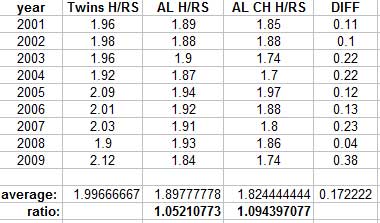
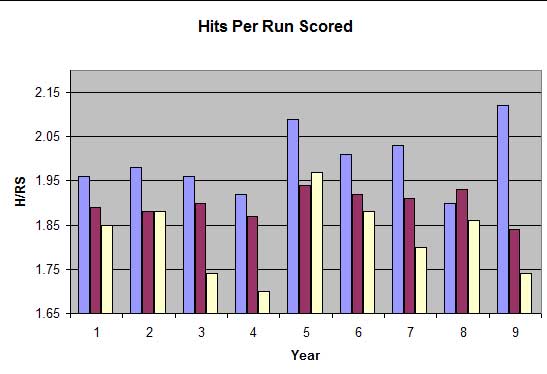
How has that pride and joy helped the Twins during the Gardenhire years? Let's examine the facts. One way to look at it is that if the method is successful, one would assume that a team would need fewer hits to score runs. That would be efficient way of playing. In this way, you make the best of each hit and score more runs than the competition with fewer hits. This is a recipe for winning. The following graph spans every season from TK's last season, 2001 (1) to 2009 (9). I am plotting total hits over runs (i.e. how many hits it takes to score a run) for the Twins (blue), the AL average (burgundy) and the AL champion (yellow; for 2009 I am using the team with the best AL record, Toronto):


As you can clearly see, the Twins need more hits to score a run than the average AL team and the team that wins the pennant usually scored more runs with fewer hits than the average. And (other than 2008), the situation has gotten worse with Joe Vavra as the hitting coach.

Conclusion 1: Small-ball, i.e. doing the little things right, i.e the Twins' way is hurting the Twins.

How much?

Let's quantify:


This is the table that is used to create the graph above. The columns are years, Twins Hits/Run, AL Average Hits/Run and AL Champion Hits/Run for every season (the last column is the difference of the Twins' squad from that of the AL Champion every season, but it is unimportant in the calculation)

The averages of all 10 seasons are underneath each column. The ratios of the Twins average to those of the other averages are noted under each column. Still, all these are ratios, fractions and small numbers; how do they translate in concrete terms.

There we go:


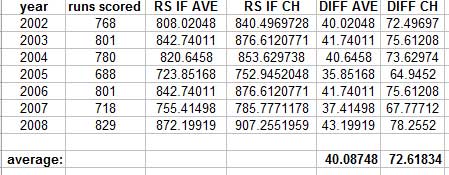
here is a table with the runs the Twins scored each season since 2002 and the runs they would have scored that season, if they were scoring runs at the rate of an average AL team based on the number of their hits and if they were scoring runs at the rate of the AL champion based on the number of their hits. The two last columns are the difference for how many runs the Twins scored and how many they would have scored, if they were translating their hits into runs as effective as the average AL team or the AL Champion. I averaged the values of the last two columns and came to this conclusion:

Doing things the Twins' way, cost this team between 40 and 73 runs every season.

And if you calculate about 5 runs per win, this is costing between 8 and 15 wins a season.

That is concrete. And it is so concrete, that in other words I could have called this little piece: "Honey I've shrunk the offense"

5/7/09

5 games behind; 5 things that should happen now

The Twins just finished the second and last game of their series in Baltimore, where they got swept, two to nothing. Despite Joe Mauer's return, this club is lacking energy and the ability to fight, from the manager down to the players. Last night's game should not have been played. It was. It was up to Gardenhire to do anything possible to delay it in order not to become official. He didn't. Instead he sat at the dug out watching batters swing away and pitchers pitch fast and throwing strikes. All he did was to whine afterward during the press conference about how unfair it was to play. Yesterday, Matt Tolbert was brought up from Rochester and Alexi Casilla was optioned to the Red Wings. This might help infuse some life to an apparently lifeless club, but here are 5 moves that should be made sooner than later:

  1. Re-assign Joe Vavra within the Twins organization and get Riccardo Ingram from Rochester as the interim hitting coach. In Vavra's four years with the Twins the teams ranked 12th (current), 9th (2008), 13th (2007) and 8th (2008) among the 14 teams in OPS. As a reminder, OPS and more specifically the SLG component of OPS is what makes the Twins win. And here is how the Twins are ranking among the 14 AL teams during Joe Vavra's tenure: 2009: 12th, 2008: 9th, 2007: 13th, 2006: 8th. An exact mirror of the OPS rank. About time for a change

  2. Option Brian Buscher to Rochester and recall Luke Hughes. This season the Twins are hitting .240/.295/.343 against left hand pitching. The right hand batters are hitting an even worse .195/.260/.280 against LHP. Luke Hughes in Rochester this season against LHP has been hitting .474/.524/1.158 (yes, folks, that is a 1.682 OPS) with 4 home runs. Nobody will miss Buscher's "defense" and his .179/.324/.286 line. In addition, Brian Buscher has appeared in a grand total of 5 games this season. It is time that a better player comes up. This would allow the Twins to establish a rotation of Tolbert/Hughes at 2B and Harris/Punto at SS, with Hughes serving as the primary PH and some DH against LHP

  3. Establish an outfield of Denard Span LF, Carlos Gomez CF, Delmon Young RF and find a taker for Cuddyer or keep him on the bench. The energy and defensive ability of Gomez at center is direly missed this season. This arrangement is the best defensive arrangement for the Twins and Young will be able to provide better offense than Cuddyer. Once Cuddyer is traded, bring up Dustin Martin or Jason Pridie (both LHB) from Rochester as the 4th OF.

  4. Assign Mike Redmond to Rochester and recall Jose Morales. Hopefully Redmond will accept the assignment. The fact that this team lost a lot of energy and started losing when Morales went to AAA instead of the worse-performing Redmond, is not coincidental. Morales could replace Redmond as the back up catcher and provide a better LH bat off the bench than Buscher.

  5. Keep a short leash on Craig Breslow and R.A. Dickey and be on the phone with Pedro Martinez' agent. I have been a a proponent for the Twins signing Pedro this offseason. Their starting pitching at this point, esp. Baker, Blackburn and Perkins do not inspire a lot of confidence. Martinez will need about a month to tune up and be in MLB form. At that point, if Dickey falters, release him and replace him with the starter who is the least productive in the pen and insert Martinez in the rotation. Or, Alternatively, since the Dodgers are now an outfielder short and have six starting pitchers, try to see if you can work out a deal of Mike Cuddyer for Hiroki Kuroda. The money is pretty much even.


I think that all these moves will energize these Twins. What do you think?

5/6/09

A blog not to miss

I became away of a brand new blog, 'R Red Wings, which is a must for followers of the Twins' minor leagues. There is nothing like it as far as Red Wings' coverage and there are even videos of the games. Make sure you drop in.

I was going to write a post about the recent event, but got sidetracked. Will probably do it tomorrow or tonight if the game is called/delayed

5/4/09

Pitching and the seventh-inning stretch

The seventh-inning stretch has been a long tradition in baseball, legendarily attributed to President Taft. During the middle of the 7th innings, the fans are standing up in the stands and signing take me out to the ball game.

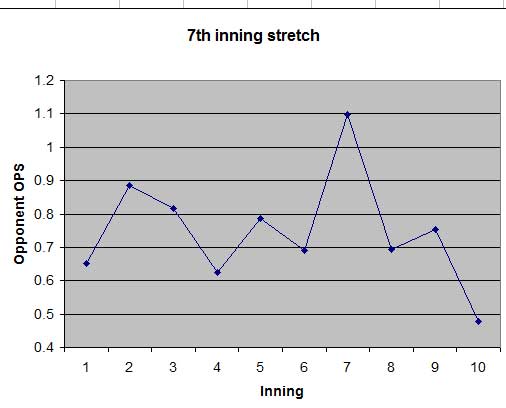
However, the Twins pitchers this season, so far are creating a different version of the seventh inning stretch, practically begging to be taken out off the ball game.

Here is the Twins' opponent OPS at the different innings (10 is all extra innings):

5/3/09

Minor league Thoughts after Sunday's game

Just a bunch of thoughts about the minor leagues, after the end of the series with the Royals today. I will probably write more about the state of the big club tomorrow, but I strongly believe that the big club is as strong as its whole organization, so I will start with the minors


  • Juan Morillo after he was outrighted to Rochester, he appeared in two games for the Red Wings pitching one and two-thirds innings of perfect baseball. No walks, no strikeouts. So far he has been used as a middle reliever in both occasions. I strongly believe that his coupling with Bobby Cuellar, Rochester's pitching coach and the man who taught Johan Santana the change up, would be a great think for Morillo. To accommodate Morillo in the roster, the Red Wings released Carmen Pignatiello, a LHP with 14.14 ERA and 2.15 WHIP and one of the never-had-beens that Jim Rantz likes to accumulate in Rochester every season

  • Speaking of Jim Rantz' rejects, Rochester has been horrible this season. If Twins' fans are concerned about the major league team, Red Wings' fans have many more reasons of concern. The team is 9-12, nine games behind Scranton in 5th place, below the lowly Lehigh Valley IronPigs. Is there a reason for Twins' fans who are not really concerned with minor league matters to be concerned about this? Yes. Since the 71 year old Jim Rantz, the Twins minor leagues director discovered Shane Mack as a minor league free agent 28 years ago, he repeats the practice of signing 5-10 aging minor league free agents every season. Nobody the last 28 years of the practice panned out. The closest was Randy Ruiz last season. Singing minor league free agents might be a good practice if: a. the player has some upside and b. the player is young enough to potentially realize that upside. For example, the singing of Justin Huber, a 26 year old OF/1B, former minor league All Star, who has a power right hand bat was great. That of the likes of Carmen Pignatello, Sean Henn, Bobby Keppel, Mike Gosling, Reid Santos, all pitchers at or beyond their primes were not for a pitching-rich organization.

  • There are several problems with this practice:

    1. It keeps talented players from advancing in the organization (e.g. Rob Delaney is setting up Anthony Slama who is closing at New Britain, when either of them could close in Rochester instead of Sean Henn and both of them are more capable pitchers than any of Rantz' 5 never-had-beens in Rochester and they are not spring chicken either: Delaney is 24 and Slama 25 years old

    2. This practice creates a Domino effect throughout the organization, keeping players like the 23 year old Steve Hirshfield (0.69 ERA, 0.538 WHIP), the 22 year old Carlos Gutierrez (0.78 ERA, 0.652 WHIP) and the 24 year olds Henry Arias and Blair Erickson in Ft. Myers instead of New Britain, and someone like Tom Stuifberger, the guy who held the powerful Dominican Republic lineup scoreless in the WBC for the Netherlands, in extended spring training

    3. One of the worse parts of this practice is that when the major league club needs a player in case of injury or bad performance, a suitable replacement has to be found outside of the organization, because the best players are usually in AA, with AAA filed up with lesser quality players

  • The Twins need to re-evaluate the way they are doing things as an organization. Here is an example: Once a player is put in the 40-man roster, he has 3 years of "options" and evaluation before he either has to be part of the major league (25 man) roster practically for the rest of his career, or be released. The Twins have 2 players in that roster who are in Ft. Myers (D. Romeiro) and in New Britain (W. Ramos), while players with iffy future with the organization who are not part of the 40 man roster (Machado, Christy) are in Rochester. It should practically be a rule that if someone is on the 40-man roster he better be either in the majors or in AAA (potentially AA the first year he is added) so that the team properly evaluates him.

  • The Twins' bullpen might need some help at this point. Nobody in Rochester, other than Anthony Swarzak, is ready to answer the call.


Update: The Twins re-activated Crain and send Jose Morales to the minors. Morales has been batting .238 OPS points higher than Redmond and .180 OPS points higher than Brian Buscher, but he is the one to go. This is not the way to win games. You have to put the best 25 man in the majors and at this point neither Redmond nor Buscher are part of the 25 best players in the organization. As I have indicated previously Morales should have stayed ahead of both Redmond and Buscher. And there is something else to consider: Morales is leading the team in batting average. His reward? A $350K pay cut. This in not how a top organization should reward its top performers.

4/27/09

Who is Ramon Santana?

Ramoncito (Ramon) Santana is probably one of the biggest, if not the biggest, surprise in the Twins' minor league system this young season. Here is a closer look at Ramon:


Ramon, a diminutive (generously listed at 5'9" and 152 lbs) right handed middle infielder, was signed as a free agent from Venezuela by the Twins in 2004. His first professional season was in 2006 at age 20 with the Dominican Summer League Twins, where he joined a team that also included Rene Leveret, Santos Arias, Danny Rondon, Yangervis Solarte, Alexander Soto, Henry Reyes, and Jeanfred Brito. That was one of the most successful DSL squads since all the aforementioned made the jump to the US and joined either the GCL Twins (R-) or the Elizabethton Twins (R) for the 2007 season.

In 2006 season, Ramon appeared in 50 games and had 223 plate appearances for the DSL Twins splitting time between second base and short stop. It was a very productive season for him. He hit .313/.448/.528 (.977 OPS, team leading .215 isoP) team leading 8 HR, walked 38 times, while struck out 37 and drove in 30. These numbers are great for a corner infielder or outfielder, but simply phenomenal for a middle infielder, in both power and plate discipline. In 2007 Ramon Santana along with a slew of his DSL teammates made the trip up north to play in the US-based minor leagues. The transition was not kind to Ramon. In 2007 he was assigned to the Gulf Coast League Twins (low Rookie) where he appeared in just 18 games (66 PA) hitting an unremarkable .211/.288/.351. In the middle of 2007 season, because of injury to Chris Cates and promotion of Brian Dinkelman to Ft. Myers, the Twins assigned Santana to the Beloit Snappers (Midwest League, A), effectively by-passing the high Rookie Elizabethton. In 15 games and 50 plate appearances in Beloit, Santana hit .225/.347/.325. This was better than his Elizabethton numbers, esp. in the plate discipline aspect, but still lacking in the contact and power aspects. In 2008, instead of starting the season in Elizabethton, Santana repeated in Beloit, where he appeared in 75 games (280 PA) and hit .241/.316/.404 with 8 HR. His 8 home runs were second in the team behind Chris Parmelee's 14, tied with Gregory Yersich's 8 but happened in 80 fewer plate appearances than Yersich. Unfortunately, last season Santana shown to be prone to strike outs, walking 18 times and striking out 84.

The 2009 season has all the elements of a breakthrough season for Santana. In 15 games and 52 plate appearances (very similar to his plate appearances with the Beloit squad in 2007) he is hitting .356/.476/.615 (1.092 OPS, .250 isoP) with a team-leading 3 HR. Also he walked 10 times and struck out 15. It looks like his power and plate discipline are back. He is enshrined at the #3 spot in the batting order and has appeared in more games and has the most plate appearances of all Snappers.

Ramon Santana has been a very pleasant surprise for the Twins' organization this season. It is not inconceivable that he might move to Ft. Myers as the season progresses, esp. if Steven Tolleson moves to Rochester, creating a Domino effect of promotions in the organization. Santana is a better second baseman than a short stop on the field and the Twins' organization has several good middle infielder prospects, however nobody has Santana's power bat, except Luke Hughes, who these days is playing more corner infield and outfield positions.

Update: After this post was published, Santana went 3 for 4 with a double and 2 RBI, in Beloit's game to raise his numbers to .393/.493/.643.

4/26/09

A Blast from the Past

After Glen Perkins' last start, I posted an entry suggesting that this is a new and improved Glen Perkins because this season, unlike 2008 when he was the weakest link in the Twins' rotation, he managed to keep the hitters off balance by changing speaks.

Today at Cleveland, Glen Perkins converted to his old ways. This is a graph of pitch number vs pitch speed from his appearance today, from Brooks Baseball:


As you can see, there was a series of 21 pitches all within 4 mph of each other with the exception of two pitches (red circle). This is not good and it coincided with his 3-run third inning (red bar below.) Perkins just cannot do that if he wants to be effective. He cannot throw 19 out of 21 fastballs in a row and survive in the bigs. I think that his problem is clear, he should know it, Anderson should know it, the catchers should not it and he just got to stop doing it. Otherwise, I am afraid, that he will be the Perkins of old, who is not that good...

4/24/09

The Numbers Game

When Joe Mauer returns, as early as a week from today, a spot should open on the 25-man roster to accommodate him. I think that there are three potential candidates for that spot, in alphabetical order: Brian Buscher, Jose Morales and Micheal Redmond.

Here is how they have been performing this season:

Brian Buscher: 18 PA, .200/.333/.333 (.667 OPS). He swung at 37.5% percent of the pitches he faced, making contact on 66.7% of those, so he made contact with 25% of the pitches he saw

Jose Morales: 26 PA .250/.308/.333 (.641 OPS). He swung at 56.3% percent of the pitches he faced, making contact on 81.6% of those, so he made contact with 45.9% of the pitches he saw

Mike Redmond: 31 PA .214/.290/.250 (.540 OPS.) He swung at 41.1% percent of the pitches he faced, making contact on 89.7% of those, so he made contact with 36.9% of the pitches he saw


As far as plate performance goes, Morales has been making more contact with the ball than Redmond and Redmond has been making more contact with the ball than Buscher. One might argue that it is a small sample size, but Buscher's career contact% on all pitches he saw is 35.3% far bellow Morales' and still below Redmond's.

At this point, Morales and Buscher are playing at replacement level, Redmond below replacement level.

Redmond brings veteran leadership and clubhouse presence. Morales brings a live bat, upside, a spanish-speaking catcher who can communicate with Ayala, Liriano, Mijares and Morillo better than Redmond or Mauer. He is a switch hitter. Buscher brings in a left hand bat from the bench. Both Morales and Buscher still have minor league options.

Redmond and Morales are adequate defensively. They will not throw runners out but will not make errors. Buscher is a defensive liability who does not belong on the field in a major league stadium.

There is more than one way to make that decision and it will be a hard decision to make, since there are advantages and disadvantages to all 3. I think that Morales' bat and the fact that is adequate defensively as a catcher, as well as Redmond's veteran leadership should be chosen over Buscher's LH bat off the bench. Morales has a better LH bat off the bench (as a LH hitter he is batting .300/.333/.400, .733 OPS in 21 PA) than Buscher, anyways, and he is more versatile. If I were to rank the 3 in order of who should stay, it would be: Morales, Redmond, Buscher.

What do you think? Feel free to comment and vote on the poll at the upper left hand side of the blog.

4/23/09

Is Michael Cuddyer done?

Micheal Cuddyer was one of the heroes of the 2006 Twins that won the AL Central division in dramatic fashion the last day of the regular season. That season, his age 27 season, he exceeded expectations after establishing himself as the starting right fielder, instead of being moved around in the infield, hitting .284/.362/.504 with 24 HR and 109 RBI. The Twins' organization regarded him as a power right hand bat that could split the franchise lefties, Joe Mauer and Jason Morneau and create a formidable core in the middle of the lineup for years to come. In the off-season after his 2006 season, he signed an one year $3.575 million contract to avoid arbitration. After his 2007 season, which was not as productive (.276/.356/.433 16 HR, 18 RBI), the Twins decided to keep him long term, offering him a 3 year/$25 million contract through 2010 with a team option for 2011 worth $10.5 million. This contract coincided with the departures of Torii Hunter to the Angels via free agency and Johan Santana to the Mets via a trade. The Twins needed a face for their franchise to quell disappointment by these departures and the gregarious and outspoken Cuddyer was cast into that role. There are a lot of arguments against that contract given to Cuddyer after a down season and at age 28; however, it should be clear that this contract was not only for his field production but for his franchise representation to the public. That said, here is the question that I will try to answer:

Are Michael Cuddyer's best days as a player behind him?


To try to answer this question, I will try to examine the following:

  • hitting through career, represented by OPS
  • comparable players
  • power through career, represented by isoP
  • tendencies at bat through career
  • monthly hitting since 2004


Career Hitting


this graph is a plot of Michael Cuddyer's OPS in the different seasons he played. Season 1 is 2001 and season 9 is his current age 30 season.

It is clear that his OPS peaked at season 6, 2006 his age 27 season, and has practically linearly declined since.


Comparable Players

Baseball Reference has a great tool that determines the 10 most similar players to a particular player, based on production. Here I am examining Michel Cuddyer's 10 most similar, looking at when they had their peaks, in order to potentially get additional clues about Cuddyer. Here is a list of the 10 most similar players with the age of their peak in parethesis. A couple are disqualified from this analysis, one because he is still 25 years old and the other because he played in the 50s:

1. Kevin Mench (peak age 26)
2. Jeff Francoeur (too young, just in age 25 season)
3. Walt Moryn (played in the 50s - entered MLB at 28)
4. Leon Roberts (peak age 27)
5. Gabe Kapler (peak age 24)
6. Sean Berry (peak age 29)
7. Mike Lamb (peak age 28)
8. Chris Singleton (peak age 26)
9. Butch Huskey (peak age 27)
10. Xavier Nady (peak age 29)

the average age peak of these 8 players is age 27. The exact age Michael Cuddyer was during his 2006 season.

Career Power
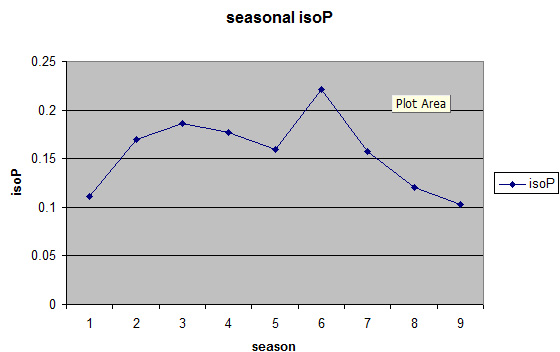


this graph is a plot of Michael Cuddyer's isoP (isolated power = SLG%-batting average) in the different seasons he played. Season 1 is 2001 and season 9 is his current age 30 season.

It is clear that his power, like his hitting ability, peaked at season 6, 2006 his age 27 season, and has declined since, however not with as dramatic a rate as his hitting ability.

Hitting Tendencies
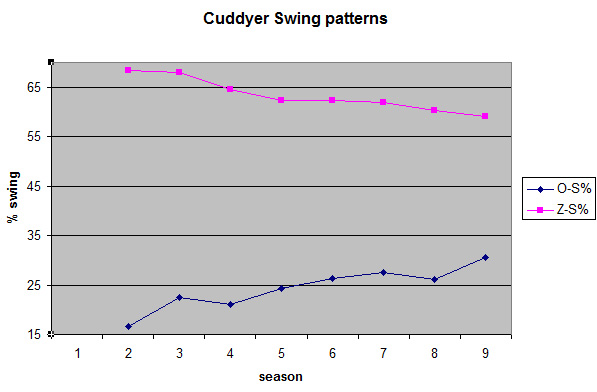


This was a big surprise to me.

The graph above is a plot of the percentage of balls inside the strike zone (Z-S%) and outside of the strike zone (O-S%) that Micheal Cuddyer has been swinging at during the different seasons. There is no data for 2001, so this is from 2002 on.

As you can see, consistently every season, Cuddyer swings at more balls than the previous season and swings at fewer strikes that the previous season. This is not a recipe for success and it really is bothersome, because it indicates that since his 2002 age 23 season, Cuddyer has become progressively worse in pitch selection.

in other words:

Cuddyer had a better judgment on balls and strikes at age 23, than he had during his age 27, 2006 season and now


Cuddyer, following the example of Denard Span underwent LASIK eye surgery in the off-season. Based on his early 2009 results, it seems that the surgery did not help him distinguish balls and stikes; if anything it made things worse.

Monthly hitting

I wanted to get a bit more granular view than seasonal hitting, so I plotted Cuddyer's monthly OPS from the 2004 season to now, to help identify his peak better:
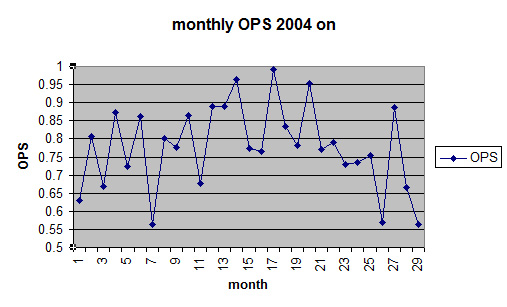


The bottom line is that since May 2007, when Cuddyer had an OPS of .954 in 100 plate appearances, with the exception of June of 2008 when his OPS was .866 in 91 plate appearances, Cuddyer a. did not have a single month with OPS higher than .800, and b. his OPS has been practically declining month by month.

This is not good news.

Is Cuddyer done?

At this point, there are a lot of indicators, that Cuddyer's best days are over. The swing graphs and the monthly and seasonal OPS drops are somewhat disheartening. However, the June of 2008 provides a glimmer of hope, despite all the other negative indicators. Potentially Cuddyer might have similar months, however even these months will probably not be close to his 2006 production. I think that the Twins should focus on giving more time to Carlos Gomez and Delmon Young, whose best days are ahead of them and give Cuddyer a more limited role, similar to that of Craig Monroe and Randy Ruiz of the 2008 season. Cuddyer will be better than both of them in that role and will be positive for the team. Yes, he will be an overpaid bench/role player, however, as I indicated earlier, part of his contract was because his off-field role, so the "overpayment" for a limited on-field role is mitigated. And if he shows signs that he might have months like the June of 2008, his role could increase for that month and return to limited upon signs of decline (easy to spot based on swinging tendencies)

4/20/09

Pitching Checkpoint

This off day I was planning or writing something about the catching situation, but since there were a few new developments on the pitching side, I decided not to ignore those. Since it looks like there will be a rain out tomorrow, I will discuss catching tomorrow.

It is old news by now, but Jesse Crain has been placed at the 15-day DL retroactive to a couple days ago and Jose Mijares has been called up from Rochester to replace him. LEN3 was the first to break that story. Mijares after an awful spring when he showed up in camp looking like Pat Williams and pitching in a way that made Kevin Frederick look like a Cy Young candidate, seems to have found parts of his last September in Rocherster, where in five games he amassed these numbers: 6.1 IP, 2 H, 1 BB, 4 K, 0 ER (0.00 ERA, 0.47 WHIP.) Crain did get overused so far this season. It was inexcusable for Gardy to put him in the 9th inning to close a blow out game. That is done, it cannot be corrected, but I hope that Gardenhire realizes his mistake and does not repeat it. Speaking of repeating mistakes, when Gardenhire was asked about who the set up man will be now, he answered that everyone who is rested except Morillo who is still "a project". Wrong answer. He should select one (even pull names off a a hat) and go with him. The worse thing about a reliever is not knowing what his role is. Pitchers need to get ready to pitch. I hope that Crain gets healthy soon and that he returns effective because he showed signs of brilliance so far this season.

A lot of people are climbing on Glen Perkins' bandwagon this season and with a good reason: he has been the most effective starter on the staff. Yesterday in the Angels series' review I wrote the following about Perkins:

The Perkins of 2009 so far is different than the Perkins of 2008: He apparently worked on his change up and slider this off-season and unlike last year, he has complimentary pitches to his fastball. His slider still needs work, but his change up is very effective. And when he is down on the count he does not throw fastballs in the middle of the plate like he did in 2008. This allows him to get through innings with fewer pitches and pitch deeper into the games


And because a picture is supposedly worth a thousand words, I will save myself two thousand and present you with these two from one of the great baseball sites out there, Brooksbaseball.net, to illustrate my previous point.

Exhibit A:


This is a graph of pitch number on the X axis and pitch velocity on the Y axis. This is Perkins pitching in yesterday's game against the Angels. As you can see, it is rare that he is throwing more than 2 fastballs in a row and there is a great mix between fastballs and off-speed pitches.

Exhibit B:


This is from a typical Perkins' outing in 2008. The 8/14 game in Seattle: He throwed a series of only fastballs four times (red circles-me-Bert), very few off-speed pitches, and when he got in trouble towards the end of his outing he threw 10 straight fastballs. This was not the way to pitch successfully and I had indicated ad noseum last season, that if this continues, Perkins does not belong in a major league rotation.

I am very happy that this has change and I hope that Glen keeps it up and when in trouble does not revert to bad habits.

The general opinion is that the Twins' starters have struggled last season:

here is a little known fact: The Twins (co-lead the majors) with 9 starters going more than six innings. I hope this makes the Twins' fans feel a little better.

4/19/09

looking between the lines: four series down

The Twins finished the four first series of the young season, sweeping the Los Angeles Angels of Anaheim in the Metrodome in a three game series. After 14 games they are 1 game out of first place in the AL Central division, trailing the Detroit Tigers, Chicago White Sox and Kansas City Royals, while they are leading the last place Cleveland Indians by 2.5 games. Here are my observations about the team at this time point:

  • A three game home series facing the assortment of AAA and bullpen arms of the Angels was a shot in the arm for the bats. Jason Kubel had 2 great days back to back, being the third player ever to hit for the cycle and completing it with a game winning grand slam. I am sure that in the long term, this will be a career highlight for Kubel; however for the short term, even more important might be the fact that the next day Garderhire started him against a LHP at DH and he delivered

  • Kevin Slowey might be back. He pitched 7 innings in the middle game of the series having only very few bad pitches, one of which was hit for a home run by Torii Hunter. Glen Perkins has been very surprising this season. The Perkins of 2009 so far is different than the Perkins of 2008: He apparently worked on his change up and slider this off-season and unlike last year, he has complimentary pitches to his fastball. His slider still needs work, but his change up is very effective. And when he is down on the count he does not throw fastballs in the middle of the plate like he did in 2008. This allows him to get through innings with fewer pitches and pitch deeper into the games

  • This series brought the first transaction of the young season, the acquisition of Jose Morillo off waivers and the DFAing of Phillip Humber. After the first appearance of Morillo in the ninth inning yesterday, where he pitched a scoreless inning allowing one hit and striking out one, while his fastball was between 96 and 98 mph, it might be safe to assume that the Twins will not miss Mr Humber much this season

  • Every position player got into the hit parade the last 2 days. I will post some thoughts about the catching situation tomorrow during the first off day of the season, but Jose Morales had a very good series, Delmon Young and Carlos Gomez not only hit the ball but worked counts out for walks and Brendan Harris so far is putting Ted Williams-like numbers in limited duty, which seems to be deservingly increasing

  • How sustainable is this? There are some good signs: The Twins are two games ahead of their 2008 pace so far (there were 6-8 after 14 games in 2008) without the complete rotation gelling, without all relievers bringing out top notch performances, with Joe Crede, Mike Cuddyer and Alexi Casilla lagging at the plate and with Joe Mauer in Florida. I think that the Twins are in good shape. If they finish the month of April within 1-2 games from the division lead, they will be a force to be reckoned with, since the bench and the pen is better than last season and the rotation seems to be better just by the fact that Perkins is pitching like a different pitcher. Time will tell, but so far so good


Position Player MVP of the series with the Angels:

Jason Kubel
14 AB, 8 H, 5 R, 7 RBI, 0 BB, 1 K, 1 HR (hit for the cycle)


Best Pitcher of the series with the Angels:

Glen Perkins
8 IP 4 H 1 ER 1 BB 4 K

4/18/09

Another comeback for the ages!

highlighted by a grand slam to complete hitting for the cycle by Kubel. It seems that the Twins are going to spoil us with comebacks this season.

4/17/09

Meet and Greet: Juan Morillo

Today the Twins designated Phillip Humber for assignment and claimed Juan Morillo off waivers from the Colorado Rockies.

Who is Juan Morillo?

Juan is a 25-year old righty from San Pedro de Macoris, Dominican Republic, who was signed by the Rockies in 2001 as a 17 year old. He is a flamethrower. His main weapon is his fastball, that averages in the high 90s and occasionally hits triple digits. He has a 89-90 mph slider and a 88-89 mph "change up". His control has been a work in progress, and has been his biggest downfall. Additionally, lack of movement in his fastball has been pointed out. Thus the earlier comparison to Rick "wild thing" Vaughn from the movie "Major League".

Can Juan Morillo help the Twins?

Let's examine the facts:
His career minor league numbers are: 6 seasons, 183 games, 83 GS, 543 IP, 520 H, 262 ER, 326 BB, 519 K, which translate to 4.34 ERA, 1.56 WHIP, 5.4 BB/9, 8.6 K/9 and 1.59 K/BB. He made the transition to a reliever in 2007. Also, from those 188 games, he spent 59 games in the Pacific Coast League with the Colorado Springs Sky Sox (AAA). If we exclude his PCL games, and look at his numbers, they become 3.5 BB/9, 8.54 K/9, 2.43 K/BB, which is more palatable. In addition he held opponents to an encouraging .246 batting average (lefties: .247, righties:.246.) In his last season away from the PCL, 2007, when he pitched for the Tulsa Drillers of the Texas League (AA), he held lefties to a .161 and righties to a .248 batting average. Furthermore, in parts of 3 major leagues seasons he faced 44 batters of which he walked 4 and struck out 7. Another positive sign is that batters do not hit home runs easily off him. In 536 IP he allowed 32 home runs in the minors.

At some point, Colorado organizational scouts had ranked him higher than Ubaldo Jimenez when they were both with the Modesto Nuts (California League, A+), in 2005. Here is what a Rockies' scout had to say about Juan Morillo then:

I thought the emphasis on patience practiced in Midland would hurt Morillo, but his command looked much improved from the first time I saw him this season. It's hard to tell if his fastball moves because I could hardly pick it up through the black net. His fastball and the Midland starter's fastball were like night and day, and few hitters could get around to pulling the ball on Juan. Produced tons of weak liners, soft grounders and high pop ups. Only three balls put in play appeared to get hit squarely. Fastball was outstanding, but slider came and went. I liked that he pitched more for contact and went after hitters, because even a 99 mph-er down the middle is rarely struck well. Very promising start. He still has needs work, but he's a legit top ten organizational talent, and should reach the bigs and contribute in some fashion.


Will Morillo turn into a top notch set-up guy overnight? It is unlikely, but he is still 25 and if used appropriately he might surprise. He will be removed from the thin air of Colorado and the Pacific coast league, which does not allow a slider to break as it should. He will be moving to a league that no batter has faced him before. If he throws strikes and is able to get his slider over the plate, he will be a good addition to the club. A high reward, low risk situation, which shows that Smith is not afraid to do moves that help the club. It would be great, if Morillo turns out like the last pitcher Bill Smith picked out of the waiver wire: Craig Breslow.

Like Phillip Humber, Juan Morillo is out of options and has to stay in the Twins 25-man roster all season or be exposed to waivers. Morillo was assigned uniform number 31. The last pitcher who wore 31 was J.D. "The Real Deal" Durbin. Let's hope that Morillo performs closer to the first pitcher who wore number 31 for the Twins, Jim Perry.

Juan Morillo is a Twin

The Twins just claimed Juan Morillo off waivers from the Rockies and designated Philip Humber for assignment.

A full profile of Juan Morillo is here, but this video pretty much summarizes Juan Morillo. I wonder whether they will issue him the number 99 jersey.

looking between the lines: the first three series in the books.

The Twins finished their first three series of the 2009 season and are sitting with a 4-7 record in the 4th place of the AL Central, having won a single game more than the Cleveland Indians. This is a disappointing start, and all the parts of the team (Starting rotation, bullpen and bats) have contributed equally. Let's look closely, trying to pick possible glimmers of hope:

  • This team is 2 games behind of the 2008 team, when the Twins were 6-5 after 11 games. On the other hand, in 2008 in their first 3 games at Chicago, they also went 1-2, in their first 4 home games with Toronto they went 0-4 and in their 3 home games with Seattle they went 3-0. Based on those individual series breakdowns, the 2009 Twins are keeping pace with the 2008 Twins who won 88 games. And they are doing in without Joe Mauer, who is slated to return as early as the Cleveland series next week, after starting rehabilitation with the Ft. Myers Miracle next Monday

  • Crain and Nathan can anchor the back of the bullpen. Despite the fact that the other members of the bullpen have struggled, Crain and Nathan have been performing great, when they got the call.

  • Morneau is up to a great start. He is hitting .341/.348/.568 with 2 home runs and 8 runs driven in and if he continues close to this pace, he will have another MVP year

  • Span has been the Span of 2008 and not the Span of Spring Training 2009. He has been hitting .293/.408/.390 and leads the team in stolen bases with 3. If he continues close to this pace, he will provide the team with a reliable pace setter

  • The rotation will rebound, and the rebound has already started. Liriano pitched like the August of 2008 Liriano yesterday and not like the April 2008 Liriano. Perkins has been brilliant in his 2 starts. I am confident that Blackburn, Slowey and Baker will be back to form soon; hopefully the first two as soon as the Angels series starting today. Part of it might be the inexperience of Morales in calling a game. With Morales behind the plate, opponents bat .337/.388/.546 off the Twins' pitchers. With Redmond behind the plate, opponents bat .256/.315/.422 off the Twins' pitchers. This suggest that with the upcoming return of Mauer, the pitching numbers will improve, since in 2008 opponents had practically the same OPS against Twins' pitcher with either Mauer or Redmond behind the plate.


Position Player MVP of the series with Toronto:

Justin Morneau
17 AB, 8 H, 3R, 1 RBI, 0 BB, 4 K


Best Pitcher of the series with Toronto:

Glen Perkins
8 IP 7 H 2 ER 1 BB 4 K

4/15/09

The curious case of Kevin Slowey

A lot of people (including me) have been expecting greatness this year by Kevin Slowey, after his great pitching last season, followed by a tremendous spring training performance.

In the first 2 games of the 2009 season, Kevin Slowey is pitching at a rate of: 11.1 IP, 22 H, 10 ER, 1 BB, 7 K (7.94 ERA, 2.03 WHIP, 5.56 K/9, 7 K/BB), promoting comparisons to Livan Hernandez by a certain Twins' beat writer.

How worried should the Twins be about Slowey?

My answer is: not that worried. Here are the reasons:

  1. Everyone can have a bad 2 games in a row. Here are some examples:


    • 2007 Cy Young award winner, Jake Peavy, in two consecutive September games that season produced this line: 11 IP 12 H 10 ER 5 BB 9 K (8.18 ERA).

    • 2004 Cy Young award winner, Roger Clemens, in two consecutive June games that season produced this line: 10.2 IP 20 H 10 ER, 3 BB, 9 K (8.41 ERA).

    • 2005 Cy Young award winner Bartolo Colon in Two consecutive games in July that season produced this line: 11 IP, 15 H, 12 ER, 6 BB, 7 K (9.82 ERA)

  2. Slowey's BABIP so far has been .421. This is much higher than the league average of .295 and is about to regress towards that average sooner or later. This means that Slowey has been very unlucky in balls hitter put in play.

  3. Stowey's stuff is not that different from last year in these two games with one exception:
    Here are his pitches, percentage of time he threw each and (average velocity),from FanGraphs:

    Season FB SL CB CH

    2008 66.3% (89.9) 14.0% (85.7) 11.9% (74.3) 7.8% (82.8)
    2009 62.0% (90.0) 22.3% (83.3) 9.2% (74.5) 6.5% (83.3)


    All of his pitches are pretty close to 2008 other than his slider that has lost about 2.5 mph and he has been throwing it almost twice as frequently in 2009 as he did in 2008. This might be what we are seeing right now, and it is a very easy adjustment: throw fewer sliders.

    Also the results of his pitches other than batted balls has been very similar to 2008:

    Season BB/9 K/9 K/BB
    2008 1.3 6.9 5.13
    2009 0.8 5.6 7.00


    if anything, he seems to have better command in these two games that he had last season


My conclusion is that Slowey will rebound very soon and will end up having the great season that a lot of us expected from him. What do you think?

4/14/09

Decisions, decisions, decisions.

Last night's game was a big disappointment for the Twins' Fans: The bats were alive, but Slowey and Ayala were not on the top of their game, resulting to turning the game in the favor of the Blue Jays, pretty quickly at the late innings.

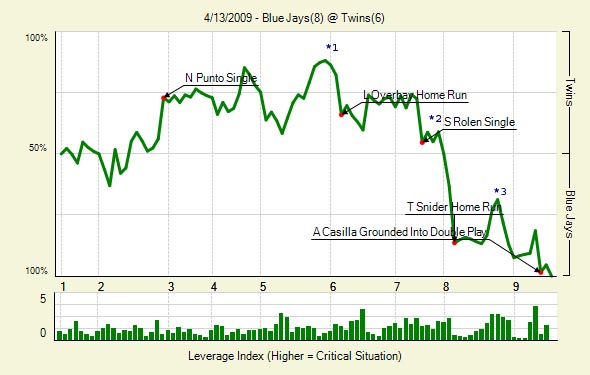
Here is a closer look to the win probability graph by fangraphs:


I marked 2 points with asterisks (*1, *2 and *3), because I think they were the turning points of the game and they were bad decisions by Ron Gardenhire:

*1: Kevin Slowey has been struggling throughout the game, but Gardenhire sends him in to start the 6th inning. At this point, the Twins are about 85% win probability. If Slowey left the game then, and the Twins won, he would have been credited with the win. Slowey allows a hit to Rolen. Instead of taking him out at that point, Gardenhire lets him face the next batter (in a manner similar to that allowing Liriano to face multiple hitters after he walked in a run with the bases loaded in the last game of the Chicago series). Overbay hits a home run and the Jays are within 2. A little too late, after facing 2 more batters and walking one, Gardenhire lifts Slowey for Guerrier. Guerrier finishes the inning and starts the next. Breslow replaces him in the 7th after he gives a hit and strikes out the only batter he faces. At this point, Gardenhire, uses Breslow again only to face a single lefty hitter and replaces him with Ayala who finishes the 7th giving a hit and driving a run with 2 outs to bring the Jays within 1 (6-5 Twins)

*2: Top of the 8th inning. You would think that Crain is the 8th inning man, esp. with Ayala having problems the previous inning, who can provide a bridge to Nathan. But this is not the case: Gardenhire keeps Ayala in. A double and a home run later, the Twins' win probability drops from 75% to 15% and the score is Jays 8, Twins 6. That was the biggest turning point of the game

*3: Bottom of the 8th, the Twins hitters are staging a comeback: Brendan Harris doubles to start the inning and goes to third with no outs on a wild pitch. Delmon Young is up. The Twins have a great batter and the best AL Centerfielder in Carlos Gomez on the bench, one would think that getting Gomez in to sacrifice Harris (or get a bunt base hit) would be the proper play (or at least have Young try for the sacrifice). The win probability with Harris at 3rd, nobody out and the Twins down by 2 runs, climbed up to 30%. Young strikes out. Gardenhire, still going for a 2-run homer instead of getting the man from third in with a sacrifice, substitutes Crede for Morales. Crede strikes out. Punto strikes out. Inning over.

Last season, Gardenhire's mismanagement of the pitching staff and the bullpen, cost the Twins the division championship. He was rewarded with a contract extension. Apparently he has not yet learned his lessons from last season. I hope he learns them pretty quickly before this season gets out of hand.

4/12/09

looking between the lines: Series one and two in the books.

The first 2 series of the season are in the books. As I promised, I will not be doing game analysis (there are just way too many of those, and most of them are great, already in the internets.) What I will be doing, is continue to look between the lines for facts about the team's performance that have not been stressed much as well as for clues about what a particular set of games, might imply for the near future.

The Twins lost the series to the Chicago White Sox at the US cellular field, 2-1, after winning Joe Crede's homecoming by a comfortable margin, mainly due to offensive issues the last 2 games.

So far this season the Twins are 3-4. What does that mean? Last year the Twins also started the season 3-4. Let's look at some of the specifics of the 2008 and 2009 teams' performances and try to see whether there is anything of note in this comparison:

After seven games in 2008: 3-4

team batting: .252/.295/.349 19 runs scored;
team pitching: 4.06 ERA, 1.18 WHIP, 27 runs. 13.97 Pitches/IP, 5.83 K/BB, 4.77 K/9

After seven games in 2009: 3-4
team batting: .233/.306/.345, 26 runs scored;
team pitching: 5.16 ERA, 1.31 WHIP, 37 runs. 15.87 Pitches/IP; 1.98 K/BB, 5.46 K/9.

There are 2 silver linings for the 2009 team:

a. they equaled the record of the 2008 team that went on to win 88 games, without Joe Mauer and by having a home series and an away series; the first 7 games of 2008 were at home against the Los Angeles Angels of Anaheim and the Kansas City Royals.

b. the 2009 team seems more efficient with the bat than the 2008 team. It scored 7 more runs in the same 7 games with about equal team OPS. If this continues, and esp. if this offensive effort gets more equally distributed among games, is a very positive sign.

What went wrong?

The 2009 pitching in these first 7 games has not been as good as the 2008. The root cause is fairly obvious when one looks at the numbers: The Twins' pitchers have a harder time throwing strikes this season, compared to 2008. The number than speaks the most is the K/BB comparison: 5.83 for 2008 and just 1.98 for 2009. This translates to a higher number of pitches thrown per inning (15.87 vs. 13.97), and a higher WHIP (1.18 vs. 1.31), which in turn translates to more runs allowed (37 vs 27) and results to a higher ERA (4.06 vs. 5.16). An apparent positive note is the K/9 number: 5.46 for 2009 vs 4.77 for 2008. However, at this point, I am not convinced that this is not an artifact of increased wildness and batters simply swinging outside the zone.

The bottom line from the first 2 series is that:

  • The 2009 Twins are keeping pace with the 2008 Twins where it matters: W-L record

  • The biggest issue with the pitching has been an inability to throw strikes, which I think is very correctable for this squad, because throwing strikes has always been a power of this group and these pitchers did not overnight collectively forgot how to do it

  • The biggest issue with the offense has been very similar to that of the 2008 team: Run distribution per game. I am not sure that this is correctable, but it is concerning. The Twins' bats seem to act in unison: there are days that everyone hits and there are days than nobody hits. That said, the 2009 team's offense so far has been more powerful than that the 2008 team's, and Joe Mauer will return soon


What is coming up? A 3 game home series with the Toronto Blue Jays and the return of Scott Baker who pitched 7 very efficient innings in a Florida State League game with the Ft. Myers Miracle last week. One of Philip Humber, R. A. Dickey and Brian Duensing will probably leave the team when Baker returns. I think that the obvious choice is Brian Duensing, not because he pitched worse than Philip Humber, but because, unlike Humber, he has options. R.A. Dickey has earned a spot and should be with the Twins in a bullpen role.

Position Player MVP of the series at Chicago:

Nick Punto
10 AB, 5 H, 2 R, 2 RBI, 2 BB, 1 K; .500/.583/.500


Best Pitcher of the series at Chicago:

Matt Guerrier
1.1 IP, 0 H, 0 R, 0 BB, 2 K; 0.00 ERA, 0.00 WHIP, 13.53 K/9

4/11/09

Looking at tomorrow

Tough loss today, but the Twins are still in first place (albeit in a 3-way tie) in the AL Central. Tomorrow's game looks promising because the Twins are hitting a collective .317/.349/.466 of Chicago's projected starter, Mark Buehrle. Some notable performers against Buehrle:

Michael Cuddyer (69 AB) .304/.333/.493
Justin Morneau (38 AB) .237/.279 /.421
Nick Punto (33 AB) .303/.294/.394
Mike Redmond (28 AB) .500/.483/.571
Delmon Young (18 AB) .389/.421/.611
Brendan Harris (16 AB) .313/.389 /.375
Alexi Casilla (13 AB) .231/.333/.231
Carlos Gomez (11 AB) .545/.545/1.091
Denard Span (6 AB) .333/.429/.833
Jason Kubel (3 AB) .000/.250/.000

Based on this, I expect Redmond to start at catcher, Gomez and Span to be on the field as one of Cuddyer and Young, while the other is the DH, with Kubel sitting. I suspect that Crede will start at 3B, but I will not be surprised if Harris takes his spot.

The numbers match up looks really good for the Twins.

4/10/09

This might summarize tonight's game

and, yes, the Twins are leading the Central.

(if you do not know why I selected that tune, it was because that is the song playing in the Cellular field before Crede's first plate appearance there. After his home run it was just booos)