1/26/13

Assessing the Starting Pitching in the Twins' Organization

For a baseball team to content, one of three things need to happen:
  1. An organization has to develop impact starting pitchers.
  2. An organization has to trade for impact starting pitcher.
  3. An organizations has to sign impact starting pitcher free agents.
I demonstrated earlier this month that the Twins' last two year abysmal record could have been predicted as earlier as 2008, based on the state of their starting pitching prospects.  Only 11 pitchers who have been in the Twins' minors in 2008 are still in the organization and none has been an impact starter.  The Twins have been adverse in doing numbers 2 and 3 above, so in order to compete, they have to develop starting pitching talent.

The Denard Span and Ben Revere trades infused the Twins with 3 young starting pitchers: Vince Worley, 24, and Trevor May and Alex Meyer, both 22, which makes the future a bit more hopeful.  How hopeful?  I will try to quantify, so the rest of the discussion here will be metrics and numbers based.  This will actually be somewhat of a logical continuation of this analysis, where in August last year, I tried to look positively into the 2012 Minnesota Twins pitching and draw conclusions based on potential.  What I am doing here is looking at the whole organization Starting Pitching, under very similar metrics and see what the future might look like.  This will include potential rankings of Twins' starters, but it is not a prospect list.  They are based on their 2012 performance (and adjusted for age and playing level) and not their potential.  Injured players, such as Wimmers and Salcedo will be higher on prospect lists that ranked here, because their numbers were awful.

The metrics I like to use to do this have been some simple things of my own device: Pitching Effectiveness or PE and Expected Pitching Effectiveness or xPE.  I fiddled around with PE in 2008 and with xPE in 2009.  Here is the reason I devised PE and here is the reason I optimized it to xPE.  My main arguments were a. I felt like xFIP and FIP and DICE weigh too much things like home runs (which anyone who watched the home runs by Miquel Cabrera and Delmon Young against the Twins yesterday cannot deny that they are a matter of inches and ballpark and luck and fielding performance from being a long fly ball).  Also these formulae are hard to memorize and I wanted something simple I can calculate looking at a stat sheet and also something that you can calculate using splits (e.g. how has Brian Duensing or Glen Perkins been as a starter vs as a reliever); you can find xFIP around, but not in a spit form.  So in 2008 I devised PE, which simple takes account three things:  Strikeouts, walks and hits.  So a pitcher who strikes out more people, walks fewer and gives lesser hits is more likely to succeed than someone who doesn't.  And all hits are counted equal because the difference between a single and a triple might be the difference of having Delmon Young or Ben Revere play Left Field or the difference between a fly ball out and a home run might be the difference of having Torii Hunter or Rich Becker playing Center Field.  And I use WHIP, K/9 and K/BB to calculate PE (a simple PE= (K/9*K/BB)/WHIP).  xPE further normalizes for BABIP (to league average .290) to account for "luck" with hits.  And unlike FIP and ERA, these two measures go the opposite directions (higher is better) and have a large variation (0.x to 100+) to allow for granularity in comparisons vs. compressing performance from 0 to 10 or so.  Over here, I show that xFIP and FIP correlate pretty well to the much more complex SIERA, which is way too complex to be able to calculate just with a cell phone calculate (which is my goal as far as metrics go.)

PE and xPE have been fine to show performance and expected performance.  How about potential?  This is the many million dollar question, because if someone is able to guess estimate future potential of a player in single A, he/she will be having a great advantage in identifying cheap, future impact players, in a more objective way than scouting reports.  So yet a new measure in the PE family has been devised:  the adjusted expected pitching effectiveness or axPE.  I tried something similar the off-season after the 2008 season, but the resulting formula was too complicated (cannot fit on a T-shirt or be calculated using a cell phone calculator), so needed to be refined.  I hope I am close to this, since axPE is simpler.  It takes into consideration level of play.  Each level of play gets a number.  Here are these numbers:

All Rookie Leagues: 1
A: 2
A+: 3
AA: 4
AAA: 5
MLB: 6

the average of the levels a player participated is taken into consideration for axPE.  For example if a pitcher spent part of the season in high A and then moved to AA, the average level grade is 3.5.

The other adjustment involves someone's age.  Younger players in higher levels have higher potential; this is the premise here. axPE is defined as xPE* (level/age) *7 .  The 7 is a coefficient that makes it a number  in the neighborhood of PE and xPE.

A note of importance:  agPE is biased towards better performance in higher levels; this is by design, since there have been pitchers who blew away rookie leagues and then bottomed out when they went to AA.

The PE family metrics translators for starters (and relievers, for the sake of completeness, but RP are out of score here) are roughly translated to:

Rotation:
xPE/axPE
35+ Ace
25-35 #1- #2 Starter
15-25 #2- #3 Starter
10-15 #3 - #4 Starter
7.5-10 #5 Starter

Bullpen:
xPE/axPE
35+ Closer
25-35 Closer-Setup
15-25 Setup- Long Relief
8-15 Long Relief-Mopup

where axPE denotes intermediate/long term potential.

So, do the Twins have any potentially impact starters in their organization, based on their 2012 performance?

Without further ado, here are the numbers, that include pretty much every pitcher in the Twins organization, including the new ones, and those who pitched only in the major league level in 2012, under 30 years old.  The age indicated is their age in 2012.  I am including Nick Blackburn, for comparison's sake.  Raw data is taken from B-R and an (*) denotes LHP:
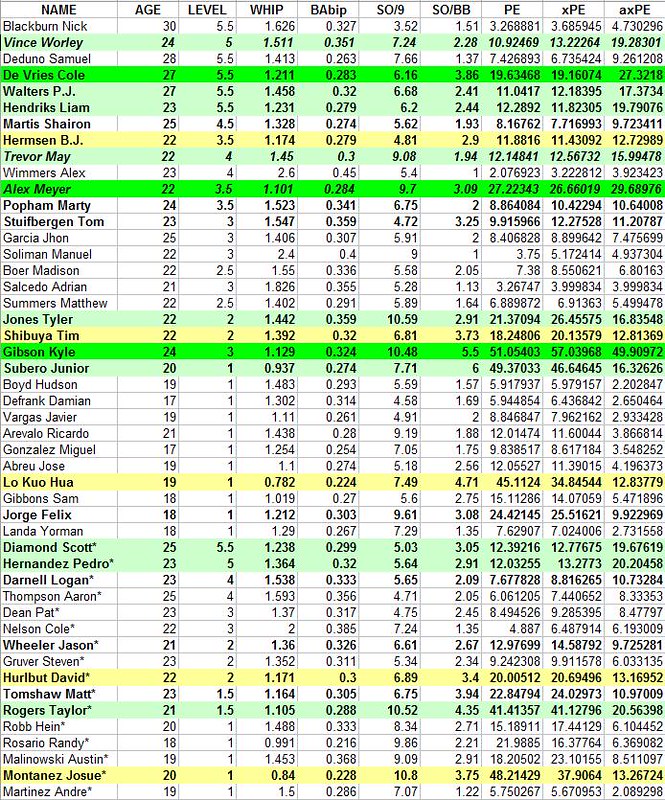


Thus,  it looks like the Twins have 3 potential impact starters in their organization; Kyle Gibson and Alex Meyer are not a surprise.  Cole DeVries is.  Cole DeVries' axPE is higher than his xPE level (which turns out to suggest a middle of the rotation starter), because he performed at the MLB level.  Whether or not potential is applicable to a 28 year old who has reached the majors, is a good discussion.   On the other extreme, some of the K/9 leaders in the organization, Josue Montanez, Taylor Rogers, Felix Jorge, Tyler Jones have repressed axPE, because they are still at the lower levels of the organization.  I think that they need to prove themselves at higher level.

Based on this, and if you cut the list at 25 years old or younger, the Twins have at least couple of pitchers who have impact starter (i.e. top of the rotation/ace) potential and several who have mid-rotation potential. 

A huge qualifier:  This list is of pitchers who were used mostly as starters (i.e. made more starts than relief appearances in 2012.)  This leaves at least one particular pitcher out who should be included, but he made 4 starts and 7 relief appearances:  Jose Berrios.  His numbers (albeit in 11 games and 30 some innings) are out of this world: 284.12 PE, 236.11 xPE, and 91.82 axPE.  He should be part of the discussion and definitely has top of the rotation potential, but there is an asterisk for the reasons mentioned.

Others who made few starts but mostly used in a relief role but definitely should be part of the equation are (in no order) : Matt Houser, Miguel Munoz, AJ Achter, Cole Johnson, Argentis Silva (the 16 year old high bonus singing) Elias Villasarra, Fernando Romero, Luke Bard, Jose Jimenez, Corey Kimes, Brett Lee and Mason Melotakis.

Again, this is an intermediate term discussion and does not really involve recent Twins veteran acquisitions Rich Harden, Mike Pelfrey and Kevin Correia.


1/25/13

Who is the newest member of the Twins HOF, Tom Mee.

Today the Minnesota Twins selected two new members to their Hall of Fame,  LHP "Everyday" Eddie Guardado, and long time staffer Tom Mee.  All Twins' fans know Everyday Eddie, but who is Tom Mee?

Tom Mee has been with the Twins' organization from their first season in Minnesota (1961) until their last title (1991).   He was the first front office person hired when the Twins moved to Minnesota in 1960 and was asked to lead their transition from Washington.  The following season he became their PR Director, a position he held until his retirement.  After his retirement  from the Twins he was the official scorer in the Metrodome until 2007 and spend 2 seasons (1992 and 1993) with the Twins' broadcasting team with Dick Bremmer and Jim Kaat.

He is a graduate of Joe Mauer's Alma Matter, St. Paul's Cretin High School. Mee was a baseball player with the University of Minnesota Golden Gophers in the late 40s and played a couple seasons in the Independent Leagues.  He was then certified by the Brown Institute of Radio as an announcer and his career as a Baseball radio announcer begun.  It took him form Detroit Lakes to Montana to New Mexico when he finally settled back in the Cities doing Public Relationships for the St. Paul Saints (the former incarnation) in 1957.

One of the little known facts about Mee is that he is the person who hired Jim Rantz to the Twins front office.  In 1965, when the Twins won the pennant and went to the World Series, his one man PR department was overloaded and he needed a part time assistant so he hired Rantz who was managing the St. Cloud Northern League Club.  Rantz stuck around from 1965 until last off-season.

Tom Mee's son and grandson have also played baseball at the University of Minnesota.   His grandson, Mike Mee, played a couple seasons in the Diamondbacks organization last decade.


1/21/13

2013 Spring Training Guide to Fort Myers Part II: The Baseball

This is the second of the three 2013 Spring Training Guides to Fort Myers that will appear here.  The first one was a guide on the logistics of how to get there and where to stay etc., including some ways to get there as inexpensively as possible, if that is a consideration.  The Logistics Guide can be found here.  The next guide will be about food and this one is about the reason people go to Fort Myers:  Spring Training baseball.

The Twins' Spring Training Complex:

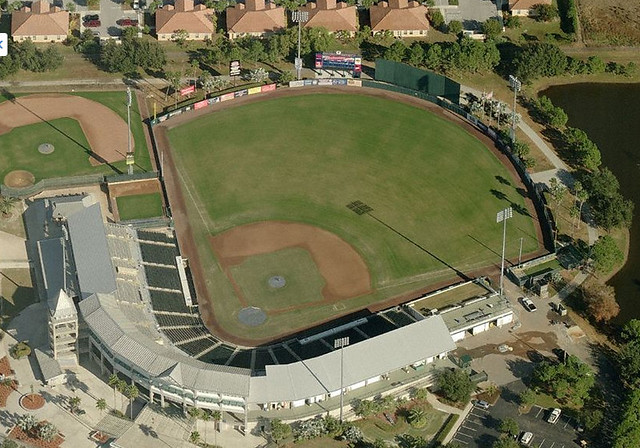
Here is a satellite image of the Lee County Sports Complex (all images are screenshots from Bing Maps) :


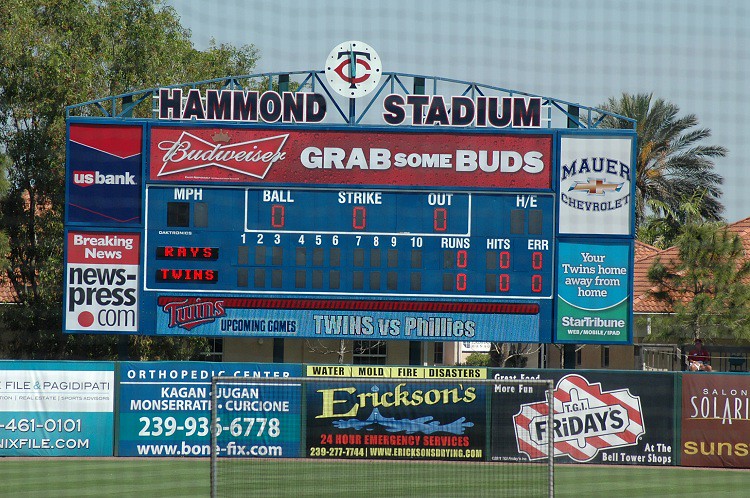
The complex is accessible via the Miracle on 34th St, either from Ben C Pratt Pkwy or from Plantation Rd. The best was to go is via the Parkway, esp. if it is busy. Miracle on 34th St divides the Twins' part of the complex from the four county softball field. Hammond Stadium, the site of the Twins Spring Training home games and the home of the Fort Myers Miracle (the Twins' high A, Florida State League affiliate) is on the Northeast corner of the Complex. Those parallel lines is the parking lot that can fit about 2000 cars. The stadium seats about 8000 people, so parking can be tight.

In addition to Hammond Stadium, there are four full size practice fields and two infield practice fields. You can find Twins' major and minor league players working out in those fields throughout the day, so it might make sense to explore the whole complex or even catch (a free, other than parking) minor league game or two. Some Hotels offer free shuttle service to the Complex, so make sure you explore this option if available

During Twins' home games you have to pay for parking, however when the Twins are away, you can come into the complex and park for free and watch the Twins' minor leagues (you can do that on game days in the morning as well.)  The minor leaguers are using the 3 full fields further away from the Ballpark and the inflied half field right next to the clubhouse (the tin building). The practice field next to the ballpark is exclusively used by the MLB team.

There are 2 different camps take place there (the MLB and MiLB camp) but there is not a "dividing line" that folks who are cut from the big camp have to cross to get "down to the minor league" camp.  As you can see, all the fields are next to each other.   Often, non-travelling major leaguers (I saw Casilla and Carroll do that last season) play in Minor League games.  So do rehabing major leaguers.

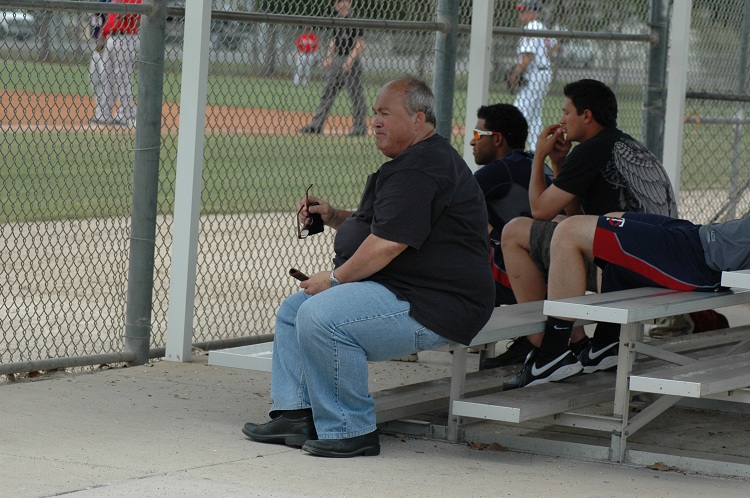
The best way to watch the minor leaguers is to drive and park close to the clubhouse (there are not too many cars on non-game days, about as many as they are in the picture) and go between the 3 large fields.  Usually AAA plays on the North West most field and AA next to it.  With a little bit of imagination, one can sit between both fields and watch 2 games.  There are bleachers in the area (metal).  Bathrooms and a water fountain are in the south of the clubhouse building.   Bringing water is a must here because there are no concessions.  A lot of lower level or non-playing minor leaguers are around  and on the stands watching the AAA and AA games.  Actually pitchers are relegated to radar charting duty in tables in the common area behind the home plates and the fence, and standing around there is a good place to look at the radar readings.  You can also find Twin Cities Sports Celebrities on the stands:


The "dugouts" and "bullpens" are just fenced in areas so you can get a great look of the Twins' minor leaguers.  All minor league games are free.  The new Twins' lease will provide for a dorm to be build in the area, but I am not certain on its wearabouts, but likely South of the fields and just west of the county softball fields.


Hammond Stadium:

Hammond Stadium (and the Lee County Complex) was officially opened in the Spring of 1991. (The year of the Twins' last World Championship.) It is the home of Fort Myers Miracle, a franchise that has Jimmy Buffett and Bill Murray as part-owners. It has been recently renovated and is one of the largest Ball Parks in FSL, sitting up to 8500 people.


As with most minor league stadiums, most sitting is on the infield between the two dugouts. Hammonds Stadium has a nose bleed 2xx level as well and a small grassy field on short right field for fans to sit picnic style. Spring training tickets cost from $45 to $10 or so, depending on the opponent and the seating.  As far as tickets go, there are ticket outlets just outside the Park.  You can preorder tickets over the web, or you can frequently obtain them from locals in the parking lot who are not interesting in attending the game.


One thing that you MUST note: bottled water in unopened containers is permitted in the stadium, as are bags up to 16x16x8 (think reusable grocery bags), so please take advantage of that. That said, the stadium has one of the best selections of beers, including more than 20 mainstream, import and microbrew beers and ales. The best variety of beer, including beer sold only for Twins' and Miracle's games there, is at the bar at the far left (third base) end of the outside concourse, right before the bullpen

They only sell Pepsi products as far as soft drinks go. I will have a food guide within a week, but I have to mention that there is an interesting variety of food, including pizza, sweet potato fries, fish tacos, deep fried nachos on a stick, and two artery clogging specialties: the Carolina Dog, a hot dog topped with pulled pork, baked beans and coleslaw and the Richard Simmons burger a behemoth featuring a 1/4 lb burger, a 1/4 lb chicken, a 1/4 lb brat, held together by 3 slices of cheese and six strips of bacon and contains more calories that the average developing world person eats in a week. There is an annual concession guide, for the stadium that yet has to be published.

Here is the seating guide from the Miracle web site. Also, this is a great article about Hammonds Stadium with a lot of detail about the ball park.  Also, here is a must see panoramic view of the seating are a from last year's Spring Training.  The Twins' dugout is on the third base side and the bullpen on the end of the bleachers in short left.  The new lease provides for major renovations to the Ballpark including a catwalk area at the Outfield.  Not sure when this will start and whether it will be around for the 2013 Spring Training. 

Little known fact:  If you go to the Spring Training and the home of the Fort Myers Miracle and expect to find Miracle merchandise in the gift shop, you will be disappointed.  During Spring Training, there are only Twins' merchandise.  However, they have Miracle merchandise.  If you go there in a day where there are no games (the ballpark is open) and go to the gift shop and ask, they will bring you some.

Other things:

Last but not least, the Twins do not play home games every day. So what to do in an off day? I would chose from one of the following two things: Either drive to the Complex trying to catch minor leaguers (my favorite choice) and non-traveling major leaguers in action in one (or more) of the fields, or drive to watch the Twins in an away game. Here is a map of Florida that shows all the Grapefruit League home team locations:


The Rays play their home games about half an hour away and the Pirates and Orioles about an hour away or so. The Red Sox play in Fort Myers. Those are the most convenient ball parks to visit. 

Next:  The Food Guide.


1/20/13

Newest Twins' Uniform Numbers

Amid great speculation Twins' President David St. Peter revealed the uniform numbers of the newest Twins.  They are:

Kevin Correia 30 (last worn by Scott Baker).  Correia has worn 29 the last 4 seasons with the Pardes and the Pirates and 50, 53 and 32 with the Giants

Mike Pelfrey 37 (last worn by Sean Burroughs.) Pelfrey has worn 34 all his career, but we all know who this number belongs to.

Rich Harden 47 (last worn by Fransisco Liriano.) Harden has worn, 16, 40 and 18 with the Athletics and 40 with both the Rangers and Cubs.

Vance Worley 49 (last worn by Jeff Manship.)  49 is the only number that Worley wore in his pro career (with the Phillies so far)

Aaron Hicks 63 (last worn by Joe Benson). Hicks has been wearing 55 in Spring Trainings

There you go.  You can now order your custom made shirsey or jersey.

Interesting to see that the Ps who are ready for a new beginning are wearing numbers they did not use before. 

1/19/13

2013 Spring Training Guide to Fort Myers. Part I: The Logistics.

Less than a month for Pitchers and Catchers to report to Fort Myers so it is about time for you to make your arrangements to go to Fort Myers (I made mine late last year) and it is about time for the second annual Fort Myers Guides.

Last season there were two Spring Training Guides: the Spring Training Guide to Fort Myers and the Fort Myers Culinary Guide .  This season there will be three guides and will be different than last year's.  After I went to Spring Training in 2012 and about in the middle of the summer last year, the dice were rolled in such a way that I now go to the Central and South Central Florida area on a multiple times a month basis and I do have a list of additional tips on how and where best to get to Fort Myers.  This will be the first guide:  The Spring Training Logistics Guide, where the area is described and the best and least expensive ways of getting to the Twins' Spring Training home.  Knowing what I know now last season, I could have saved at least a couple hundred dollars in airfare, at least that much in a hotel and about that much in a car rental, money better spent watching the Twins and buying Twins' (and Miracle) gear.   As a bonus, I will list the official Twins' hotel, which is the place where a lot of Twins' people stay and a great place to rub elbows with Twins' players and staff.

The second guide will be about what to do once you are there.  And this is all about baseball.  What is going on at the Training Complex, tips and tricks about watching the games at Hammond Stadium (based on my fresh experience from last year) and other ballparks you might want to visit.  This with be the Spring Training Baseball Guide. 

The third guide will be a Food Guide to Fort Myers, but changed from last season's.  Last season's it was cuisine-specific and I think that it is still a valuable resource.  This season will be more restaurant-specific.  As a bonus, I will list established hangouts of Twins' players.

These guides are mainly from the Twins' perspective but useful for Red Sox' (and soon Nationals') fans

How to get to Fort Myers:

Unless you want to have a non-rental car with you (a good choice if you are a player or will be there for a month or so, or you live close to Fort Myers) flying is probably the best choice. There is a local airport (Southeast Florida International, code: RSW) served by a variety of airlines, but there are a total of about 75 flights a day into and out from there. Alternative airports are the larger Tampa International (TPA) and Miami International (MIA), about 2 and 2.5 hrs drive respectively as is the Sarasota Bradenton International Airport (SRQ) is slightly over an hour drive from Fort Myers and slightly larger airport than the Southwest Florida International at Fort Myers.  Fort Lauderdale (FLL) is also an option, and a potentially fairly attractive one if your home airport has airlines like Frontier, Spirit and Allegient and you are willing to fly them, because they have inexpensive and relatively frequent flights there.  Flying into Fort Myers is probably the most expensive option in the list but you do not have to drive far.  Also, the TSA checkpoints in the return trip are a mess.  Budget an extra hour to go through.  My favorite option (and what I am doing this year?) Orlando.

Orlando International (MCO) is about 3 hrs away from Fort Myers, but it offers the benefit of having the lowest airfare and lowest car rental prices in Florida, in combination to more that 60 mainstream carrier flights daily.  Plus, as a bonus, if you have a family, you can spend a few days there with the kids, which will help them palate more 8+ hrs of baseball-related stuff that you would do once at Fort Myers.  As far as airfare prices go and where to find the best ones, go to the ITA Matrix software portal, chose the "show a calendar of lowest fares" and play with it.  This is the tool that travel agents are using.  Once you find a flight, go online to the airline or an online travel agency and reserve it.   My fares in and out of MCO have been in the $150-200 range from the North East, but YMMV depending on departing city.

As far as rental cars go (and you do need one since the public transportation in Fort Myers is non-existent,) the best value in Florida is Dollar.  And here is a trick:  Go to the Dollar web site and register to be an express member for free.  This way you will have the car waiting in a predetermined spot and you by-pass the counter.  Next, make your reservation, by selecting view all car types and picking the least expensive option. Once you make your reservation, check it often and early and "modify" it to see if there are any lower prices posted.  Dollar is notorious of dropping their car prices, especially close to the reservation dates.  I usually rent cars at about $12-16 a day.  But you have to check and change those prices a lot.  Refuse the automatic toll machine ($8ish/day) and the GPS ($13ish a day) and deal with the insurance as you normally do (i.e. if you refuse because you are covered by your own car, refuse it.)

If you want to drive down there, the fastest was to get there is via I-75 that goes through the town. From most points of the Midwest or Northwest, the best way is to catch I-75 around the Metro Atlanta area. From South and South West, I-10 hits I-75 in North Florida about an hour east of Jacksonville. From the East Coast, the best bet would be I-95 all the way to Daytona Beach, then I-4 through Orlando and catching I-75 at Tampa. If you live at the Twin Cities area, Minneapolis is about 1700 miles away from Fort Myers, which means about 3 days of 8 hours driving each, each way.  Enjoy :)

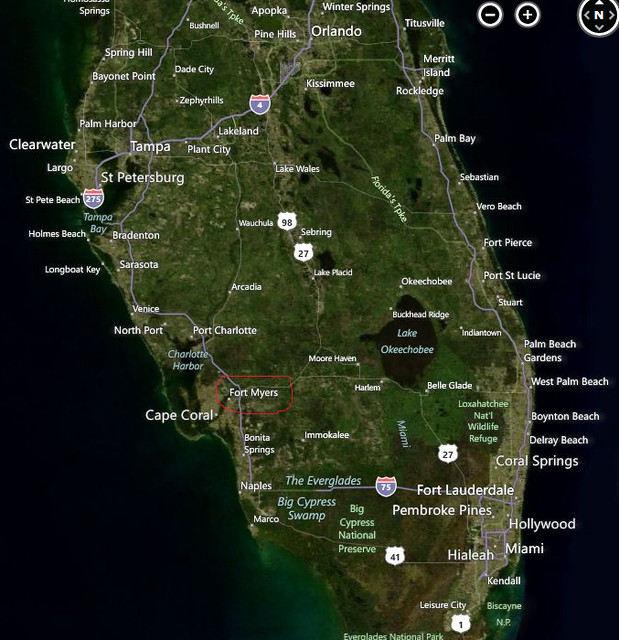
This is a map of South & Central Florida, to let you see where Fort Myers is situated in Florida (all maps and satellite images used in this post are screen shots from Bing maps) :


The Metro Area and the City:

Fort Myers (and, btw, it is not Ft. Myers) is the smallest of 3 cities in the Fort Myers-Cape Coral Metropolitan area. It has about 62,000 people, whereas the Metro has about 650,000 people most of them living in Cape Coral, a city planned and started in the late 50s as a huge retirement community. Interestingly enough the planners wanted to make every property close to water, so they created and extensive system of Canals. Cape Coral has more miles of navigable waterways than any city in the world, including Venice (Italy, not FL) and Amsterdam. About 400 miles of canals. Fort Myers Beach, Sanibel Island and Pine Island are popular beach front communities with a lot of beach-related tourism.

Here is a photo of the Cape Coral- Fort Myers metro:


An important note, especially to people from northern climates: Average temperatures in March are 80 for high and 60 for low, so make sure that you pack sunscreen, hats, glasses, shorts, t-shirts and a swimsuit, if you are so inclined.  And if you get sunburns, you will get a sunburn there, so please plan accordingly

The city of Fort Myers itself is very easily navigated. Here is a map of the City with the Twins' Spring Training Headquarters noted with an orange Marker:


You can click here for a larger picture in a new window.

Where to Stay:

The Fort Myers Airport is about 6 miles due west from Hammonds Stadium and the Spring Training Complex. Daniels Parkway (that becomes Cypress Lake Dr in the City) will take you from the Airport to the town and the Twins' complex. If you are on a budget and looking for a hotel, the ones on Daniels Parkway and that area west of I-75 offer good bargains and are fairly close to the Twins' Spring Training Complex. Another area for reasonable accommodations is the S. Cleveland Avenue North of Page Field.

Mostly everything can be found within a large triangle defined by S. Cleveland Ave to the West, Colonial Blvd to the North and the Ben C. Pratt Pkwy going Northeast to Southwest. The Twins' Spring training complex is on the South part of Ben C. Pratt Pkwy, just South of Daniels Pkwy.  Traffic, other than when the games are over, is not an issue at Fort Myers.

If you want to rub elbows with Twins' players and staff, the Twins' official/unofficial hotel in the Fort Myers' area is the Hilton Garden Inn Fort Myers (not the one by the airport, but the one "in town").

Alternatively you can stay at Naples (offers more things to do at night) or Port Charlotte (offers less expensive rooms and it is the Rays' Spring Training Home).  Both are about half an hour easy drive away.

The best bargains for Hotels (unless you are a frequent guest and can use points for free rooms) are either Hotwire or Hotels.com, but the establishments are sometimes name-less so it can be a gamble.  On the other hand, if you stay pretty close to the ballpark and away from the downtown area, there are not any seedy places.

This year I will be staying at Port Charlotte and will be watching some Twins' games there as visitors as well.

The Twins' Spring Training Complex:

Here is a satellite image of the Lee County Sports Complex:


More about the complex, how and when to get there and all the things about the Twins' Spring Training home in the next guide.

An illustration of what is in the heart of the Twins pitching problems

With Catchers and Pitchers reporting in less that one month for Spring Training 2013, I decided to get ready for my Spring Training Coverage (teaser: expect 3 new guides this month) so I was looking at the past coverage here.  I stumbled upon this little piece from the end of the 2009 Spring Training.  It looks really innocent.  After all it is a list of all 97 pitchers in the Twins' minors in 2008 from DSL to AAA, who were still with the organization in 2009 along with the 2009 MiLB FAs and where they would potentially end up in 2008.

Fairly innocent.

Until you fast forward to 2013, where you see that only 11 of those 97 players are still in the Twins' organization in any level and nobody made any impact in the Twins' rotation.  The best players in the list were swingmen and bullpen arms.  Here is the list of the 11 who are still with the Twins (the original list of 97 is here ):

Alex Burnett
Cole Devries
Brian Duensing 
Deolis Guerra
B.J. Hermsen
Bruce Pugh
Tyler Robertson
Adrian Salcedo
Anthony Slama 
Tom Stuifbergen
Anthony Swarzak

So if your minor league system does not feed the major league team with impact starters for 4 years and you do not sign impact starters via free agency or acquire them via trades, how do you expect to compete?

The writing for the mess that was 2011 and 2012 was on the wall for the Twins in 2009.  They either just could not see it (by believing that their prospects were better than what they were) or they ignore it.  Either way, it is equally bad.
'

1/8/13

Projecting Possible Breakout Seasons For 2013 Rookie Position Players

Note: this is a guest post by Hannah Miller from FanDuel.com


In 2012, Mike Trout and Bryce Harper proved that you do not need MLB experience to become key cogs in an offense. Harper turned in one of the best seasons ever for a teenager, while Trout turned in one of the best overall seasons ever. As we get closer to 2013, are there any players poised to possibly be the next breakout star in baseball?

For starters, it is unrealistic to expect the next crop of rookies to make the type of impact those two did. It rarely happens that way. However, there are some top prospects who will get a shot at every day playing time most likely in 2013. Here are three that look poised for possibly big seasons.

Will Myers (Tampa Bay Rays)

The Rays picked up Myers as the centerpiece in the James Shields/Wade Davis trade, and many believe he has all the makings of a five-tool outfielder in the future. Myers is actually older than Trout, but the Royals brought him up a little bit more slowly than the Angels did with their uber-talented outfielder. Like Trout, Myers will more than likely spend some time in the minors before being moved up later in the season for Tampa Bay.

Travis d’Arnaud (New York Mets)

Like Myers, d’Arnaud is changing organizations this offseason, which actually gives him a better shot at playing a lot in 2013. As part of the R.A. Dickey deal, d’Arnaud is now penciled in as the Mets catcher for the future. So will when the Mets officially bring up the catcher who can hit for power and average?

One advantage for d’Arnaud over most other prospects is his age. He is going to be 24 years old on opening day in 2013, so the Mets probably will not waste a ton of time to bring him up. With the Mets probably not going very far next season, he should get plenty of time to learn on the job.

Billy Hamilton (Cincinnati Reds)

This might be going out on a limb a bit, but Hamilton might have the best chance to make a huge impact on a potential playoff team in 2013. The Reds figure to be solid next season with or without him playing every day, but if shows enough consistency at the plate, Hamilton could force his way into the lineup.

Last season, Hamilton played both shortstop and outfield for the Single-A and Double-A affiliates. He is known for his amazing speed though, which could be a game changer. He hit for a solid average and draws walks, but his lack of power and definite position scares some people. If he can find a place to play every day for the Reds, he could change the game each time he is at the plate or on the base paths and put up some serious fantasy baseball numbers. He is never going to be the five-tool, conventional star baseball player, but he could change baseball in his own way.

12/29/12

An Attempt towards an Objective 2013 MLB Hall of Fame Ballot

'Tis the time of the year when BBWAA writers who have ballots for the Hall of Fame voting, as well as everyone else, indicate who they want to be in the Hall of Fame.   There are a lot of those lists and most of them come without much explanation and most of the picks are somewhat subjective (of the type: "Jack Morris should be in because he was the best post-season pitcher like ever").  Also, you have the steroid witch hunters sharpening their arrows and tightening their bows trying to make it all "alright".  Furthermore, you have the people who think that because someone is a "nice guy", he should be in (Dale Murphy supporters now and Jim Rice supporters earlier fall into this category.)

What are my ground rules for crating a Hall of Fame Ballot (and even though the word "objective" is on the title, this is the list of the subjective criteria I am using - and one has to use subjective criteria, since there is no objective direction from the Hall on when someone should or should not be in):

  • You cannot "punish" one type of PED users (steroid users) and not another.  So either all deserved players are in or all out.  Since MLB listed amphetamines or "greenies" in the PED banned list, lots of the enshrined players should be out, according to the ones who are on the Steroid witch hunt, starting with Hank Aaron, who in a televised interview with Bob Kostas, admitted to have taken greenies.  All in or all out.  Period. Otherwise it is a hypocrisy akin to that of a pro-lifer supporting the death penalty.  So, in my ballot, they are all in.  No time for witch hunts
  • I believe that the Hall of Fame should not be the Hall of Very Good (or with the recent addition of the likes of Jim Rice, the Hall of All Stars).  Only the best players of an era should be there.  A handful.  The very best
  • I would like to find an objective criterium to use to rank players.  And since this is a lifetime achievement, career WAR is as close as it gets.  WAR takes care of the era and included hitting, fielding and base running for position players, and it is adjusted for position so it is pretty holistic (and helps obliterate arguments that someone who is a Catcher or a Short Stop could be lighter hitting than an OF/1B and still in the Hall.  That is all reflected in the number).  Some people indicate that pitcher WAR is useless; my take is that (since it is a cummulative achievement award) for this exercise works pretty well (and the data below show it) unless it is for a reliever.
Without further ado, here is a list of all players in the 2013 ballot, in decreasing WAR (Baseball-Reference style), including recently selected players in blue backgrounds.


The players in green (Barry Bonds, Roger Clemens, Jeff Bagwell and Curt Schilling) will have my vote.  The players in yellow are in a bubble (based on the previously inducted Roberto Alomar and Barry Larkin) and will get some votes.  There are 11 playes in yellow and green and only 10 spots.  Lee Smith will always get votes, but his WAR is just too low compared with that of Goose Gossage (whom I consider borderline)  Players like Dale Murphy, Jack Morris, Mark McGwire and Sammy Sosa do not belong in the Hall.

You heard it correctly:  Mark McGwire and Sammy Sosa do not belong in the Hall of Fame.  And not because they used steroids potentially.  They do not belong because their numbers are not good enough.  Objectively.  Not witch huntingly.  Roger Maris of 61 in 61, whose record was broken, has a career WAR in the 30s, btw.

So here you have it.  And there will be the McGwire and Sosa debate (for the wrong reasons) and the Morris and Murphy debate, but objectively, none of these guys should be in.

12/24/12

Who will be the one who will push Plouffe at third base for the Twins?

The Twins' General Manager has been on the record many times this offseason indicating that he would like to get someone who will "push" Trevor Plouffe at third base.  The Twins' field and front office staff are unhappy with Plouffe's defense in the hot corner.   Plouffe has had his moments there, but he is still learning the position.  Let us not forget that the powers of being who feel that Plouffe is inadequate defensively are the same who gave starting roles at third base to Brian Buscher and Brendan Harris, who, arguable were worse defenders than Plouffe, plus Buscher has played the position all his life.  Regardless, for some reason getting another player who can play third base is a priority for Terry Ryan for the Twins to rebound from consecutive 99 and 96 loss season.

Who would that player be?

There are three internal options:  Jamey Carroll, Deibinson Romero and Mark Sobolewski.  I have already discussed that last two here.  For some reason, it seems that Terry Ryan does not like these options (Only Carroll was invited in Spring Training) and had an offer out to light hitting 33 year old Jack Hannahan whose greatest claim to fame is that he is Minnesotan; he snubbed the Twins and elected to sign a 1 year $2 million dollar contract with the Twins.  I suspect that Ryan will not be bringing back Nick Punto or sign Chone Figgins.  The pickings out there at the major league level are really slim and all remaining are aging utility players with very weak bats plus Scott Rollen who is old but serviceable mulling retirement or returning to the Reds.  But, this would be the team to take 24 HRs away from a RHB (Plouffe) to install a light hitting third baseman.

Are there any other possibilities?

Looking at the list of the minor league free agents, here are the ones who are still available and at least decent defensively and offensively at third base.  I suspect that unless Ryan chooses any of the aforementioned internal options, one of these folks would be it:

Shawn Bowman, 29, RHB
Audy Ciriaco, 26 RHB
Brooks Conrad, 33, SHB
Mike Costanzo, 30, LHB
Ruben Gotay, 30, SHB
Michael Hollimon (re-sign) 31, SHB
Kevin Howard, 32, LHB
Tug Hulett, 30, LHB
Andy LaRoche, 29, RHB
Mario Lisson, 29, RHB
Matt Mangini, 27, LHB
Jimmy Swift, 26, RHB

Your guess is good as mine


12/22/12

Mike Pelfrey interview about his elbow injury - pre surgery.


Complete Injury History of Twins' Rich Harden

The newly signed by the Minnesota Twins, Rich Harden has been 10 times on the disabled list in his career and has been day to day in the majors, injured in the minors or in the training camp 14 more times, for a total of 758 days lost.  His major issues has been with his right shoulder (italicized and underlined below), which have occurred annually and until last off-season, been treated with "rest and rehab".  Some of them were severe, some of them were described as "fatigue" or "soreness".  Hopefully the shoulder surgery will help him overcome those issues.  In addition he has had a UCL Sprain that has not been treated surgically in 2006, but also with "rest and rehab".  Maybe his shoulder gave up the following years before his elbow, but his elbow will be something to watch as well (Potentially Similar situation with Joel Zumaya who came in the Twins' camp last season and blew his UCL)   Note: His Labrum Surgery in 2005 was on his left shoulder, to correct an issue that happen after a collision while covering first base in 2004.  The other issues were in his right, throwing shoulder.  His shoulder issues were reported first in 2004 when he arrived in the MLB camp, but it is hard to know his MiLB medical history...

On the other hand, a broken down Rich Harden is still a very effective pitcher, which makes me really hopeful if the surgery cleared his practically chronic elbow issue.

Here is a complete list of his injuries, chronologically:

2003;

Right angle sprain (13 days, MiLB)
Low Back Spasms (2 days, 2 games)

2004:

Right Shoulder Stiffness (50days, 0 games, training camp)
Left Shoulder Subluxation (6 days, 5 games)

2005:

Right middle finger blister (4 days, 4 games)
Left Oblique Strain (38 days, 34 games)
Right Shoulder Strain (38 days, 36 games) 
Left Labrum (shoulder) surgery (10/5/2005 - off-season no days lost)

2006:

Low back strain (38 days, 34 games)
Right Elbow Ligament (Ulnar Collateral Ligament) Sprain (104 days, 84 games)

2007:

Right Shoulder Impingement (66 days, 58 games)  
Right Shoulder Strain (84 days, 74 games)  

2008:

Right Shoulder Strain (38 days, 34 games)
Right Shoulder Soreness (6 days, 5 games)

2009:

Partial tear of Right Shoulder Labrum (50 days, January - no games)
Flu-like symptoms (5 days, training camp)
Middle Back Strain (26 days, 22 games)
Right Shoulder Fatigue (17 days, 16 games)

2010:

Left Hip Strain (49 days, 42 games)
Right Shoulder Inflammation (15 days, 13 games)

2011:

Right Shoulder Strain (101 days, 82 games)

2012:

Right Rotator Cuff capsule surgery 1/31/2012; out for the season


12/16/12

Thoughts about the Pelfrey signing by the Minnesota Twins

Ryan did ok with this singing, but there are other issues, namely the fact that it increases the already horrid logjam of starting pitchers in the 3 higher levels of the organization by another body.

If Ryan had not re-signed the likes of PJ Walters, Sairon Martis and Luis Perdomo and singed the likes of Kevin Correia, Scott Elarton, Jason Lane and Virgil Vasquez (add Nick Blackburn, Sam Deduno and Cole De Vries and now you have AAA-level pitchers to fill 2 teams' rotations), I would have loved the signing of Mike Pelfrey.

I am probably more optimistic for Mike Pelfrey than most in the Twinsland; on the other hand, due to location, I have been able to follow Mike's career for a few years, unlike most in the Twinsland.  And there are more this to Pelfrey that his numbers:

Pelfrey was drafted by the Mets as the 9th overall pick of the 2005 draft (the one the Twins drafted Matt Garza).  With the addition of Pelfrey to Jeff Clement, who was the 5th overall pick of that draft, the Twins now have 2 of the top 10 picks of the 2005 draft.  He will turn 29 the coming January 14th and just entering his prime.

Pelfrey is 6'7" and came out of college with a plus plus fastball that topped at 97 mph with a lot of movement, an above average change up and a borderline average-above average curveball with hard movement but command issues.   Pelfrey in typical Mets' fashion was rushed in his first professional season (2006) and moved from high A all the way to the majors with short stops in AA and AAA.  He started 4 games in the majors in 2006.   In the 2006 post-season he was ranked the #38th best prospect in Baseball by Baseball America.  In 2007 he spent part of the season in AA and AAA before moving up to the Mets for good as a 23 year old with less than a year of professional baseball and only one good (actually great) pitch under his belt.

At next spring training Rick Peterson asked him to stop using the curveball and start learning a slider.  2 spring trainings later, Mets' next pitching coach, Dan Warthen, made him junk the slider, rethrow the curve and learn a splitter.  So there has been a lot of trial and error in the quest for a secondary offering.  I suspect that Bobby Cuellar will do wonders working with his change up.

A couple of encouraging numbers:  His career FIP is 4.20 (and relatively dropping each season), his BABIP is >.300 and his %K has been increasing every season.  All that with one (and a half pitch).   I think that with a bit of coaching and the development of at least another plus pitch, he will be a solid middle of the rotation starter, unlike Kevin Correia.

A few interesting tidbits about Mike:  

  • He has been wearing number 34; this is no longer an option with the Twins
  • He was part of the players who were involved with unethical brokers in the banking scandal and lost about $9 million in it.
  • He has a tendency to lick his hands during the game.  The Wall Street Journal reported that he did it 89 times in a game they were counting  
 All in all a good move in my book, but lots of pitchers need to be cut in spring training. 


12/15/12

The Twins have way too many starting pitchers, but too few good enough.

The common wisdom among the Twins' fans and the media that cover the Minnesota Twins is that the Twins are on the prowl for adding starting pitching.  Unfortunately, the spendthrift ways of Terry Ryan have already resulted in a huge number of sub-par starting pitchers, the best of whom is Vance Worley or Scott Diamond (depends on who you ask) and they are tops number 3 starters in a competing team.  This massive mess of starting pitching is the result of Ryan's love for MiLB free agents.  Right now the Twins have enough older Starting Pitchers in the organization to fill an MLB, a AAA and a AA rotation (and then some), which guarantees stagnation of their prospects by being stuck at most at Fort Myers (and some of them pitched at AA last season.)

Here is the mess, analytically:

On the 40-man roster and projected on the 25-man roster:

Kevin Correia
Scott Diamond
Vance Worley   

On the 40-man roster potentially fighting for a spot for the Twins rotation:

Cole De Vries
Kyle Gibson
Liam Hendriks
B.J. Hermsen
Pedro Hernandez

not on the 40-man but got a shot to make the Twins' team (and if not, they will be in AAA):

Nick Blackburn
Luis Perdomo
Samuel Deduno
Scott Elarton
Jason Lane
Michael O'Connor
Bryan Augenstein
Virgil Vasquez
PJ Walters
Sairon Martis

This is 18.  Enough to Fill the MLB, AAA, AA rosters with a couple to spare. This means that unless some of the MiLB FAs are cut, the following will start at most at Fort Myers:

Unaccounted Prospects:

Trevor May (40-man)
Alex Meyer
Tom Stuifbergen
Manuel Soliman
Pat Dean
Madison Boer
Marty Popham
Matt Houser
Adrian Salcedo
Steven Hirschfeld
Andrew Albers

This is at least 2 rotations worth and sorry to the SPs who pitched at Beloit or Elizabethton last season:  Cedar Rapids and Etown will be your destination this season.   This indiscriminate collection of pitchers who are not good enough, in addition to not creating a competitive major league team, it destroys development of the best prospects.  Unfortunately Terry Ryan once again is going for rotation breadth vs. depth throughout the organization.

36-year old Scott Elarton

12/9/12

Twins' Rule 5 draftee Ryan Pressly pitches in the Arizona Fall League


Who is Mark Sobolewski and what does he mean to the Twins?


The additions of three high quality arms (in the Denard Span and Ben Revere trades) and another one via the rule 5 draft, stole the spotlight of another Twins' acquisition, this of Minor League third baseman Mark Sobolewski previously in the Toronto Blue Jays' organization in the minor league portion of the Rule 5 draft.  The reason that he was able to be selected was that he was not protected in the Jays' AAA reserve list and, unlike the MLB rule 5 picks, he does not have to be with Rochester the whole season or be returned to his original club.  He will be a Twin.

I believe that this acquisition is more than organizational depth at 3B, which is needed, since the only pure third baseman in the upper levels of the organization is now Deibinson Romero who will probably start the season in Rochester.  

A couple of interesting things about Sobolewski (btw, his first name is Robert; Mark is his middle name) : He replaced former Twin Danny Valencia as the starting third baseman at University Miami and he looks a lot like the former Twin with the bat, hitting 18 HRs for the AA New Hampsire Fisher Cats in less than 400 plate appearances, but is much better on the field.   He has above average range at third and makes all the routine plays, which was not Danny V's strength.

Sobo (his nickname), is a cancer survivor.  He is 25 years old, just like Romero who, also just like Romero, had a break through season in the Eastern league (AA) last season. Sobolewski's defense is slightly superior, while Romero has a better eye at the plate. I suspect that these 25 year olds will provide competition for Trevor Plouffe (something that Terry Ryan wants for some reason) at Spring Training and they will probably start the season in AAA Rochester. It is worth mentioning that both guys are pure third basement and they primarily played there other than a couple of games at second for Sabolewski and at first for Romero.

Sobolewski's acquisition is not like those of Matt Carson, JR Towles, Sean Burroughs and the like of the past season, since, unlike the aforementioned, he has not been a disappointment at the majors and he is just 25, ahead of his prime.

Here is a video of Sobolewski hitting a home run last season:


11/25/12

One trade the Twins should make right now

There have been a lot of official and unofficial "blue prints" based on what the Twins should be doing this off-season; surprisingly they are all centered around starting pitching.  Even the Twins' brass has admitted that they probably need at least 2-3 new starting pitchers in their rotation in order to be competitive, since the only pitcher who is guaranteed a spot is Scott Diamond, who despite his great success last season compared to the rest of the Twins' rotation members, based on his numbers from last season, is a number 3 starter in an average team and a number 4 starter in a competitive team at best.

So the Twins need pitching.  And lots of it.  And they can only get so many starters better than Scott Diamond in free agency, so they would need to trade.  But in order to be competitive, they should not disrupt their core.  They do have too many centerfielders in the majors right now, and they can safely trade Denard Span (the older one who makes the most money and probably has the largest trade value of the three).  They can potentially trade Justin Morneau, because Chris Parmelee has put similar numbers in the majors (as far as WAR is concerned) and would be an adequate replacement, but other that the likes of Jamey Carroll (who is not a core player).  The Twins cannot trade any other starting position players without disrupting the competitiveness of the team.   The Twins will not trade any of their top prospects (and at this point, this is a superb approach).  Morneau and/or Span can probably bring a decent starting pitcher in return.   Maybe they can sign another one (but I do not have confidence in the team who re-signed Carl Pavano and Matt Capps for what they re-signed them for or the general manager who likes to bottom feed with the likes of Jason Marquis, Livan Hernandez, Ramon Ortiz, Sidney Ponson etc, to sign any decent free agents)

Rock and a Hard Place?  Well, it gets harder...  There have been many season ticket cancellations and reductions based on the fact that the Twins finished with 99 and 96 losses the last 2 seasons.  So the need to do something to a. get starting pitching better than Scott Diamond and b. put some bottoms on the seats (or the eating and drinking establishments) of Target Field.

What should they do?  Make a trade that is a win-win for both teams and will guarantee an increase in attendance.  But:  It will require thinking outside the box.  Here is the trade:

Allow the New York Mets to pick any 2 pitchers from the Twins' 40-man roster who pitched for the MLB team last season and not named Scott Diamond, Glenn Perkins, Jared Burton, Brian Duensing or Liam Hendriks and any middle infielder of the ones who played with the Twins last season not named Brian Dozier for $12.5 million and Johan Santana.

This would would be something like Cole DeVries plus Alex Burnett plus Pedro Florimon for a year of Johan Santana at $12 million and an option that the Twins will not pick up.

Johan pitched 117 innings last season with a 8.54 K/9, 2.85 K/BB an 1.33 WHIP and a  4.02 xFIP in a pretty much rehab situation.  This season he will be at full force and he is just 34.  BTW, that 8.5 K/9 is his highest in his Mets' career.  There is another intangible:  Johan will be reunited with Bobby Cuellar, the man who taught him the change up and has been somewhat of a father figure for him.  So Santana will be better than Diamond, will come at a price less than half for what the Twins paid for Pavano and Capps and Marquis last season and is guaranteed to put butts on the seats and bar stools of Target Field.  So it is a no-brainer for the Twins, esp since they will practically give nothing in return.

Would the Mets do it?  In a heartbeat and in a New York minute.  Why?  For the same reason they let Jason Bay go:  They need up front money to extent David Wright and they know they are not contending next season, so a season of Santana means less to them than the $12 million they will save and some of the MLB-ready players they will get in return.

Will it happen?  I am not sure that the Twins' brass can think that much outside the box.

Should it happen?  What do YOU think?